




Description
Rifle Scope Product Details
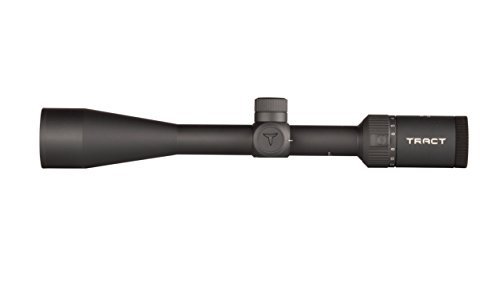
Tract Toric 3-15×42 Riflescope w/T-Plex Reticle – The Ultimate in Long Range Hunting Optics
Rifle Scope Product Features
TORIC’s Fully Multi-Coated, Ultra High Definition optical system, utilizes Extra Low Dispersion (ED) objective lenses to eliminate color fringing as well as highly prized SCHOTT HT (High Transmission) glass to provide superior light transmission and bright, clear images even in low light hunting conditions. “The TORIC had one of the highest combined low-light and resolution scores in our test” Outdoor Life, Optics Gear Test – June/July 2016
The Glass Etched T-Plex reticle takes the standard Plex type reticle to another level by eliminating the thick top vertical post, creating a cleaner field of view while still allowing your eye to quickly find the center crosshair for fast target acquisition.
4″ of constant Eye Relief through entire magnification range & Locking Side Focus adjustment dials out parallax from 15 yards to Infinity increasing accuracy
Hand Turn windage and elevation adjustments with precise, repeatable and audible 1/4″ clicks at 100 yards are easily reset to zero without any tools, making sighting in or field adjustments quick and easy. Includes High Profile MOA turret kit with Zero Stop and Locking function.
Lifetime Warranty – The TRACT Trust Assurance guarantees the functionality of the product for the duration of its lifetime regardless of whether you’re the original owner. No time limit applies and no paperwork is needed.
TRACT Optics is doing things differently. Period. As an optics company producing high-end riflescopes and binoculars, we have created a direct-to-consumer business model that makes your experience our top priority.
From day one, we’ve had a very specific purpose at TRACT: Build a bridge directly to you, the consumer. We’ve cut out the middleman to eliminate retail markup and unreliable product support. TRACT set out to build the finest line of optics without making any sacrifices or letting any barriers get in their way. The result is our TORIC line of superior riflescopes with specifications and features that perform every time, anywhere, no matter the conditions.
Just know we appreciate the opportunity to share with you our passion for creating incredible optics, all the while giving you first-rate product support.
TRACT Premium Optics Designed and Engineered to be Best in Class
This ultra-versatile 5x zoom 3-15×42 TORIC UHD is engineered for the hunter who needs the very best whether hunting in the hardwoods or over a long range bean field. It features TRACT’s advanced Ultra High Definition optical system comprising of Fully Multi-Coated SCHOTT HT (high transmission) glass throughout the entire scope providing sharp, bright images with superior light transmission of any scope in this class. The ED (Extra Low Dispersion) lens helps eliminate chromatic aberration and increases contrast especially at the higher powers.
Take advantage of the quick focus eyepiece, 4 inches of constant eye relief and the Glass Etched T-Plex reticle providing unsurpassed performance in low-light conditions at longer distances.
TORIC’s Optical System Separates itself From the Crowd
TRACT’s Ultra High Definition (UHD) optical system incorporates:
Industry leading SCHOTT HT (High Transmission) special glass variants that are known for their superior transmittance
ED (Extra Low Dispersion) glass reduces Chromatic Abberation resulting in unsurpassed clairty and precise image quality
Fully Multi-Coated lens system
“All combined, TRACT’s UHD system provides the shooter with incredibly sharp, bright images with superior light transmission values.
High Profile Turret Kit Included
Each TORIC riflescope comes with a High Profile Turret Kit. The kit allows you to replace the exisiting standard medium turret, with the high profile turret providing the long range shooter with the following benefits:
“Locking Turret Feature – To provide the shooter with the confidence that the elevation turret cannot be moved even in the roughest of conditions
Simply lift the high profile elevation turret up to disengage the lock. Turn the elevation knob in the desired direction. Push turret back down to return to the locked position.
“Zero Stop provides the shooter with the assurance that he will not go past his zero.
After sighting in your rifle, simply insert the Turret Kit and set the zero stop module in place.
Once assembled, you now have a positive repeatable stopping point at your chosen zero point. Then, no matter how many elevation adjustments you make, turning the elevation knob down to the zero stop setting returns you to your original zero.
No counting clicks or need for visual reference. In poor or low-lighting conditions,you can return to your original zero stop simply by feel.
“Turret provides 20 MOA per revolution. Total internal adjustment 50 MOA
Many Other Quality Features:
TORIC Locking Side Focus:
“Corrects for parallax and will help in your desire to be a more accurate long range shooter.
Locking Side Focus adjustment dials out parallax from 15 yards to Infinity. By getting rid of parallax, you’re assured that your point of impact is going to be exactly where you intend it to be because your foculsed on the same optical plane as the reticle
Main benefits of the TORIC Locking Side Focus:
Easy to reach, and use while in the shooting position
Don’t have to lift your head off the stock to use
The side focus reference markings are highly visible and easy to read
The side focus feature helps shooters who are not consistent in their cheek weld method or if the eye is in a less than ideal alignment with the scope
The shallow depth of focus can aid in determing mirage and reading wind direction
Large Ocular Lens with 4” of Constant Eye Relief
“Benefits:
“Keeps your cheek weld consistant throughout the entire magnification range for improved accuracy
4” of eye relief keeps you safe from getting hit under heavy magnum recoil or shooting at sharp angels.
“Easier for the shooter to locate the target
The Glass Etched T-Plex reticle takes the typical plex-type reticle design to a new level.
Benefits of TORIC T-Plex Reticle:
By eliminating the thick top vertical post, this opens up the reticle to provide a cleaner, less obstructed view of the target.
The thickness in the horizontal and bottom vertical posts still allows for fast target acquisition.
The point of the bottom thick post is strategically placed to provide bullet drop compensation for various distances based on the cartridge you are shooting.
Simply use the IMPACT Ballistic Program to determine your maximum point blank range, bottom post distance and other crucial aspects that will make you a more accurate shooter.
About the Tract Scope Maker
Tract is a premium company for firearm scopes, optics, mounts, and other accessories used for firearms like rifles and long guns. They create and build their scopes, mounts, and related products by using building materials which are durable and long lasting. This includes the Tract Toric 3-15×42 Riflescope w/T-Plex Reticle – The Ultimate in Long Range Hunting Optics by Tract. For additional shooting items, visit their website.
Facts About Optics
Rifle scopes enable you to specifically align a rifle at various targets by aligning your eye with the target over a distance. They do this through magnifying the target by utilizing a set of lenses inside the scope. The scope’s alignment can be dialed in to take into account different ecological aspects like wind and elevation increases to account for bullet drop.
The scope’s purpose is to understand precisely where the bullet will land based upon the sight picture you are seeing using the scope as you line up the scope’s crosshair or reticle with the intended point of impact. Most modern-day rifle scopes and optics have about eleven parts which are arranged inside and on the exterior of the scope body. These parts include the rifle scope’s body, lenses, elevation dials or turrets, focus rings, and other elements. See all eleven parts of optics.
Rifle Glass Styles
Rifle scopes can be either “first focal plane” or “second focal plane” kind of scopes. The style of focal plane an optic has decides where the reticle or crosshair lies in connection with the optic’s magnification. It actually implies the reticle is located behind or ahead of the magnifying lens of the optic. Picking the most effective style of rifle optic is based upon what form of shooting or hunting you anticipate undertaking.
First Focal Plane Optics
Focal plane scopes (FFP) come with the reticle in front of the magnification lens. This induces the reticle to increase in size based on the level of magnification being used. The benefit is that the reticle measurements are the same at the amplified range as they are at the non amplified distance. For example, one tick on a mil-dot reticle at 100 yards without any “zoom” is still the very same tick at 100 yards with 5x “zoom”. These kinds of scopes work for:
- Quick acquisition, far away kinds of shooting
- Shooting situations where calculations are very little
- Experienced shooters who recognize their target “hold over” as well as “lead” relationships for their long gun
- Shooters who do not mind the reticle is enlarged and takes up more visual eyesight space than a SFP reticle
About Second Focal Plane Scopes
Second focal plane scopes (SFP) include the reticle behind the magnifying lens. This induces the reticle to remain at the very same dimensions in connection with the volume of magnification being used. The final result is that the reticle measurements adjust based upon the zoom employed to shoot over lengthier distances due to the fact that the markings present different increments which fluctuate with the magnification. In the FFP example with the SFP optic, the 5x “zoom” 100 yard tick would be 1/5th of the non “zoom” tick measurement. These kinds of optics work for:
- Long distance types of shooting where shooters have more time to make ballistic estimations
- Shooting where most of the shots happen within much shorter ranges and spaces
- Shooters who like a clearer optic picture without room used up by the larger size FFP reticle
Optic Zoom
The amount of zoom a scope provides is figured out by the diameter, thickness, and curvatures of the lenses inside of the rifle scope. The zoom of the scope is the “power” of the scope.
Fixed Power Lens Scopes
A single power rifle scope and optic comes with a zoom number designator like 4×32. This implies the zoom power of the scope is 4x power while the objective lens is 32mm. The zoom of this kind of scope can not fluctuate because it is a fixed power optic.
Variable Power Lens Rifle Glass Details
Variable power rifle scopes use enhanced power. The power modification is accomplished by making use of the power ring part of the scope near the rear of the scope by the eye bell.
Rifle Glass Power and Ranges
Here are some recommended scope power settings and the ranges where they can be effectively used. Highly magnified glass will not be as efficient as lower magnification scopes given that too much magnification can be a negative aspect depending on your shooting distance. The exact same concept applies to longer ranges where the shooter needs to have sufficient power to see exactly where to properly aim the rifle.
About Lens Coatings
All modern rifle optic and scope lenses are coated. There are different types and qualities of glass lens coatings. Lens covering can be an essential element of a rifle when thinking about high end rifle optics and targeting systems. The glass lenses are one of the most crucial components of the optic since they are what your eye sees through while sighting a rifle in on the point of impact. The covering on the lenses offers protection to the lens exterior as well as assists with anti glare from excess sunrays and color presence.
Details on Lens Coatings – HD Versus ED
Some scope manufacturers likewise use “HD” or high-definition lens finishings which use various procedures, chemicals, aspects, and polarizations to draw out different colors and viewable definition through the lens. Some scope manufacturers use “HD” to refer to “ED” to signify the lens has extra-low dispersion glass.
Single Covering Versus Multi-Coating for Scopes
Different scope lenses can also have different coatings applied to them. All lenses normally have at least some kind of treatment or coating applied to them before being used in a rifle scope or optic assembly. Due to the fact that the lens isn’t simply a raw piece of glass, they require performance enhancing coatings. It is part of the finely tuned optic. It requires a coating to be applied to it so that the lens will be optimally functional in many kinds of environments, degrees of light (full VS shade), and other shooting conditions.
This lens treatment can protect the lens from scratches while reducing glare and other less beneficial things experienced in the shooting environment while sighting in with the scope. The quality of a single coated lens depends on the scope maker and how much you paid for it.
Some scope makers similarly make it a point to define if their optic lenses are covered or “multi” covered. Being “much better” depends on the maker’s lens treatment technology and the quality of products used in building the rifle scope.
Anti-water Lens Coating
Water on a lens doesn’t assist with preserving a clear sight picture through a scope at all. Numerous top of the line and military grade scope makers will coat their lenses with a hydrophilic or hydrophobic finishing.
Alternatives for Installing Rifle Glass on Firearms
Mounting approaches for scopes come in a few options. There are the standard scope rings which are individually mounted to the optic and one-piece scope mounts which cradle the scope. These various types of mounts also generally can be found in quick release versions which use throw levers which allow rifle operators to quickly mount and dismount the optics.
Hex Key Scope Ring Mounting Solutions
Basic, clamp style mounting scope rings use hex head screws to install to the flattop style Picatinny scope mounting rails on rifles. These varieties of scope mounts use two detached rings to support the scope, and are made from 7075 T6 billet aluminum which are created for far away precision shooting. This kind of scope mount is excellent for rifle systems which are in need of a durable, hard use mount which will not shift no matter just how much the scope is moved or abuse the rifle takes. These are the type of mounts you should get for a dedicated optics setup on a long distance scouting or interdiction firearm which will hardly ever need to be altered or recalibrated. Blue 242 Loctite threadlocker can additionally be used on the mount screws to stop the hex screw threads from backing out after they are installed safely in place. An example of these mounting rings are the 30mm type made by Vortex Optics. The set normally costs around $200 USD
Scope Mounts with Quick-Release Cantilever Rings
These types of quick-release rifle scope mounts can be used to quickly remove a scope and connect it to a different rifle. Numerous scopes can also be swapped out if they all use a compatible style mount. These types of mounts are convenient for rifles which are transported a lot, to swap out the optic from the rifle for protecting the scope, or for optics which are used between numerous rifles or are situationally focused.
Sealing and Gas Purging for Rifle Optic Tubes
Moisture inside your rifle optic can mess up a day of shooting and your costly optic by triggering fogging and developing residue inside of the scope tube. The majority of scopes prevent wetness from entering the scope tube with a system of sealing O-rings which are waterproof.
Scope Gas Purging
Another element of avoiding the accumulation of wetness inside of the rifle scope’s tube is filling the tube with a gas like nitrogen. Since this space is currently taken up by the gas, the optic is less influenced by condition shifts and pressure distinctions from the outdoor environment which might potentially allow water vapor to seep in around the seals to fill the void which would otherwise exist. These are good qualities of a decent rifle scope to seek out.


