

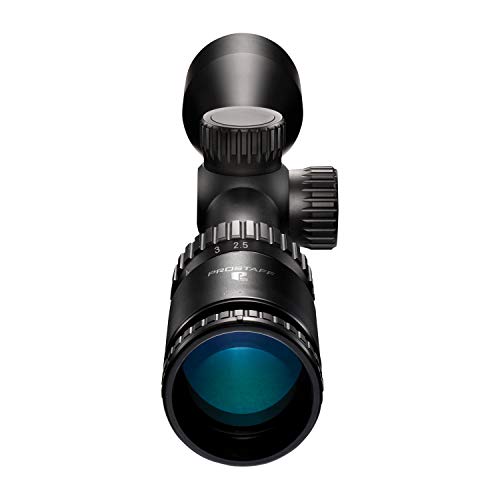


Description
Rifle Scope Product Details
PROSTAFF P5
Rifle Scope Product Features
About this item
Spring-Loaded Instant Zero-Reset Turrets and Aluminum Turret Caps
one-inch main tube
4x zoom ratio
Waterproof, Shockproof and Nitrogen Purged
Your Next Level Of Performance
The PROSTAFF P5 elevates hunting riflescope performance through a combination of proprietary Nikon optical design, superior glass, durable materials and over 100 years of innovation.
Nikon’s OPTICS FIRST Design Principle
For over 100 years, the guiding principle behind every Nikon product has been to engineer it from the inside out and create an optical system specific to the function of the product and to the needs of the user. As one of the few makers of optical glass in the world, Nikon has the advantage of being able to specify and select the exact type of glass, lens geometry and multicoatings needed to optimize the optical performance of any given optic.
PROSTAFF P5 Riflescope Technologies for Better Hunting
Fully Multicoated Optics, 4x Zoom
PROSTAFF P5 models feature a versatile 4x zoom ratio that offers the wide field of view needed for close-up shots or moving targets and the increased image detail that comes with higher magnifications.
Durable-Yet-Lightweight Ergonomics
Nikon builds the PROSTAFF P5 riflescopes’ one-inch main tube, zoom ring, focusing eyepiece and turret caps from aircraft-grade aluminum. Matched knurling on all controls is ergonomically designed for visual appeal and increased grip during use.
BDC Reticle
The BDC reticle allows hunters to hold “dead-on” at ranges exceeding those previously thought possible. The BDC’s unique see-through ballistic circles offer an incredible advantage for long range shooting”yet allow a normal sight picture for shorter-range shots where the crosshair itself is the aiming point.
Spring-Loaded Instant Zero-Reset Turrets
Precise, positive-click -MOA reticle adjustments to get you zeroed quickly and maintain your setting, even with heavy recoil. Spring-loaded Instant Zero Reset turret feature provides confidence when dialing in the field.
A Compact PROSTAFF P5 Riflescope
An ideal option for virtually any hunting rifle
Waterproof, Shockproof and Nitrogen Purged
O-ring sealed to prevent moisture from entering body. Shrugs off hard recoil and rugged use and purged using nitrogen gas for total reliability against thermal shock and internal fogging.
About the Nikon Manufacturer
Nikon is a premium manufacturer for weapon scopes, optics, mounts, and other add-ons used for firearms like rifles and long guns. They design and make their mounts, scopes, and related products by choosing building materials which are long lasting and durable. This includes the PROSTAFF P5 by Nikon. For more shooting products, visit their website.
Optic Details
Rifle scopes permit you to specifically align a rifle at different targets by aligning your eye with the target over a range. They accomplish this through magnification by employing a series of lenses within the scope. The scope’s alignment can be adapted for consideration of separate natural factors like wind speed and elevation increases to account for bullet drop.
The scope’s purpose is to help shooters understand exactly where the bullet will land based upon the sight picture you are viewing through the scope as you align the scope’s crosshair or reticle with the intended point of impact. Many contemporary rifle scopes have around eleven parts which are found internally and externally on the optic. These parts consist of the rifle scope’s body, lenses, adjustment turrets or dials, focus rings, and other elements. Learn about the eleven parts of optics.
Rifle Optic Types
Rifle scopes can be either “first focal plane” or “second focal plane” style of scopes. The kind of focal plane an optic has decides where the reticle or crosshair is located in regard to the optic’s magnifying adjustments. It actually implies the reticle is located behind or ahead of the magnifying lens of the optic. Deciding upon the most effective style of rifle glass depends upon what variety of shooting or hunting you intend on doing.
Info on First Focal Plane Glass
First focal plane scopes (FFP) feature the reticle before the magnification lens. This induces the reticle to increase in size based upon the level of zoom being used. The outcome is that the reticle measurements are the same at the magnified distance as they are at the non magnified distance. One tick on a mil-dot reticle at 100 yards with no “zoom” is still the very same tick at one hundred yards by using 5x “zoom”. These types of scopes work for:
- Quick acquisition, long distance types of shooting
- Shooting scenarios where calculations are low
- Experienced shooters who understand their aim point “hold over” and “lead” ratios for their rifles
- Shooters who do not mind the reticle is enlarged and uses up more visual sight room than a SFP reticle
Info About Second Focal Plane Glass
Second focal plane optics (SFP) come with the reticle to the rear of the zoom lens. This causes the reticle to remain at the same scale relative to the volume of zoom being used. The result is that the reticle measurements adjust based upon the zoom used to shoot over greater distances since the reticle markings represent different increments which change with the magnification. In the FFP example with the SFP glass, the 5x “zoom” 100 yard tick measurement would be 1/5th of the non “zoom” tick. These types of scopes are handy for:
- Far away kinds of shooting where shooters have increased time to make ballistic calculations
- Shooting where most shots occur within shorter ranges and distances
- Shooters who want a clearer optic picture without area taken up by the larger sized FFP reticle
Ins and Outs of Scope Zoom
The measure of scope zoom you need on your glass depends upon the sort of shooting you want to do. Just about every type of rifle optic gives some degree of zoom. The volume of zoom a scope delivers is determined by the dimension, density, and curvatures of the lenses within the rifle scope. The zoom of the scope is the “power” of the glass. This indicates what the shooter is aiming at through the scope is magnified times the power factor of what can typically be seen by human eyes.
Fixed Single Power Lens Optics
A single power rifle scope or optic comes with a zoom number designator like 4×32. This suggests the zoom power of the scope is 4x power while the objective lens is 32mm. The zoom of this type of optic can not adjust considering that it is a fixed power scope.
Info on Adjustable Power Lens Rifle Scopes
Variable power rifle scopes have adjustable power. It will list the zoom amount in a format such as 2-10×32. These numbers suggest the zoom of the scope can be changed between 2x and 10x power. This always incorporates the power levels in-between 2 and 10. The power manipulation is accomplished by employing the power ring component of the scope near the back of the scope by the eye bell.
Power Levels and Range
Here are some advised scope powers and the distances where they can be efficiently used. Always remember that high magnification glass will not be as practical as lower powered optics due to the fact that too much zoom can be a negative thing in certain situations. The same applies to longer distances where the shooter needs to have increased power to see exactly where to best aim the rifle.
Lens Covering for Glass
All contemporary rifle optic lenses are coated. There are various types and qualities of glass lens coverings. When looking at high end rifle targeting devices, Lens finish can be an important component of a rifle. The glass lenses are one of the most crucial parts of the glass due to the fact that they are what your eye sees through while sighting a rifle in on the target. The finishing on the lenses safeguards the lens surface area and even improves anti glare capabilities from excess sunrays and color recognition.
ED Versus HD Rifle Scopes
Some scope manufacturers likewise use “HD” or high-definition lens finishings which use different methods, polarizations, chemicals, and components to draw out a wide range of colors and viewable quality through the lens. Some scope makers use “HD” to refer to “ED” to signify the lens has extra-low dispersion glass.
Single Rifle Scope Lens Finishing Versus Multi-Coating
Various optic lenses can also have various finishings applied to them. All lenses generally have at least some kind of treatment or finish applied to them prior to being used in a rifle scope or optic assembly. This is due to the fact that the lens isn’t simply a raw piece of glass. It becomes part of the carefully tuned optic. It requires a coating to be applied to it so that the lens will be optimally functional in numerous types of environments, degrees of sunlight (full light VS shaded), and other shooting conditions.
This lens treatment can protect the lens from scratches while decreasing glare and other less useful things experienced in the shooting environment while sighting in with the scope. The quality of a single coated lens depends on the scope manufacturer and how much you paid for it.
Some scope manufacturers also make it a point to specify if their optic lenses are coated or “multi” covered. Being “better” depends on the producer’s lens treatment innovation and the quality of materials used in building the rifle scope.
Hydrophobic Glass Lens Covering
Water on a lens does not assist with maintaining a clear sight picture through a scope at all. Lots of top of the line and military grade optic companies will coat their lenses with a hydrophilic or hydrophobic coating.
Alternatives for Installing Rifle Glass on Firearms
Mounting solutions for scopes can be found in a couple of options. There are the basic scope rings which are separately mounted to the scope and one-piece scope mounts which cradle the scope. These various kinds of mounts also normally are made in quick release variations which use throw levers which allow rifle operators to quickly mount and remove the glass.
Hex Key Rifle Scope Rings
Normal, clamp style mounting scope rings use hex head screws to mount to the flattop design Picatinny scope mount rails on rifles. These types of scope mounts use two separate rings to support the optic, and are made from 7075 T6 billet aluminum which are created for long range precision shooting. This type of scope mount is perfect for rifles which require a resilient, rock solid mounting solution which will not move no matter how much the scope is moved or abuse the rifle takes.
Rifle Scope Mounting Solutions with Quick-Release Cantilever Rings
These types of quick-release rifle scope mounts can be used to quickly attach and remove a scope from a rifle before reattaching it to a different rifle. Multiple scopes can also be swapped out if they all use a similar style mount. These types of mounts come in handy for long guns which are transferred a lot, to swap out the optic from the rifle for protecting the scope, or for scopes which are used between multiple rifles or are situationally focused.
Sealing and Gas Purging for Rifle Optic Tubes
Wetness inside your rifle scope can ruin a day of shooting and your pricey optic by inducing fogging and developing residue inside of the scope tube. The majority of scopes protect against humidity from going into the optical tube with a system of sealing O-rings which are water resistant. Typically, these optics can be submerged within 20 or 30 feet of water before the water pressure can push moisture past the O-rings. This should be ample moisture content avoidance for common use rifles, unless you anticipate taking your rifle on boats and are worried about the scope still working if it goes overboard and you can still retrieve the gun.
Rifle Optic Gas Purging
Another part of avoiding the accumulation of moisture within the rifle scope tube is filling the tube with a gas like nitrogen. Because this area is currently occupied by the gas, the scope is less altered by temp shifts and pressure variations from the outside environment which could potentially enable water vapor to seep in around the seals to fill the vacuum which would otherwise be there. These are good qualities of a decent rifle scope to seek out.


