



Description
Rifle Scope Product Details
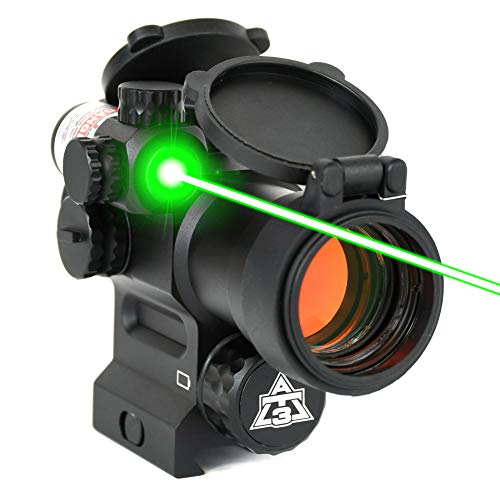
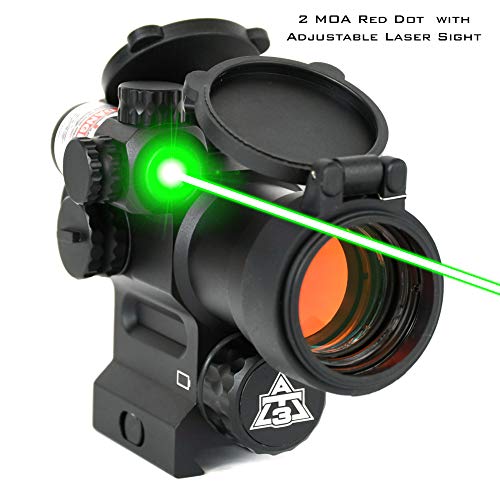
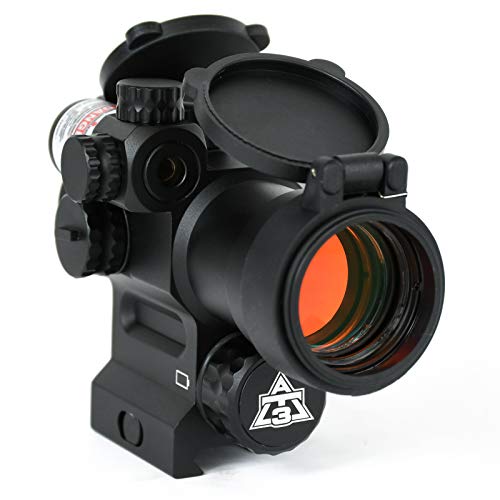
AT3 LEOS Red Dot Sight with Integrated Green Laser Sight – 2 MOA Red Dot Scope with Flip Up Lens Caps
Rifle Scope Product Features
About this item
NEW Brilliant Green Laser & Crisp 2 MOA Red Dot with W/E Adjustment. 50K Hour Max Battery Life for Red Dot, 8 Hour Max for Laser
Riser Mount Housing, Flip Up Lens Caps, & Tool-free Windage & Elevation Adjustments
Durable, Waterproof 6061 Aluminum Housing – Lifetime AT3 Warranty
Ideal for home defense, tactical & law enforcement, hunting, plinking, competitive shooting, or any shooting scenario where magnification is not required.
For use on sporting & hunting rifles, shotguns, air rifles, & any other weapon with a picatinny or weaver mounting rail.
Reliable and Feature Packed
The LEOS is the red dot sight that has everything. A crisp 2 MOA red dot, brightness memory, integrated riser mount, flip-up lens caps, and a laser sight available in red or green. Both the red dot and laser can be adjusted separately using the included adjustment caps, allowing you to set this optic up for your personal preference. This sight is great for fast target acquisition as well as rugged use cases.
Accurate
Crisp 2 MOA red dot with 6 brightness settings for accurate both-eyes-open aiming
Brilliant laser sight enables rapid targeting ” perfect for home defense, tight quarters, & low visibility
Crystal-clear fogproof multi-coated optics resist scratches and provide clarity in all situations
Unfailingly maintains zero ” even with high-caliber weapons
Versatile
Precise digital controls for simple control of the sight and integrated laser ” switch between red dot only, red dot laser, and laser only modes with the push of a button.
Integrated riser mount puts sight at optimal eye level, and provides lower 1/3 cowitness with iron sights
Tool-free windage and elevation adjustment with integrated screwdriver on W/E caps
Spring-assisted flip-up lens caps provide rapid deployment and superb lens protection
Reliable
Durable 6061 Aircraft-Aluminum housing with a stealthy matte-black hardcoat anodized finish
Fully waterproof and fogproof ” sealed design with nitrogen purged optics
Extra-long battery life ” up to 50,000 hours on lowest brightness setting (red dot only); up to 40 hours of continuous red laser use, and 8 hours of continuous green laser use.
Shockproof circuitry rated for impacts up to 800 G’s ” it can handle any recoil you throw at it.
Uses commonly available CR123 lithium batteries ” Surefire CR123A included
Easy thumb screw for secure mounting to any picatinny rail (can tighten by hand, or with a coin or flathead screwdriver)
Specifications
Red Dot Sight
Power / Obj. Lens: 1x30mm
Reticle: 2 MOA Red Dot
Weight: 8.3 oz
Total Length: 4.3 in
Waterproof/Fogproof: Yes
Body material: 6061 Aluminum
Battery life: up to 50,000 hours on lowest setting. Approx. 5,000 hour with typical use
Windage/Elevation Click Value: 1 MOA per click
Adj Range: +/- 35 MOA (total adjustment range 70 MOA)
Laser power: 4mw class 2
Included in the Box
LEOS Red Dot Sight
Surefire CR123A Battery
Instruction Sheet
Allen Wrench
Lens Cloth
RD-50 PRO Red Dot Sight with Riser and Armor LEOS Red Dot Sight with Red Laser ARO Micro Red Dot Sight RD-50 Red Dot Sight LEOS Red Dot Sight with Green Laser
Reticle 2 MOA Red Dot 2 MOA Red Dot 3 MOA Red Dot 2 MOA Red Dot 2 MOA Red Dot
Riser Mount Included – Two Cowitness Options Integrated Included Low Mount Integrated
Laser Sight Red Laser Green Laser
Brightness Levels 11 6 6 11 6
Brightness Memory
About the AT3 Tactical Scope Maker
AT3 Tactical is a premium manufacturer for long gun scopes, optics, mounting solutions, and other accessories used for firearms like rifles and long guns. They create and build their mounts and related products by using elements which are long lasting and durable. This includes the AT3 LEOS Red Dot Sight with Integrated Green Laser Sight – 2 MOA Red Dot Scope with Flip Up Lens Caps by AT3 Tactical. For more shooting items, visit their site.
What You Need to Know About Scopes
Rifle scopes permit you to specifically align a rifle at various targets by lining up your eye with the target at range. They accomplish this through magnifying the target by using a series of lenses inside the scope. The scope’s positioning can be adjusted to take into account varied environmental aspects like wind speed and elevation to make up for bullet drop.
The scope’s function is to understand exactly where the bullet will hit based upon the sight picture you are viewing through the scope as you line up the scope’s crosshair or reticle with the intended target. A lot of contemporary rifle optics have about 11 parts which are arranged inside and outside of the scope body. These optic pieces consist of the rifle scope’s body, lenses, modification dials, objective focus rings, and other elements. Learn about the eleven parts of rifle scopes.
The Varieties of Rifle Scopes
Rifle scopes can be either “first focal plane” or “second focal plane” type of scopes. Opting for the optimal type of rifle optic depends on what type of shooting you plan on doing.
Info on First Focal Plane Glass
First focal plane optics (FFP) come with the reticle ahead of the magnifying lens. This causes the reticle to increase in size based on the extent of zoom being used. The result is that the reticle measurements are the same at the magnified range as they are at the non amplified distance. One tick on a mil-dot reticle at one hundred yards with no “zoom” is still the exact same tick at 100 yards by using 5x “zoom”. These types of scopes are beneficial for:
- Quick acquisition, long distance types of shooting
- Shooting situations where computations are very little
- Experienced shooters who recognize their target “hold over” as well as “lead” ratios for their firearms
- Shooters who do not mind the reticle is bigger and uses up more visual eyesight area than a SFP reticle
Second Focal Plane Glass
Second focal plane scopes (SFP) come with the reticle behind the zoom lens. In the FFP example with the SFP scope, the 5x “zoom” 100 yard tick would be 1/5th of the non “zoom” tick reticle measurement.
- Long distance types of shooting where shooters have extra time to make ballistic estimations
- Shooting where most of the shots take place within shorter ranges and distances
- Shooters who would like a clearer optic picture without space taken up by the larger sized FFP reticle
Rifle Glass Zoom
The extent of scope magnification you need is based on the style of shooting you plan to do. Just about every style of rifle glass offers some level of zoom. The volume of magnification a scope delivers is identified by the size, density, and curves of the lens glass within the rifle optic. The zoom of the optic is the “power” of the glass. This indicates what the shooter is checking out through the scope is amplified times the power aspect of what can normally be seen by human eyes.
Fixed Power Lens Scope Info
A single power rifle scope or optic uses a magnification number designator like 4×32. This means the magnification power of the scope is 4x power while the objective lens is 32mm. The magnification of this type of scope can not change because it is a fixed power optic.
Adjustable Power Lens Glass
Variable power rifle scopes can be changed between magnification increments. These types of scopes will note the magnification degree in a configuration like 2-10×32. These numbers imply the zoom of the scope can be adjusted in between 2x and 10x power. This also utilizes the powers in-between 2 and 10. The power modification is achieved utilizing the power ring component of the scope near the back of the scope by the eye bell piece.
Power and Range
Here are some advised scope power levels and the ranges where they could be effectively used. High power glass will not be as efficient as lower magnification glass considering too much magnification can be a negative aspect depending on your shooting distance. The same idea relates to extended ranges where the shooter needs to have adequate power to see where to best aim the rifle.
Info on Rifle Scope Lens Coating
All modern-day rifle scope and optic lenses are layered. Lens finish can be an important element of a shooting system when purchasing high end rifle optics and scope setups.
HD Versus ED Glass Lens Coatings
Some glass makers also use “HD” or high-definition lense finishes that use different procedures, aspects, polarizations, and chemicals to extract various colors and viewable definition through lenses. This HD covering is commonly used with more costly high density lens glass which lowers light’s capability to refract by means of the lens glass. Some scope brands use “HD” to refer to “ED” suggesting extra-low dispersion glass. ED deals with how colors are represented on the chromatic spectrum and the chromatic aberration or difference which is similarly called color distortion or fringing. Chromatic aberration can be visible over things with hard edges and shapes as light hits the object from particular angles.
Details on Single Coating Versus Multi-Coating
Different optic lenses can likewise have various coverings used to them. All lenses normally have at least some type of treatment or finish used to them before being used in a rifle scope or optic.
This lens treatment can protect the lens from scratches while reducing glare and other less beneficial things experienced in the shooting environment while sighting in with the scope. The quality of a single covered lens depends on the scope producer and how much you paid for it.
Some scope makers similarly make it a point to specify if their optic lenses are layered or “multi” covered. Being “better” depends on the manufacturer’s lens treatment technology and the quality of materials used in developing the rifle scope.
About Hydrophobic Coating
Water on a lens does not assist with keeping a clear sight picture through a scope at all. Lots of top of the line and military grade optic makers will coat their lenses with a hydrophobic or hydrophilic finishing.
Rifle Optic Mounting Options
Mounting approaches for scopes are available in a few options. There are the standard scope rings which are separately installed to the optic and one-piece scope mounts which cradle the scope. These different kinds of mounts also normally can be found in quick release versions which use toss levers which enable rifle shooters to quickly mount and remove the optics.
Hex Key Glass Ring Mounting Solutions
Standard, clamp-on type mounting optic rings use hex head screws to mount to the flattop style Picatinny scope mounting rails on the tops of rifles. These types of scope mounts use two detached rings to support the optic, and are normally constructed from 7075 T6 billet aluminum or similar materials which are developed for far away accuracy shooting. This form of scope mount is great for rifle systems which require a resilient, unfailing mount which will not change no matter how much the scope is moved or abuse the rifle takes. These are the type of mounts you want for a specialized optics setup on a reach out and touch someone scouting or competitors long gun which will hardly ever need to be altered or recalibrated. Blue 242 Loctite threadlocker can additionally be used on the scope mount’s screws to stop the hex screw threads from backing out after they are installed firmly in position. An example of these rings are the 30mm type from Vortex Optics. The set typically costs around $200 USD
Quick-Release Cantilever Rifle Optic Ring Mounting Solutions
These types of quick-release rifle scope mounts can be used to quickly detach a scope from a rifle and reattach it to a different rifle. Multiple scopes can also be switched out if they all use a complementary style mount. The quick detach mount style is CNC machined from anodized 6061 T6 aluminum and the mounting levers attach tightly to a flat top type Picatinny rail. This permits the scope to be sighted in while on the rifle, removed from the rifle, and remounted back on the rifle while preserving accuracy. These types of mounts are useful and handy for rifles which are transferred a lot, to take off the optic from the rifle for protection, or for optics which are chosen for use between numerous rifles. An example of this mount style is the 30mm mount from the Vortex Optics brand. It normally costs around $250 USD
Rifle Glass Tube Sealing and Gas Purging
Wetness inside your rifle optic can destroy a day on the range and your highly-priced optic by inducing fogging and creating residue inside of the scope’s tube. The majority of scopes protect against wetness from going into the scope tube with a series of sealing O-rings which are water resistant. Normally, these scopes can be immersed within 20 or 30 feet of water before the water pressure can push moisture past the O-rings. This should be sufficient humidity prevention for basic use rifles for hunting and sporting purposes, unless you intend on taking your rifle sailing and are worried about the scope still functioning if it is submerged in water and you can still rescue the rifle.
About Rifle Scope Tube Gas Purging
Another element of avoiding the buildup of moisture inside of the rifle optic tube is filling the tube with a gas like nitrogen. Given that this space is already occupied by the gas, the optic is less impacted by temperature alterations and pressure differences from the outdoor environment which could possibly permit water vapor to leak in around the seals to fill the vacuum which would otherwise exist. These are good qualities of a good rifle scope to seek out.


