Description
Rifle Scope Product Details
Vortex Optics Spitfire 1x Prism Scope – DRT Reticle (MOA)
Vortex Optics Spitfire 1x Prism Scope – DRT Reticle (MOA)
Rifle Scope Product Features
About this item
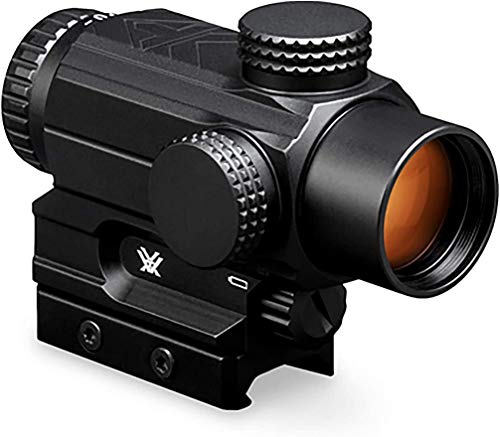
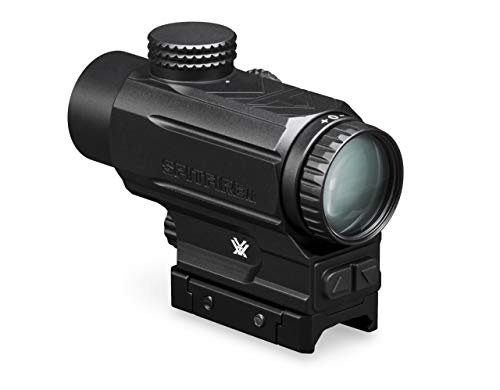
The Spitfire Prism Scope has been built from the ground up to maximize the fast handling performance of your rifle in close to medium range shooting applications. This prism scope is backed with all the features you need in a tactical optic.
The generous sight picture and forgiving eye box get you on target effortlessly in any scenario. Fully multi-coated lenses offer true to life clarity and brightness.
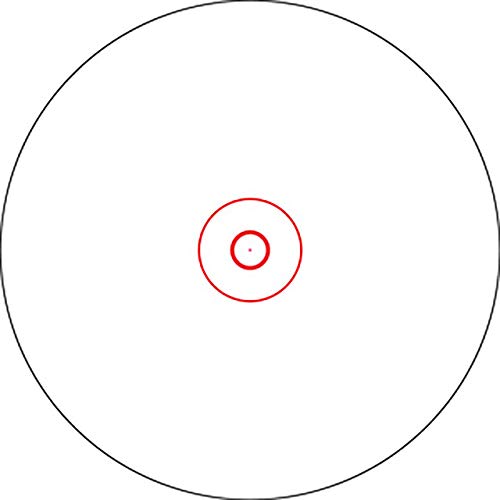
The dual ring tactical reticle is etched on the prism providing you with a visible point of aim whether powered up or not. Ten intensity levels perfectly match ambient light conditions while you also have an option between red or green illumination.
With shockproof construction, the Spitfire withstands recoil and impact while nitrogen purging and o-ring seals ensure fogproof and waterproof performance.
A common AAA battery powers the illuminated reticle. Field of View: 79 feet/100 yards
Spitfire 1x Prism Scope (SPR-200)
Built from the ground up specifically to maximize the quick-handling performance of rifles, Vortex’s Spitfire prism scope delivers incredible optical quality and ultra-fast functionality in a lightweight, streamlined package. The generous, parallax-free, sight picture and forgiving eyebox gets shooters on target effortlessly – even in high-stress scenarios.
Dual Ring Tactical (DRT) MOA Reticle
The DRT (Dual Ring Tactical) reticle is designed for rapid shooting at close distances. The dual ring design pulls the eye into instant alignment with the reticle center and target. Etched directly on the prism to assure consistent point-of-aim at all times with selectable red/green illumination of five intensity levels to match specific conditions.
Basic Operation
Illumination Control
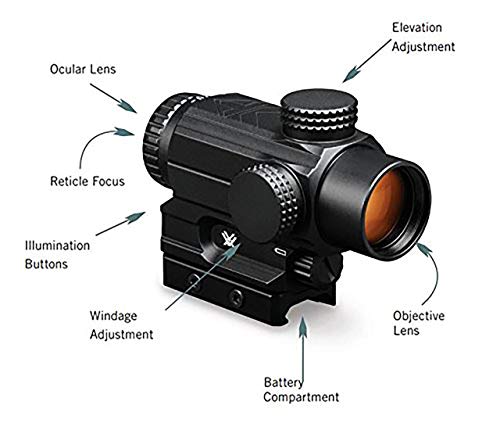
Illumination is available in both red and green colors. To change between colors, momentarily press and release both Up and Down buttons at the same time. Illumination intensity can be adjusted by either tapping Up or Down buttons, or holding button down to automatically cycle through adjustment range. The Spitfire has twelve levels of brightness, with the last two being ultra-low to allow use with NV equipment.
Reticle Focus
The Spitfire prism scope uses a fast focus eyepiece designed to quickly and easily provide a sharply focused reticle. To adjust the reticle focus:
1. Look through the scope at a blank white wall or up at the sky.
2. Turn the eyepiece focus dial in or out until the reticle image is as crisp as possible.
Mounting the Spitfire
Orient the Spitfire so the adjustment buttons face the shooter.
1. Loosen the base crossbolts and attach the Spitfire to the rail/base, making sure that recoil lugs are solidly seated in the base groove.
2. Check that the mount fully engages the base, press the Spitfire down and forward, then tighten the base crossbolts.
About the Vortex Brand
Vortex is a premium manufacturer for firearm scopes, optics, mounting solutions, and other add-ons used for guns like rifles and long guns. They design and build their scopes and related products by choosing building materials which are long lasting and resilient. This includes the Vortex Optics Spitfire 1x Prism Scope – DRT Reticle (MOA) by Vortex. For additional shooting items, visit their website.
Facts About Optics
Rifle scopes enable you to exactly align a rifle at different targets by aligning your eye with the target at range. They accomplish this through magnification by employing a set of lenses within the scope. The scope’s positioning can be dialed in to account for different ecological aspects like wind speed and elevation increases or decreases to account for bullet drop.
The scope’s function is to understand exactly where the bullet will hit based on the sight picture you are viewing through the optic as you align the scope’s crosshair or reticle with the target. The majority of contemporary rifle optics have around 11 parts which are located internally and externally on the optic. These optic pieces include the rifle scope’s body, lenses, modification dials, objective focus rings, and other elements. Learn about the eleven parts of glass.
About Scope Types
Rifle scopes can be either “first focal plane” or “second focal plane” type of scopes. Choosing the best type of rifle scope depends on what type of shooting you plan on doing.
First Focal Plane Glass
Focal plane scopes (FFP) include the reticle in front of the zoom lens. These kinds of scopes are useful for:
- Quick acquisition, far away kinds of shooting
- Shooting situations where calculations are low
- Experienced shooters who have an idea for their aim point “hold over” and also “lead” correlations for their long guns
- Shooters who do not mind the reticle is enlarged and takes up more visual sight room than a SFP reticle
About Second Focal Plane Scopes
Second focal plane glass (SFP) come with the reticle behind the zoom lens. This causes the reticle to stay at the same dimensions in connection with the quantity of zoom being used. The outcome is that the reticle measurements evolve based on the zoom used to shoot over lengthier distances considering that the markings represent distinct increments which can vary with the magnification. In the FFP example with the SFP scope, the 5x “zoom” 100 yard tick would be 1/5th of the non “zoom” tick measurement. These particular kinds of scopes are beneficial for:
- Far away types of shooting where shooters have more time to make ballistic calculations
- Shooting where most of the shots happen within shorter proximities and ranges
- Shooters who want a clearer optic sight picture with less space taken up by the bigger FFP reticle
Rifle Glass Zoom
The amount of scope zoom you need on your scope is based on the type of shooting you want to do. Practically every kind of rifle optic delivers some degree of zoom. The volume of zoom a scope offers is established by the diameter, density, and curves of the lens glass inside of the rifle optic. The magnification level of the optic is the “power” of the opic. This indicates what the shooter is observing through the scope is amplified times the power element of what can usually be seen by human eyes.
Fixed Power Lens Rifle Glass Info
A single power rifle scope or optic uses a magnification number designator like 4×32. This implies the magnification power of the scope is 4x power and the objective lens is 32mm. The magnification of this type of scope can not change given that it is a fixed power scope.
Adjustable Power Lens Rifle Glass
Variable power rifle scopes can be adjusted between magnification increments. It will note the magnification amount in a format such as 2-10×32. These numbers imply the zoom of the scope can be adjusted between 2x and 10x power. This always includes the power levels in-between 2 and 10. The power manipulation is accomplished by employing the power ring component of the scope near the back of the scope by the eye bell.
Scope Power and Ranges
Here are some recommended scope power levels and the distances where they could be efficiently used. High power rifle scope glass will not be as effective as lower magnification scopes considering that too much magnification can be a negative aspect depending on your shooting distance. The very same idea applies to longer distances where the shooter needs sufficient power to see precisely where to properly aim the rifle.
Rifle Optic Lens Coating
All top of the line rifle optic and scope lenses are covered. Lens finishing can be an important aspect of a shooting system when looking into high end rifle optics and scope equipment.
ED Versus HD Optics
Some scope brands also use “HD” or high-definition lens coatings which use different procedures, polarizations, aspects, and chemicals to draw out a wide range of colors and viewable definition through the lens. Some scope makers use “HD” to refer to “ED” indicating extra-low dispersion glass.
About Single Coating Versus Multi-Coating
Different optic lenses can likewise have various finishes used to them. All lenses normally have at least some type of treatment or coating used to them before being used in a rifle scope or optic.
Single layered lenses have a treatment applied to them which is normally a protective and boosting multi-purpose treatment. This lens treatment can shield the lens from scratches while decreasing glare and other less beneficial things experienced in the shooting environment while sighting in with the optic. The quality of a single covered lens depends on the scope producer and how much you spent on it. The scope’s maker and cost are signs of the lens quality.
Some scope producers also make it a point to define if their optic lenses are coated or “multi” coated. Being “much better” depends on the manufacturer’s lens treatment technology and the quality of materials used in building the rifle scope.
Hydrophobic Lens Covering
Water on a lens does not assist with maintaining a clear sight picture through a scope at all. Lots of top of the line and military grade optic companies will coat their lenses with a hydrophilic or hydrophobic covering.
Choices for Installing Rifle Glass on Long Guns
Mounting approaches for scopes are available in a few choices. There are the basic scope rings which are separately installed to the scope and one-piece scope mounts which cradle the scope. These different types of mounts also typically can be found in quick release versions which use manual levers which permit rifle shooters to quickly mount and dismount the scopes.
Hex Key Scope Rings
Standard, clamp style mounting scope rings use hex head screws to mount to the flattop design Picatinny scope mount rails on rifles. These types of scope mounts use a couple of different rings to support the optic, and are often made from 7075 T6 billet aluminum which is developed for long distance accuracy shooting. This type of scope mount is perfect for rifles which require a resilient, sound mounting solution which will not move no matter how much the scope is moved or abused.
Scope Mounting Solutions with Quick-Release Cantilever Rings
These types of quick-release rifle scope mounts can be used to rapidly take off a scope from a rifle and reattach it to a different rifle. If they all use a similar design mount, several scopes can also be swapped out on the range. The quick detach design is CNC crafted from anodized 6061 T6 aluminum and the mounting levers fasten nicely to a flat top style Picatinny rail. This enables the scope to be sighted in while on the rifle, removed from the rifle, and remounted while keeping accuracy. These types of mounts come in beneficial for rifles which are shipped a lot, to remove the scope glass from the rifle for protection, or for optics which are chosen for use in between multiple rifles. An example of this mount type is the 30mm mount designed by Vortex Optics. It typically costs around $250 USD
Sealing and Gas Purging for Rifle Optic Tubes
Moisture inside your rifle scope can destroy a day of shooting and your expensive optic by inducing fogging and producing residue within the scope tube. Many scopes prevent wetness from going into the optical tube with a series of sealing O-rings which are waterproof. Generally, these water resistant optics can be submerged underneath 20 or 30 feet of water before the water pressure can force moisture past the O-rings. This should be plenty of wetness prevention for conventional use rifles for hunting and sporting purposes, unless you plan on taking your rifle on boats and are concerned about the optic still performing if it goes overboard and you can still salvage the rifle.
Gas Purged Rifle Glass Tubes
Another component of preventing the buildup of wetness inside of the rifle scope tube is filling the tube with a gas like nitrogen. Because this area is currently occupied by the gas, the optic is less influenced by temperature changes and pressure variations from the outdoor environment which may possibly allow water vapor to permeate in around the seals to fill the vacuum which would otherwise exist. These are good qualities of a decent rifle scope to look for.


