



Description
Rifle Scope Product Details
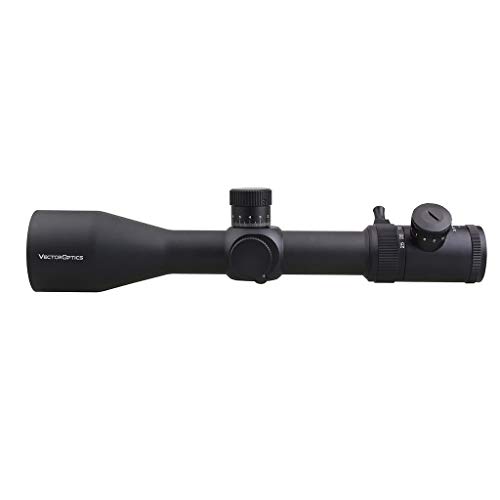
Vector Optics Reiter 3.5-25x56mm, 1/10 MIL, 35mm Tube, Red Illuminated Reticle, Second Focal Plane (SFP) Compact Riflescope
Specifications:
Magnification: 3.5-25x
Objective Lens Dia.:56mm
Tube Dia.:35mm
Adjustment Click Value: 1/10 MIL
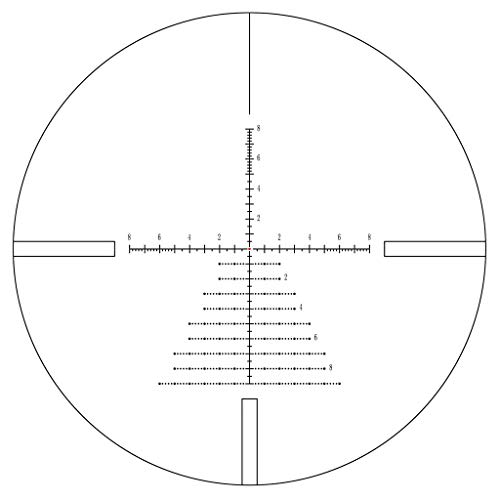
Reticle: VPA-3
Illumination: 11 gears of Red
Ocular Dia: 41mm(1.6 inch)
Ocular Length: 61mm(2.4 inch)
Field of View: 31.3-4.3 feet @ 100 yards
Eye Relief: 120-89mm (4.7-3.5inch)
Exit Pupil: 8-2.2mm
Parallax Setting: 100 yards
Elevation Range: 23 MIL
Windage Range: 14 MIL
Lens Coating: Fully multicoated
Length: 350mm (13.8 inch)
Weight: 995g (35.1 OZ)
Finish: Matte
Battery: CR2032(EXCLUDED)
Distance between objective lens part and middle turret: 43mm (1.7 inch)
Length of middle turret part: 46mm (1.8 inch)
Distance between middle turret part to power ring: 62mm (2.4 inch)
Diopter compensation from fast-focus eyepiece (+2.0 to -2.0)
Features:
5 Years Warranty
35mm Monotube. 1/10 MIL windage and elevation adjustments for fine-tuning accuracy.
The reticle is red illuminated along the second focal plane.
The illunimation has 11 gears of brightness.
The weakest dot intensity fits NV.
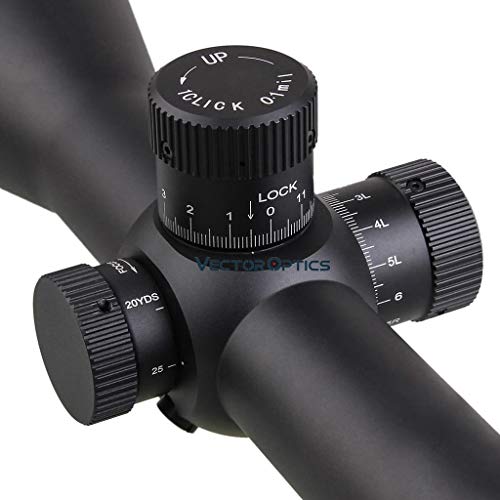
Turret lock feature: Pull to adjust, press to lock.
Side Focus starts at 20 Yard.
Fast-focus Eyepiece for quick and easy reticle focusing
O-ring Sealed and Nitrogen Purged Ensure Water Proof and Fog Proof performance; Shockproof to 1000g.
High quality 6061 T6 aircraft grade aluminum alloy with durable black matte finish.
Side Focus: 20, 25, 50, 100, 200, 700 to infinite
Package Includes:
– 1 x 3.5-25×56 Riflescope
– 2 x 35mm weaver mount ring (default) or dovetail mount ring (on request only)
– 1 x Lens Cover
– 1 x Cleaning cloth
Note: We offer 5 years WARRANTY for our products. Please feel free to contact us if you have any interests or product issues, we are available 24/7 online.
Rifle Scope Product Features
5 years warranty.
The reticle is red illuminated along the second focal plane. The illunimation has 11 levels of brightness. Side Focus starts at 20 Yard.
Optics hold zero. True 8x Zoom Factor. Turret lock sytem. Pull to adjust, press to lock.
O-ring Sealed and Nitrogen Purged Ensure Water Proof and Fog Proof performance. Shock tested up to 1000g.
Free 30mm mount rings, and lens covers, 3 inches sunshade.
About the Vector Optics Scope Maker
Vector Optics is a premium supplier for firearm scopes, optics, mounting solutions, and other add-ons used for guns like rifles and long guns. They innovate and manufacture their scopes and related products by using elements which are long lasting and resilient. This includes the Vector Optics Reiter 3.5-25x56mm, 1/10 MIL, 35mm Tube, Red Illuminated Reticle, Second Focal Plane (SFP) Compact Riflescope by Vector Optics. For more shooting goods, visit their website.
Info Rifle Optics
Rifle scopes allow you to specifically align a rifle at different targets by lining up your eye with the target over a distance. They accomplish this through zoom using a set of lenses within the scope. The scope’s alignment can be dialed in for consideration of numerous ecological factors like wind and elevation to make up for bullet drop.
The scope’s function is to help shooters understand precisely where the bullet will hit based upon the sight picture you are seeing with the optic as you line up the scope’s crosshair or reticle with the intended point of impact. Many modern rifle scopes have around 11 parts which are found within and on the exterior of the scope. These scope parts consist of the rifle scope’s body, lenses, windage and elevation dials, focus rings, and other parts. Learn about the eleven parts of glass.
About Rifle Optic Varieties
Rifle scopes can be either “first focal plane” or “second focal plane” type of scopes. Choosing the best type of rifle scope is based on what type of shooting you plan to do.
First Focal Plane Optic Details
Focal plane scopes (FFP) feature the reticle in front of the magnifying lens. This causes the reticle to increase in size based on the level of zoom being used. The benefit is that the reticle measurements are the same at the magnified distance as they are at the non amplified distance. One tick on a mil-dot reticle at 100 yards with no “zoom” is still the identical tick at one hundred yards with 5x “zoom”. These kinds of scopes are beneficial for:
- Quick acquisition, far away types of shooting
- Shooting situations where calculations are small
- Experienced shooters who recognize their target “hold over” and also “lead” relationships for their firearm
- Shooters who don’t mind the reticle is enlarged and requires more visual sight area than a SFP reticle
Second Focal Plane Glass
Second focal plane optics (SFP) feature the reticle to the rear of the magnification lens. This causes the reticle to stay at the very same overall size in connection with the amount of zoom being used. The effect is that the reticle dimensions change based upon the magnification applied to shoot over longer ranges given that the reticle markings present various increments which change with the magnification level. In the FFP example with the SFP glass, the 5x “zoom” 100 yard tick measurement would be 1/5th of the non “zoom” tick measurement. These particular types of optics are beneficial for:
- Far away styles of shooting where shooters have increased time to make ballistic computations
- Shooting where most of the shots occur within much shorter proximities and ranges
- Shooters who desire a clearer optic picture with less space taken up by the larger size FFP reticle
Magnification for Scopes
The amount of scope zoom you need depends upon the style of shooting you intend to do. Practically every type of rifle optic gives some amount of zoom. The quantity of magnification a scope delivers is identified by the diameter, density, and curvatures of the lenses inside of the rifle optic. The magnifying level of the optic is the “power” of the opic. This implies what the shooter is looking at through the scope is amplified times the power factor of what can normally be seen by human eyes.
About Single Power Lens Scopes
A single power rifle scope comes with a magnification number designator like 4×32. This suggests the zoom power of the scope is 4x power and the objective lens is 32mm. The magnification of this type of scope can not adjust because it is set from the factory.
About Variable Power Lens Rifle Scopes
Variable power rifle scopes can be tweaked between magnified settings. The power modification is handled by making use of the power ring part of the scope near the back of the scope by the eye bell.
Rifle Scope Power and Range Correlation
Here are some suggested scope power settings and the ranges where they can be efficiently used. Remember that high magnification optics will not be as effective as lower magnification level glass because excessive zoom can be a detractor. The very same idea relates to longer ranges where the shooter needs increased power to see precisely where to best aim the rifle.
Info on Scope Lens Coating
All current rifle optic and scope lenses are layered. Lens coating is a significant aspect of a shooting platform when buying high end rifle optics and scope systems.
HD Versus ED Rifle Scope Lens Coatings
Some rifle glass suppliers additionally use “HD” or high-definition lense finishings that employ various procedures, polarizations, chemicals, and aspects to extract various color ranges and viewable definition through lenses. This HD covering is often used with greater density lens glass which decreases light’s ability to refract by means of the lens glass. Some scope producers use “HD” to describe “ED” suggesting extra-low dispersion glass. ED handles how certain colors are presented on the chroma spectrum and the chromatic aberration or difference which is similarly called color distortion or fringing. Chromatic aberration may be visible around items with defined outlines as light hits the object from certain angles.
Single Optic Lens Coating Versus Multi-Coating
Various optic lenses can also have different coatings applied to them. All lenses typically have at least some type of treatment or coating applied to them prior to being used in a rifle scope or optic.
Single layered lenses have a treatment applied to them which is typically a protective and boosting multi-purpose treatment. This lens treatment can preserve the lens from scratches while minimizing glare and other less beneficial things experienced in the shooting environment while sighting in with the scope. The quality of a single layered lens depends upon the scope maker and how much money you spent on it. The scope’s maker and cost are indications of the lens quality.
Some scope manufacturers similarly make it a point to define if their optic lenses are covered or “multi” covered. Being “better” depends on the manufacturer’s lens treatment innovation and the quality of materials used in developing the rifle scope.
Anti-water Lens Coating
Water on an optical lens does not improve preserving a clear sight picture through an optic at all. Many top of the line or high-end scope producers will coat their lenses with a hydrophilic or hydrophobic finishing. The Steiner Optics Nano-Protection is a fine example of this type of treatment. It provides protection for the surface of the Steiner scope lens so the water molecules can not bind to it or develop surface tension. The result is that the water beads slide off of the scope to preserve a clear, water free sight picture.
Optic Installation Choices
Mounting approaches for scopes are available in a couple of choices. There are the basic scope rings which are separately installed to the optic and one-piece scope mounts which cradle the scope. These different kinds of mounts also generally can be found in quick release versions which use manual levers which enable rifle operators to quickly mount and dismount the optics.
Hex Key Scope Rings
Standard, clamp design mounting scope rings use hex head screws to mount to the flattop design Picatinny scope mount rails on rifles. These types of scope mounts use two separate rings to support the optic, and are often made from 7075 T6 billet aluminum which is developed for long distance precision shooting. This type of scope install is perfect for rifles which need a long lasting, sound mounting solution which will not move no matter how much the scope is moved or abused.
Quick-Release Cantilever Rifle Glass Rings
These types of quick-release rifle scope mounts can be used to quickly detach a scope and connect it to a different rifle. Several scopes can also be switched out if they all use a compatible design mount. These types of mounts are handy for rifles which are transferred a lot, to swap out the optic from the rifle for protecting the scope, or for optics which are used between several rifles.
Glass Tube Sealing and Gas Purging
Moisture inside your rifle glass can ruin a day of shooting and your pricey optic by inducing fogging and developing residue inside of the scope’s tube. The majority of scopes prevent wetness from going into the optical tube with a series of sealing O-rings which are waterproof. Usually, these water resistant scopes can be submerged beneath 20 or 30 feet of water before the water pressure can force moisture past the O-rings. This should be sufficient moisture content avoidance for standard use rifles for hunting and sporting purposes, unless you intend on taking your rifle on a boat and are concerned about the optic still performing if it goes overboard and you can still retrieve the rifle.
About Rifle Scope Tube Gas Purging
Another element of preventing the accumulation of wetness within the rifle optic’s tube is filling the tube with a gas like nitrogen. Since this space is already occupied by the gas, the scope is less impacted by climate changes and pressure differences from the outside environment which could potentially permit water vapor to leak in around the seals to fill the vacuum which would otherwise be there. These are good qualities of a decent rifle scope to look for.


