

Description
Rifle Scope Product Details
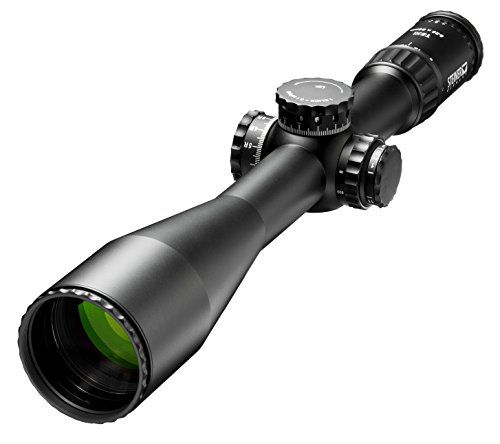
Steiner T5Xi Tactical Rifle Scope – Close Compact Riflescope for Hunting
Fire with precision and accuracy with the Steiner T5Xi 1-5x 24mm Riflescope Tactical Rifle Scope from Steiner. With a trademarked Special Competition Reticle (SCR) technology, the reticle is located on the first focal plane, extending the illumination area. Low-profile windage and elevation knobs allow for 0.1 mil per click correction in any situation from combat to competition. This scope’s oversized 34mm tube includes a 50mm objective lens and 3-15 magnification, supported by independant paralax adjustability. Ensure precision shooting for hunting, competition, law enforcement and more with this gun accessory. The broken-cross-style reticle makes targets easier to spot and groupings less obscured. Steiner makes trusted optics for life’s defining moments. No matter what you’re looking at, we strive to improve your vision so that nothing escapes you.
Rifle Scope Product Features
ULTIMATE ACCURACY ” Rely on Steiner’s T5Xi 5-25x 56mm tactical riflescope to provide precision through its one-piece, oversized 34mm tube that increases strength and reliability.
SPECIAL COMPETITION RETICLE (SCR) – Designed for precision competition use, it offers an extended illumination area, windage and holdover lines. 1/10-mil ranging brackets allow for precise ranging.
THROW LEVER allows quick, easy magnification changes and Tenebraex LENS COVERS protect the lenses from dust and moisture.Diopter Adjustment Range: +2 to -3
SECOND ROTATION INDICATOR – After the first 120 clicks, the mil numbers on the scale change automatically preventing the shooter from getting lost on the dial.
HERITAGE WARRANTY – We stand behind our products. Period! We will repair/replace defective products at no charge for the lifetime of the product. Warranty does not cover damage, loss or theft.
The Ultimate in Long-Range Precision, Ruggedness, and Versatility
T5Xi 5-25×56 Riflescope
Specs:
Magnification: 5x – 25x
Objective Lens Diameter: 56mm
Tube Diameter: 34mm
Focal Plane: 1st
Reticle: SCR – Illuminated
Windage/Elevation Click Value: 1 cm. @ 100m (1/10 mRad)
Paralax Focus: Side Focus
Turrets: Low Profile, Resettable, Second Rotation Indicator
Waterproof: Submersable to 33ft.
Battery: CR2450
Item #: 5122
Made in the U.S.A.
Steiner T5Xi 5-25×56 Riflescope
German Precision. American Pride
The T5Xi Series brings unmatched clarity, accuracy and self-assurance to any situation, from combat to competition. Precise German engineering, rugged U.S. construction, slick Never-Lost turrets, and the exclusive SCR reticle gives you the victor’s edge in long-range shooting.
Ideal for Competitive Shooting and Law Enforcement
Long-range scope with 34mm tube, illuminated etched glass featuring the Special Competition Reticle (SCR) and Second Rotation Indicator that shows each mil of elevation through the indication window on the elevation turret. Front focal plane.
The Steiner Advantage
Illuminated SCR Reticle
Long-range Special Competition Reticle (SCR) is a proprietary reticle designed by Steiner for competition use. Located in the first focal plane, it features an extended illumination area, 2/10-mil windage hold-off lines, 1/2-mil holdover lines and 1/10 mil-ranging brackets for precise distance ranging. Illumination has 7/day and 4/night levels for every lighting condition.
Razor-Edge Image Clarity
World-class engineering and optical systems provide unmatched clarity and light transmission. Steiner grinds and polishes its premium lens then multi-coats them with proprietary coatings providing more contrast and brighter detail, even in low-light conditions.
Low-Profile Never-Lost Turrets
Low-profile and resettable turrets have hard stops at zero for accurate dialing of elevation and windage. The Never-Lost turrets, a Steiner exclusive, have a second rotation indicator that after the first rotation of 120 clicks the mil numbers on the scale change automatically, preventing the shooter from getting lost on his dial.
34mm Tube for Long Range
One-piece oversized 34mm tubes increase strength and reliability, and provides greater elevation and windage adjustments for long ranges.
Legendary Military Ruggedness
After 69 years of deployment and constant improvement, Steiner optics are unmatched in their durability and reliability. Battle-proven technology is integrated into every Steiner product making them world-renowned for their ferocious toughness.
Waterproorf, Fogproof, Shockproof
For absolute fogproof and waterproof protection, Steiner seals 14-psi pressurized nitrogen into its optics for premium clarity in any condition. Fail-safe testing with medical-grade tools ensures absolute quality and zero fogging and water intrusion despite drastic changes, severe conditions, and lifetimes of use.
Tapered All-Metal Magnification Ring
The angled magnification ring allows the shooter to see the magnification setting while positioned behind the scope.
Lifetime Heritage Warranty
All Steiner scopes are covered by the Steiner Heritage Warranty for the lifetime of the product.
– No warranty card needed.
– No receipt needed.
– Fully transferable to future owners of the product.
Steiner T5Xi 5-25×56 Riflescope Steiner T5Xi 3-15×50 Riflescope Steiner T5Xi 1-5×24 5.56mm Riflescope Steiner T5Xi 1-5×24 7.62mm Riflescope
Magnification 5x – 25x 3x – 15x 1x – 5x 1x – 5x
Objective Lens Diameter 56mm 50mm 24mm 24mm
Tube Diameter 34mm 34mm 30mm 30mm
Focal Plane 1st 1st 2nd 2nd
Length (in.) 16.6 13.1 11.3 11.3
Weight (oz.) 33 29.8 19.4 19.4
Reticle SCR SCR 3TR 5.56 3TR 7.62
Illumination Control Illuminated Reticle with 4-night/7-day Levels Illuminated Reticle with 4-night/7-day Levels Illuminated Reticle with 4-night/7-day Levels Illuminated Reticle with 4-night/7-day Levels
Lifetime Heritage Warranty
About the Steiner Manufacturer
Steiner is a premium producer for rifle scopes, optics, mounting solutions, and other accessories used for firearms like rifles and long guns. They innovate and supply their mounts and related products using elements which are durable and long lasting. This includes the Steiner T5Xi Tactical Rifle Scope – Close Compact Riflescope for Hunting by Steiner. For more shooting goods, visit their website.
What You Need to Know About Rifle Optics
Rifle scopes allow you to specifically aim a rifle at various targets by lining up your eye with the target over a distance. They accomplish this through magnification by using a series of lenses inside the scope. The scope’s positioning can be dialed in for consideration of varied ecological things like wind speed and elevation increases or decreases to make up for bullet drop.
The scope’s function is to understand exactly where the bullet will land based on the sight picture you are seeing with the optic as you align the scope’s crosshair or reticle with the target. The majority of modern rifle scopes and optics have around eleven parts which are found internally and on the exterior of the scope. These optic pieces include the rifle scope’s body, lenses, adjustment dials or turrets, objective focus rings, and other parts. Learn about the eleven parts of optics.
Rifle Scope Types
Rifle scopes can be either “first focal plane” or “second focal plane” style of scopes. The type of focal plane an optic has determines where the reticle or crosshair lies in connection with the optic’s magnifying adjustments. It simply implies the reticle is situated behind or before the magnifying lens of the scope. Picking the most beneficial type of rifle optic is based on what style of hunting or shooting you anticipate doing.
Info on First Focal Plane Scopes
Focal plane scopes (FFP) feature the reticle in front of the zoom lens. These types of scopes are useful for:
- Quick acquisition, far away kinds of shooting
- Shooting scenarios where calculations are marginal
- Experienced shooters who understand their aim point “hold over” plus “lead” ratios for their rifles
- Shooters who don’t mind the reticle is enlarged and uses up more visual eyesight area than a SFP reticle
Info on Second Focal Plane Glass
Second focal plane optics (SFP) include the reticle behind the zoom lens. In the FFP example with the SFP scope, the 5x “zoom” one hundred yard tick reticle measurement would be 1/5th of the non “zoom” tick measurement.
- Long distance kinds of shooting where shooters have more time to make ballistic estimations
- Shooting where most of the shots take place within much shorter distances and ranges
- Shooters who desire a clearer optic sight picture without area used up by the enlarged FFP reticle
Magnification for Glass
The amount of scope magnification you need on your optic depends on the form of shooting you like to do. Almost every kind of rifle glass delivers some degree of magnification. The level of magnification a scope delivers is identified by the dimension, thickness, and curvatures of the lens glass inside of the rifle scope. The magnification level of the optic is the “power” of the scope. This suggests what the shooter is observing through the scope is magnified times the power element of what can usually be seen by human eyes.
Fixed Single Power Lens Rifle Optics
A single power rifle optic and scope comes with a magnification number designator like 4×32. This implies the zoom power of the scope is 4x power while the objective lens is 32mm. The magnification of this type of scope can not adjust because it is a fixed power optic.
Adjustable Power Lens Glass Info
Variable power rifle scopes can be changed between magnification power levels. These types of scopes will note the zoom level in a configuration such as 2-10×32. These numbers imply the magnification of the scope could be set between 2x and 10x power. This always involves the powers in-between 2 and 10. The power modification is achieved by operating the power ring part of the scope near the back of the scope by the eye bell.
The Power and Range of Optics
Here are some advised scope powers and the distances where they may be effectively used. High power glass will not be as beneficial as lower magnification scopes due to the fact that too much zoom can be a bad thing. The same relates to longer distances where the shooter needs enough power to see exactly where to properly aim the rifle at the target.
Lens Coating for Optics
All cutting-edge rifle glass lenses are coated. Lens coating is a significant element of a shooting system when buying high end rifle optics and scope systems.
ED Versus HD Rifle Scopes
Some scope brands also use “HD” or high-definition lens coatings which use various techniques, polarizations, components, and chemicals to draw out a wide range of colors and viewable definition through the lens. Some scope makers use “HD” to refer to “ED” indicating extra-low dispersion glass.
Single Coating Versus Multi-Coating for Rifle Scopes
Various optic lenses can likewise have various finishings applied to them. All lenses usually have at least some type of treatment or coating used to them before they are used in a rifle scope or optic.
Single covered lenses have a treatment applied to them which is usually a protective and improving multi-purpose treatment. This lens treatment can safeguard the lens from scratches while reducing glare and other less advantageous things experienced in the shooting environment while sighting in with the scope. The quality of a single covered lens depends upon the scope maker and how much you paid for it. Both the make and cost are signs of the lens quality.
Some scope producers likewise make it a point to define if their optic lenses are layered or “multi” coated. This suggests the lens has multiple treatments applied to the surfaces of the glass. If a lens gets multiple treatments, it can indicate that a manufacturer is taking multiple actions to fight different environmental aspects like an anti-glare finishing, a scratch resistant anti-abrasion covering, followed by a hydrophilic finishing. This additionally doesn’t necessarily suggest the multi-coated lens is much better than a single layered lens. Being “better” is dependent on the maker’s lens treatment technology and the quality of products used in constructing the rifle optic.
Anti-water Scope Lens Finish
Water on a lens does not help with keeping a clear sight picture through a scope at all. Lots of top of the line and military grade scope companies will coat their lenses with a hydrophilic or hydrophobic anti-water finishing.
Optic Installing Choices
Installing options for scopes come in a couple of options. There are the basic scope rings which are separately mounted to the optic and one-piece scope mounts which cradle the scope. These different kinds of mounts also generally come in quick release variations which use throw levers which permit rifle shooters to quickly mount and dismount the scopes.
Glass Mounting Solutions with Hex Key Rings
Normal, clamp style mounting scope rings use hex head screws to mount to the flattop style Picatinny scope mount rails on rifles. These types of scope mounts use a couple of different rings to support the optic, and are made from 7075 T6 billet aluminum which are created for long range accuracy shooting. This type of scope install is great for rifles which need a long lasting, rock solid mounting solution which will not move no matter how much the scope is moved or abused.
Scope Mounting Solutions with Quick-Release Cantilever Rings
These types of quick-release rifle scope mounts can be used to rapidly detach a scope from a rifle and reattach it to a different rifle. Multiple scopes can also be switched out if they all use a complementary designed mount. The quick detach mount style is CNC machined from anodized 6061 T6 aluminum and the mounting levers attach solidly to a flat top style Picatinny rail. This enables the scope to be sighted in while on the rifle, taken off of the rifle, and remounted while retaining accuracy. These types of mounts come in practical for shooting platforms which are moved a lot, to take off the optic from the rifle for protection, or for optics which are utilized in between a number of rifles. An example of this mount style is the 30mm mount designed by the Vortex Optics manufacturer. It generally costs around $250 USD
Scope Tube Sealing and Gas Purging
Wetness inside your rifle scope can ruin a day of shooting and your costly optic by causing fogging and producing residue inside of the scope tube. The majority of scopes avoid moisture from getting in the scope tube with a system of sealing O-rings which are water resistant.
About Scope Tube Gas Purging
Another element of avoiding the accumulation of moisture within the rifle scope’s tube is filling the tube with a gas like nitrogen. Given that this area is already taken up by the gas, the glass is less influenced by climate changes and pressure variations from the outside environment which might potentially enable water vapor to leak in around the seals to fill the vacuum which would otherwise exist. These are good qualities of a good rifle scope to seek out.


