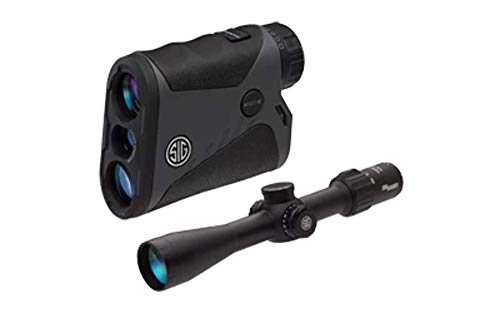
Description
Rifle Scope Product Details
Sig Sauer BDX Combo Kit, KILO1400BDX Laser Range Finder and Sierra3BDX 3.5-10x42mm Rifle Scope
Sig Sauer SOK14BDX01 bdx combo kit. Kilo1400BDX left and Sierra3BDX. Scopes. This product is manufactured in China.
Rifle Scope Product Features
About this item
BDX-capable KILO rangefinder and riflescope combo
Riflescope produces an illuminated auto-holdover dot on your target
Ballistic Data Xchange shares data between rangefinder and riflescope
LevelPlex Anti-Cant System with integrated digital level
Rangefinder ranges to 1,600 yds. on reflective targets ” deer to 750 yds. Department – unisex-adult. Included Components – 1554 rifle-scopes. Material – Plastic.
A New Hampshire-based weapons systems provider
SIG SAUER world renowned firearms are the weapons of choice for many of the premier global military, law enforcement and commercial users.
Headquartered in Newington, New Hampshire, SIG SAUER is a company with over 1,200 employees. SIG SAUER is the member of a worldwide business group of firearms manufacturers that includes J.P. Sauer & Sohn and Blaser, Gmbh. in Germany.
High quality, ultimate reliability and unmatched performance have always been hallmarks of the SIG SAUER brand.
SIG SAUER Electro-Optics transforms hunting with the unprecedented simplicity and accuracy of BDX
The BDX rangefinder and riflescope system is simple, fast, and intuitive. Simply download the ‘SIG BDX’ app available for Android or iOS smartphones, pair the KILO BDX rangefinder and SIERRA3BDX riflescope, set up a basic ballistic profile, and then you’re ready to shoot or hunt.
Download the SIG BDX app
Configure your bullet profile
Sync the app with your rangefinder
Press the Range button to measure the distance of your target
Use the app to bond the rangefinder with the riflescopeUse the app to bond the rangefinder with the riflescope
Once the riflescope is turned on, range the target and the new hold is lit up out to 800 yards
Electro-Optics Technology
AMR
Ranging technology uses an on-board inclinometer that reads incline/decline angle and modifies the effective ballistic shooting range to the target. AMR is the equivalent horizontal range and integrates perfectly when used in combination with SIG Ballistic Turret Dials.
Lightwave DSP
Lightwave DSP (Digital Signal Processing) engine leverages HyperScan ” an advanced power management technique that provides fast refresh rate in scan mode (4 times per second) even at distances over a mile. Our DSP engine uses the latest generation Field Programmable Gate Array (FPGA) running sophisticated signal processing algorithms to reduce false positives while finding weak or distant targets.
LUMATIC
An advanced display on the market. Our OLED (Organic Light Emitting Diode) display has the largest dynamic range providing for high brightness in bright sunlight or snow conditions, yet will dim down to near nightvision levels at dusk and dawn.
Stealth ID
Electro-Optics industrial design inspired by our firearms; deflection armor trapezoidal surfacing breaks up the shape and visibility of the optic along with pistol slide serrations and grip checkering to add function to the form of all SIG SAUER electro-optics.
BDX Combo Kit
The BDX family of rangefinders includes: KILO1400BDX, KILO1800BDX, KILO2200BDX, KILO2400BDX, and KILO3000BDX rangefinder binocular. These rangefinders include many of the legacy features that the KILO name was built on: Lightwave DSP digital rangefinder engine, Hyperscan with 4 times per second scan rate, RangeLock, and the Lumatic auto-adjusting display.
Available in 3.5-10x42mm, 4.5-14x44mm, 4.5-14x50mm, and 6.5-20x52mm, the SIERRA3BDX riflescopes have the look, feel, weight, and size of traditional riflescopes. They feature HD glass for superior resolution and optical clarity, 30mm main tubes, side-focus parallax adjustments, and the LevelPlex digital anti-cant system. The BDX-R1 Digital Ballistic Reticle is the evolution of holdover, providing a ballistic solution out to 800 yards with 1 MOA of accuracy.
SIG SAUER BDX Combo Kit, Kilo1400BDX LRF and Sierra3BDX Rifle Scope SIG SAUERBDX Combo Kit, Kilo1800BDX LRF and Sierra3BDX Rifle Scope SIG SAUER BDX Combo Kit, Kilo2400BDX LRF and Sierra3BDX Rifle Scope
Rifle Scope Sierra3BDX 3.5-10x42mm Sierra3BDX 4.5-14x44mm Sierra3BDX 6.5-20x52mm
Range Finder Kilo1400BDX Kilo1800BDX Kilo2400BDX
Magnification 6x 6x 7x
Objective Clear Aperture 20 mm 22 mm 25 mm
Tube Diameter 30mm 30mm 30mm
About the Sig Sauer Scope Maker
Sig Sauer is a premium company for firearm scopes, optics, mounts, and other accessories used for guns like rifles and long guns. They create and build their scopes and related products by applying building materials which are long lasting and resilient. This includes the Sig Sauer BDX Combo Kit, KILO1400BDX Laser Range Finder and Sierra3BDX 3.5-10x42mm Rifle Scope by Sig Sauer. For more shooting products, visit their website.
Information Optics
Rifle scopes permit you to specifically align a rifle at various targets by lining up your eye with the target at range. They accomplish this through magnification by using a series of lenses within the scope. The scope’s positioning can be adapted for the consideration of various ecological aspects like wind and elevation decreases to account for bullet drop.
The scope’s purpose is to help the shooter understand exactly where the bullet will hit based on the sight picture you are seeing via the scope as you align the scope’s crosshair or reticle with the intended point of impact. A lot of contemporary rifle optics have around 11 parts which are located within and outside of the scope. These scope parts include the rifle scope’s body, lenses, adjustment dials, focus rings, and other components. Learn about the eleven parts of rifle glass.
The Types of Rifle Scopes
Rifle scopes can be either “first focal plane” or “second focal plane” kind of scopes. The kind of focal plane a scope has identifies where the reticle or crosshair is located in connection with the optic’s zoom. It literally suggests the reticle is situated behind or ahead of the magnifying lens of the optic. Looking for the most effective form of rifle glass is based on what kind of shooting you intend on doing.
About First Focal Plane Scopes
Focal plane scopes (FFP) include the reticle in front of the zoom lens. These types of scopes are helpful for:
- Quick acquisition, long distance types of shooting
- Shooting circumstances where computations are small
- Experienced shooters who have an idea for their aim point “hold over” and “lead” ratios for their firearm
- Shooters who do not mind the reticle is bigger and takes up more visual eyesight space than a SFP reticle
About Second Focal Plane Scopes
Second focal plane glass (SFP) feature the reticle to the rear of the magnifying lens. This causes the reticle to remain at the very same size in connection with the volume of magnification being used. The end result is that the reticle measurements evolve based upon the zoom employed to shoot over lengthier distances since the markings represent different increments which change with the zoom. In the FFP example with the SFP glass, the 5x “zoom” 100 yard tick measurement would be 1/5th of the non “zoom” tick. These particular kinds of glass are convenient for:
- Long distance kinds of shooting where shooters have more time to make ballistic computations
- Shooting where most shots take place within much shorter distances and ranges
- Shooters who want a clearer optic picture without area used up by the larger size FFP reticle
Zoom for Rifle Glass
The amount of zoom a scope provides is figured out by the size, thickness, and curvatures of the lenses inside of the rifle scope. The magnification of the scope is the “power” of the scope.
Fixed Power Lens Rifle Glass Info
A single power rifle optic comes with a magnification number designator like 4×32. This implies the magnification power of the scope is 4x power while the objective lens is 32mm. The zoom of this kind of scope can not adjust considering that it is a fixed power scope.
Variable Power Lens Glass Info
Variable power rifle scopes use variable power levels. The power change is performed by using the power ring part of the scope near the rear of the scope by the eye bell.
The Power Level and Range Correlation of Rifle Glass
Here are some suggested scope powers and the ranges where they can be effectively used. High power rifle scope glass will not be as efficient as lower magnification level rifle scope glass because too much zoom can be a bad thing. The exact same idea relates to longer distances where the shooter needs to have sufficient power to see precisely where to best aim the rifle at the target.
Lens Coating for Glass
All modern rifle optic lenses are coated. There are various types and qualities of finishes. Lens covering is an important element of a rifle when thinking of luxury rifle optics and targeting systems. The glass lenses are one of the most vital pieces of the scope since they are what your eye sees through while sighting a rifle in on the target. The finishing on the lenses safeguards the lens surface and even helps with anti glare capabilities from refracted natural light and color perception.
ED Versus HD Rifle Optics
Some scope makers likewise use “HD” or high-definition lens coverings which use various procedures, polarizations, chemicals, and elements to draw out separate colors and viewable quality through the lens. Some scope makers use “HD” to refer to “ED” implying extra-low dispersion glass.
Single Finishing Versus Multi-Coating for Optics
Various optic lenses can even have various finishings applied to them. All lenses normally have at least some type of treatment or finishing applied to them before they are used in a rifle scope or optic. This is because the lens isn’t simply a raw piece of glass. It becomes part of the finely tuned optic. It needs to have a covering put on it so that it will be optimally functional in numerous types of environments, degrees of sunshine (full VS shaded), and other shooting conditions.
Single coated lenses have a treatment applied to them which is generally a protective and boosting multi-purpose treatment. This lens treatment can protect the lens from scratches while lowering glare and other less useful things experienced in the shooting environment while sighting in with the optic. The quality of a single covered lens depends upon the scope company and how much money you spent for it. Both the manufacturer and amount are indications of the lens quality.
Some scope producers similarly make it a point to specify if their optic lenses are covered or “multi” covered. Being “much better” depends on the manufacturer’s lens treatment innovation and the quality of products used in building the rifle scope.
Anti-water Lens Finishes
Water on a lens does not assist with preserving a clear sight picture through a scope at all. Numerous top of the line and military grade optic companies will coat their lenses with a hydrophobic or hydrophilic finishing which is water repellent.
Scope Installing Choices
Installing options for scopes are available in a couple of choices. There are the basic scope rings which are separately installed to the scope and one-piece mounts which cradle the scope. These various types of mounts also normally can be found in quick release variations which use throw levers which allow rifle operators to quickly install and remove the scope.
Scope Mounting Solutions with Hex Key Rings
Basic, clamp-on type mounting optic rings use hex head screws to install to the flattop style Picatinny scope mounting rails on rifles. These varieties of scope mounts use a pair of independent rings to support the optic, and are normally constructed from 7075 T6 billet aluminum or similar materials which are made for far away accuracy shooting. This form of scope mount is excellent for rifles which are in need of a durable, rock solid mount which will not change no matter just how much the scope is moved or jarring the rifle takes. These are the style of mounts you really want to have for a faithful scope setup on a reach out and touch someone scouting or interdiction long gun which will hardly ever need to be modified or recalibrated. Blue 242 Loctite threadlocker can additionally be used on the scope mount’s screws to stop the hex screws from wiggling out after they are mounted safely in position. An example of these mounting rings are the 30mm style from Vortex Optics. The set normally costs around $200 USD
Rifle Optic Mounts with Quick-Release Cantilever Rings
These kinds of quick-release rifle scope mounts can be used to rapidly take off a scope from a rifle and reattach it to a different rifle. Several scopes can also be swapped out if they all use a complementary style mount. The quick detach mount style is CNC crafted from anodized 6061 T6 aluminum and the mounting levers attach solidly to a flat top type Picatinny rail. This allows the scope to be sighted in while on the rifle, taken off of the rifle, and remounted back on the rifle while keeping precision. These types of mounts are useful and beneficial for shooting platforms which are moved a lot, to remove the scope glass from the rifle for protection, or for sight systems which are adopted between multiple rifles. An example of this mount style is the 30mm mount from the Vortex Optics manufacturer. It typically costs around $250 USD
What to Know About Optic Tube Sealing and Gas Purging
Moisture inside your rifle optic can mess up a day of shooting and your costly optic by causing fogging and developing residue inside of the scope tube. Many scopes avoid moisture from entering the scope tube with a system of sealing O-rings which are water resistant.
Info Around Scope Tube Gas Purging
Another component of avoiding the buildup of moisture inside of the rifle scope’s tube is filling the tube with a gas like nitrogen. Considering that this area is currently taken up by the gas, the optic is less impacted by temp shifts and pressure variations from the outside environment which might potentially enable water vapor to leak in around the seals to fill the vacuum which would otherwise be there. These are good qualities of a decent rifle scope to seek out.


