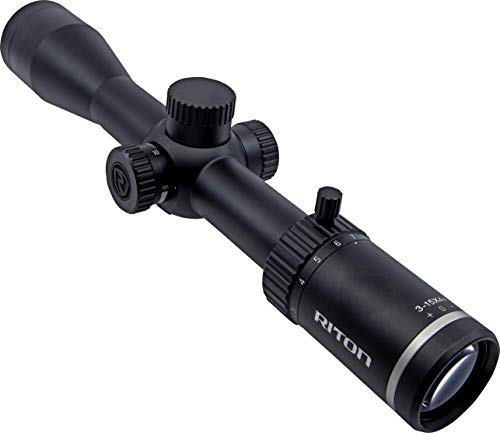
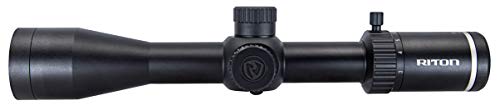


Description
Rifle Scope Product Details
Riton Optics X3 Primal 3-15×44
Rifle Scope Product Features
Featuring Capped, Zero Resettable Turrets / Integrated Removable Throw Lever
1/4 MOA Windage and Elevation Adjustment / Fast-Focus Eyepiece
Assembled in EP-Level Clean Room / 100% Waterproof, Fog Proof and Shockproof (tested up to 1200 G’s)
Aircraft Grade Aluminum with Rugged Design Ready for the Toughest Environments
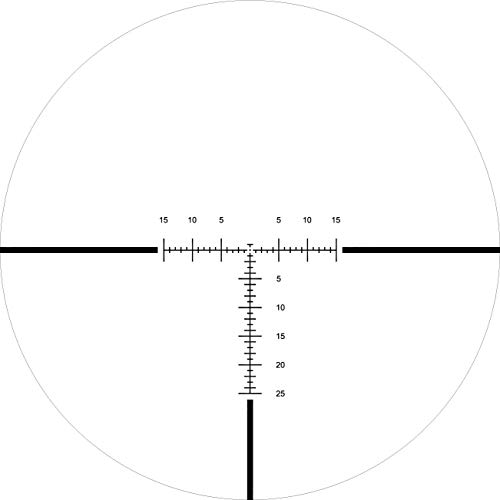
Reticle: PDTR / Adjustment Range: 85 MOA
Born In The Heart Of The Wild West
Straight out of Tucson, Arizona, Riton Optics was founded in 2013 by a Law Enforcement and Military Veteran, Brady Speth, and his wife, Carrie Speth. In designing this Veteran and family owned business, the goal was to bring quality and affordability to the optics industry with the greatest focus being you: the customer and end user.
In the initial years of the business, the focus was on market research, design and testing to ensure the Riton optics line could meet all demands of the end user. With a staff of avid shooters and hunters, the product line originates through practical, real world applications providing you with the quality and functionality needed in a variety of applications. The optics are then put through a series of tests by internal experts, as well as Tier One military personnel, law enforcement officers, competitive shooters and hunters all around the world. Riton has continued to grow their product line and market share each year through the continual development of new product requested by you.
You Will See the Difference
At Riton we have an unwavering passion for offering high quality optics at the industry’s most competitive value and matched by incredible service. With each and every order we strive to surpass your expectations. From your first look through our Riton High Density glass to your interaction with our service team in Tucson, Arizona, we are confident that you will appreciate the quality of our service and products.
You will see the difference in everything we do because we are different, and we developed this company to be exactly that so that you, the consumer, get everything you deserve.
CRAFTING PRECISION OPTICS FOR ALL
We are marksman and hunters, and because we’ve been there, we’ve built an optics line to withstand it all and never let you down. Within the Riton Optics product line, you’ll see the difference in everything we do, including the high quality products at the industry’s best value and unrelenting unmatched service support.
THE RITON PROMISE
As a company founded by Law Enforcement and Military Veterans, we take our commitment to service seriously. Beyond being members of the Riton team, we are also hunters, marksmen, outdoorsmen and women, and ultimately consumers just like you. For that reason, we base our standards for service on the Golden Rule, as we will always provide you with the level of service that we expect to receive as consumers.
We take pride in providing service that exceeds your expectations and reminds you of times when good service was not a rarity.
UNLIMITED LIFETIME PROMISE
As a part of the Riton Promise we believe in providing you with the best possible service, including the industry’s best unlimited lifetime promise. The quality of our products makes this the best unlimited lifetime promise you’ll likely never have to use; however, as hunters and outdoorsmen and women, we know that bad things sometimes happen to even the most cautious.
Our unlimited lifetime promise is simple:
No proof of purchase or registration required for your Riton products.
Unlimited Lifetime Promise regardless of original purchaser.
All unlimited lifetime promise replacements will receive a brand-new product off the shelf. We will not ever replace the product with a repaired or refurbished product.
Replacement product will be shipped within 48 hours of receiving and approving your return.
Loss, theft and/or deliberately worn and damaged products are not covered. Unlimited Lifetime Promise is VOID if damage results from unauthorized repair or alteration.
About the Riton Manufacturer
Riton is a premium producer for firearm scopes, optics, mounting solutions, and other add-ons used for firearms like rifles and long guns. They innovate and supply their scopes, mounts, and related products by using building materials which are long lasting and resilient. This includes the Riton Optics X3 Primal 3-15×44 by Riton. For more shooting goods, visit their site.
Rifle Scope Details
Rifle scopes allow you to precisely align a rifle at different targets by lining up your eye with the target over a distance. They do this through magnification using a set of lenses within the scope. The scope’s alignment can be dialed in to take into account various ecological considerations like wind speed and elevation to make up for bullet drop.
The scope’s purpose is to understand exactly where the bullet will hit based on the sight picture you are viewing with the scope as you line up the scope’s crosshair or reticle with the intended target. A lot of modern-day rifle scopes have around eleven parts which are found within and externally on the optic. These scope parts include the rifle scope’s body, lenses, windage turrets or dials, focus rings, and other components. See all eleven parts of a scope.
Rifle Optic Types
Rifle scopes can be either “first focal plane” or “second focal plane” type of scopes. Choosing the finest type of rifle scope is based around what type of shooting you plan on doing.
First Focal Plane Optics
First focal plane glass (FFP) come with the reticle ahead of the magnification lens. This triggers the reticle to increase in size based on the level of zoom being used. The outcome is that the reticle measurements are the same at the amplified range as they are at the non amplified distance. For example, one tick on a mil-dot reticle at 100 yards without “zoom” is still the corresponding tick at 100 yards with 5x “zoom”. These types of scopes are practical for:
- Quick acquisition, long distance kinds of shooting
- Shooting scenarios where estimations are small
- Experienced shooters who recognize their aim point “hold over” plus “lead” relationships for their long guns
- Shooters who don’t mind the reticle is enlarged and takes up more visual eyesight space than a SFP reticle
Second Focal Plane Glass
Second focal plane glass (SFP) include the reticle to the rear of the magnification lens. This triggers the reticle to remain at the same size in relation to the quantity of magnification being used. The final result is that the reticle dimensions adapt based on the zoom employed to shoot over greater distances due to the fact that the reticle markings represent distinct increments which fluctuate with the magnification. In the FFP example with the SFP scope, the 5x “zoom” 100 yard tick would be 1/5th of the non “zoom” tick measurement. These particular varieties of glass are beneficial for:
- Long distance styles of shooting where shooters have increased time to make ballistic estimations
- Shooting where most of the shots occur within shorter ranges and distances
- Shooters who like a clearer optic picture without space used up by the enlarged FFP reticle
About Rifle Glass Magnification
The quantity of magnification a scope supplies is determined by the size, thickness, and curvatures of the lenses inside of the rifle scope. The zoom of the scope is the “power” of the scope.
Single Power Lens Scopes
A single power rifle scope comes with a zoom number designator like 4×32. This suggests the magnification power of the scope is 4x power and the objective lens is 32mm. The zoom of this kind of scope can not fluctuate considering that it is a set power scope.
Info About Variable Power Lens Glass
Variable power rifle scopes have adjustable power. These types of scopes will list the zoom level in a configuration such as 2-10×32. These numbers mean the zoom of the scope could be changed in between 2x and 10x power. This always includes the power levels in-between 2 and 10. The power shift is accomplished by applying the power ring component of the scope near the rear of the scope by the eye bell.
The Power Level and Range Correlation of Rifle Optics
Here are some recommended scope powers and the ranges where they may be successfully used. Highly magnified scopes will not be as useful as lower magnification rifle scope glass because too much zoom can be a bad thing. The exact same concept relates to longer ranges where the shooter needs to have sufficient power to see where to best aim the rifle.
Scope Lens Finish
All modern rifle scope lenses are layered. There are different types and qualities of glass coverings. When researching luxury rifle optics and scope setups, Lens covering can be a critical component of defining the capability of the rifle. The glass lenses are among the most essential pieces of the scope because they are what your eye looks through while sighting a rifle in on the target. The coating on the lenses safeguards the lens surface and also improves anti glare from refracted light and color recognition.
ED Versus HD Optics
Some rifle scope manufacturers also use “HD” or high-definition lense coverings which take advantage of various procedures, chemicals, components, and polarizations to extract a wide range of color ranges and viewable target visibility through lenses. This high-definition covering is frequently used with increased density lens glass which drops light’s opportunity to refract by means of the lens glass. Some scope suppliers use “HD” to refer to “ED” meaning extra-low dispersion glass. ED handles how colors are represented on the chromatic spectrum and the chromatic aberration or deviance which is also called color distortion or fringing. Chromatic aberration can be noticeable around things with defined shapes as light hits the item from certain angles.
Single Rifle Optic Lens Covering Versus Multi-Coating
Various optic lenses can also have different coverings used to them. All lenses normally have at least some type of treatment or coating used to them before being used in a rifle scope or optic.
This lens treatment can offer protection to the lens from scratches while reducing glare and other less useful things experienced in the shooting environment while sighting in with the scope. The quality of a single covered lens depends on the scope manufacturer and how much you paid for it.
Some scope makers similarly make it a point to specify if their optic lenses are covered or “multi” coated. Being “much better” depends on the producer’s lens treatment technology and the quality of products used in developing the rifle scope.
Hydrophobic Lens Coating
Water on a lens doesn’t assist with preserving a clear sight picture through a scope at all. Lots of top of the line and high-end optic makers will coat their lenses with a hydrophilic or hydrophobic finish.
Options for Installing Scopes on Firearms
Mounting solutions for scopes come in a couple of choices. There are the standard scope rings which are individually installed to the scope and one-piece mounts which cradle the scope. These different kinds of mounts also normally can be found in quick release versions which use toss levers which permit rifle operators to rapidly mount and dismount the glass.
Hex Key Rifle Scope Ring Mounting Solutions
Standard, clamp style mounting scope rings use hex head screws to mount to the flattop design Picatinny scope mount rails on rifles. These types of scope mounts use a couple of different rings to support the optic, and are often made from 7075 T6 billet aluminum which are developed for long range precision shooting. This type of scope mount is perfect for rifles which require a resilient, sound mounting solution which will not move no matter how much the scope is moved or abuse the rifle takes.
Quick-Release Cantilever Rifle Glass Rings
These types of quick-release rifle scope mounts can be used to quickly take off a scope and connect it to a different rifle. Numerous scopes can also be switched out if they all use a similar style mount. These types of mounts are convenient for rifles which are carried a lot, to swap out the optic from the rifle for protection, or for optics which are used in between multiple rifles or are situationally focused.
Rifle Optic Tube Sealing and Gas Purging
Moisture inside your rifle scope can destroy a day of shooting and your expensive optic by triggering fogging and developing residue inside of the scope tube. The majority of scopes avoid wetness from going into the scope tube with a system of sealing O-rings which are waterproof.
Glass Gas Purging
Another component of preventing the accumulation of wetness inside of the rifle scope’s tube is filling the tube with a gas like nitrogen. Considering that this area is already occupied by the gas, the glass is less impacted by temperature level alterations and pressure variations from the external environment which might possibly permit water vapor to permeate in around the seals to fill the vacuum which would otherwise exist. These are good qualities of a decent rifle scope to seek out.


