




Description
Rifle Scope Product Details
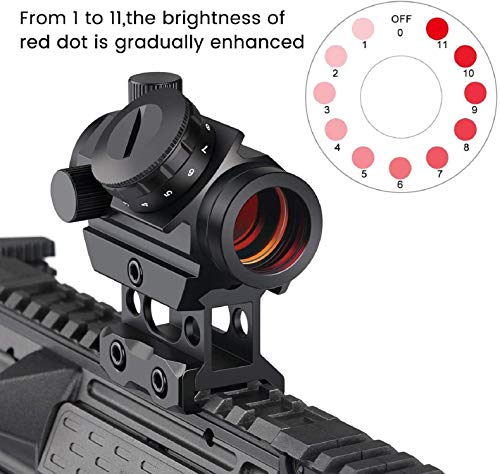
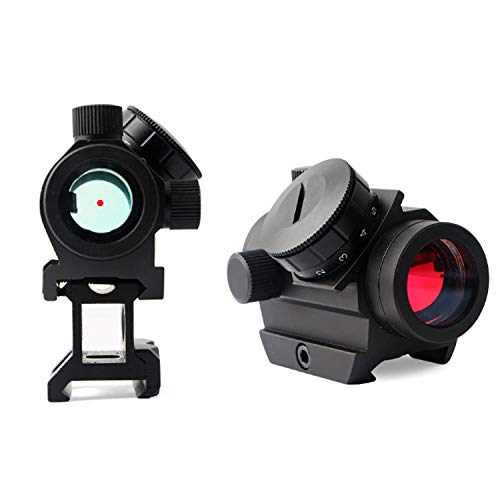
QILU Red Dot Sight, 3-4 MOA Compact Red Dot Scope 1″ Riser Mount for Cowitness with Iron Sights Waterproof and Shockproof Scratch Resistant Amber Lens
What’s In The Box
1 X Red Dot Sight
1 X Riser Mount
1 X Rubber Bikini Cover
1 X CR2032 Battery
1 X Allen Wrench
Rifle Scope Product Features
High Image Clarity – Mini Red Dot Sights With Multiple Anti-reflective Coatings On All Air-to-glass Surfaces Increase Light Transmission. Bright Red Dot Display Is Highly Visible In Daylight.
Precise Target – Red Dot Scope . Weighing Merely 0.25lbs, This Micro Red Dot Sight Allows Easy Operation And Convenient Transportation. Red Dot Sight Provides Clear Red Dot, Which Contributes To Peak Accuracy And Bright Enough To Hunt Even The Thickest Woods.
Durable & High-Quality Constrction – 100% Waterproof, Fog-proof And Shockproof Construction. Fully Waterproof With Sealed Housing. A Shockproof Aluminum Body Displays Extreme Durability And Resists Damage From Rough Handling. Matte Black Anodized Finish Resists Scratches While Keeping A Stealthy Profile.These Features Prevent Moisture, Dust And Debris From Penetrating For Reliable Performance In All Environments. Feel Free To Use Red Dot Rifle Scope To Hunt In Any Weather And Seasons.
Widely Used – It Is Perfect For A Wide Range Of Daytime Applications Including Hunting, Tactical Scenarios, And Precision Shooting. Ideal For Close-range And General Shooting.
Unrestricted Eye Relief – For Most Optic Sights, It Matters How Far Away The Shooter’s Eye Is From The Sight, , The Eye Relief Is Unlimited. With The Parallax-free Design, The Reflex Sight Scope Follows The Movement Of The Users Eye While Remaining Fixed On The Target, Eliminating Any Need For Centering.This Feature Allows For Faster Targeting, Because It Takes Away Part Of The Restraint Placed Upon Someone Who Is Aiming With Another Type Of Sight.
About the QILU Company
QILU is a premium producer for firearm scopes, optics, mounts, and other accessories used for guns like rifles and long guns. They style and supply their scopes, mounts, and related products by choosing materials which are long lasting and durable. This includes the QILU Red Dot Sight, 3-4 MOA Compact Red Dot Scope 1″ Riser Mount for Cowitness with Iron Sights Waterproof and Shockproof Scratch Resistant Amber Lens by QILU. For additional shooting products, visit their site.
Glass Facts
Rifle scopes allow you to specifically aim a rifle at various targets by lining up your eye with the target over a range. They do this through zoom by using a set of lenses within the scope. The scope’s positioning can be dialed in for consideration of separate natural elements like wind speed and elevation decreases to account for bullet drop.
The scope’s purpose is to help shooters understand precisely where the bullet will hit based upon the sight picture you are seeing via the optic as you align the scope’s crosshair or reticle with the intended point of impact. The majority of modern-day rifle scopes have around eleven parts which are located internally and on the exterior of the optic. These parts consist of the rifle scope’s body, lenses, elevation turrets, objective focus rings, and other parts. See all eleven parts of a rifle scope.
The Types of Rifle Scopes
Rifle scopes can be either “first focal plane” or “second focal plane” type of scopes. Choosing the best type of rifle scope depends on what type of shooting you plan to do.
First Focal Plane Scope Details
Focal plane scopes (FFP) come with the reticle in front of the magnifying lens. This triggers the reticle to increase in size based upon the extent of zoom being used. The benefit is that the reticle measurements are the same at the amplified distance as they are at the non amplified distance. One tick on a mil-dot reticle at one hundred yards without “zoom” is still the very same tick at one hundred yards with 5x “zoom”. These types of scopes work for:
- Quick acquisition, far away kinds of shooting
- Shooting circumstances where estimations are marginal
- Experienced shooters who know their aim point “hold over” and “lead” correlations for their rifles
- Shooters who don’t mind the reticle is bigger and uses up more visual eyesight room than a SFP reticle
About Second Focal Plane Glass
Second focal plane optics (SFP) feature the reticle behind the magnification lens. In the FFP example with the SFP scope, the 5x “zoom” one hundred yard tick would be 1/5th of the non “zoom” tick measurement.
- Long distance forms of shooting where shooters have increased time to make ballistic computations
- Shooting where most shots happen within shorter spaces and ranges
- Shooters who would like a clearer optic picture with less room taken up by the enlarged FFP reticle
Scope Zoom
The quantity of zoom a scope supplies is determined by the diameter, thickness, and curvatures of the lenses inside of the rifle scope. The magnification of the scope is the “power” of the scope.
About Fixed Power Lens Rifle Optics
A single power rifle optic and scope uses a zoom number designator like 4×32. This suggests the magnification power of the scope is 4x power while the objective lens is 32mm. The magnification of this type of optic can not fluctuate considering that it is fixed.
About Variable Power Lens Glass
Variable power rifle scopes have adjustable power. These types of scopes will note the magnification level in a configuration such as 2-10×32. These numbers indicate the magnification of the scope can be changed in between 2x and 10x power. This always involves the power levels in-between 2 and 10. The power manipulation is achieved using the power ring part of the scope near the rear of the scope by the eye bell piece.
The Power and Range of Rifle Glass
Here are some suggested scope power levels and the ranges where they may be successfully used. Always remember that higher magnification optics and scopes will not be as practical as lower powered optics and scopes due to the fact that increased magnification can be a detractor. The very same idea goes for longer ranges where the shooter needs to have increased power to see exactly where to best aim the rifle.
Rifle Optic Lens Finishing
All contemporary rifle optic and scope lenses are layered. There are various types and qualities of lens finishings. When shopping for luxury rifle optics and scope devices, Lens finish can be a critical aspect of a rifle. The glass lenses are among the most significant components of the optic since they are what your eye looks through while sighting a rifle in on the point of impact. The coating on the lenses safeguards the lens surface area and even improves anti glare from excess direct sunlight and color visibility.
HD Versus ED Lenses
Some scope manufacturers also use “HD” or high-definition lens finishes which use different methods, elements, chemicals, and polarizations to draw out a wide range of colors and viewable quality through the lens. Some scope makers use “HD” to refer to “ED” meaning extra-low dispersion glass.
Details on Single Finishing Versus Multi-Coating
Various scope lenses can also have various finishes applied to them. All lenses usually have at least some kind of treatment or finishing applied to them before being used in a rifle scope or optic. This is since the lens isn’t just a raw piece of glass. It becomes part of the finely tuned optic. It requires a coating to be applied to it so that it will be efficiently usable in lots of kinds of environments, degrees of light (full light VS shade), and other shooting conditions.
This lens treatment can protect the lens from scratches while minimizing glare and other less useful things experienced in the shooting environment while sighting in with the scope. The quality of a single covered lens depends on the scope producer and how much you paid for it.
Some scope makers also make it a point to specify if their optic lenses are coated or “multi” coated. This implies the lens has multiple treatments applied to them. If a lens receives numerous treatments, it can establish that a company is taking multiple actions to combat various environmental factors like an anti-glare finishing, a scratch resistant anti-abrasion finishing, followed by a hydrophilic finishing. This additionally doesn’t always suggest the multi-coated lens is much better than a single covered lens. Being “better” is dependent on the producer’s lens treatment techniques and the quality of products used in constructing the rifle optic.
Hydrophobic Finish for Glass
Water on a scope’s lens doesn’t help with preserving a clear sight picture through an optic whatsoever. Many top of the line and premium optic manufacturers will coat their lenses with a hydrophilic or hydrophobic covering. The Steiner Optics Nano-Protection is a good example of this kind of treatment. It provides protection for the exterior surfaces of the Steiner glass lens so the water molecules can not bind to it or produce surface tension. The result is that the water beads sheet off of the scope to maintain a clear, water free sight picture.
Options for Installing Rifle Scopes on Long Guns
Installing options for scopes come in a few choices. There are the standard scope rings which are individually mounted to the optic and one-piece scope mounts which cradle the scope. These various kinds of mounts also normally are made in quick release versions which use manual levers which permit rifle shooters to rapidly mount and dismount the scope.
Glass Mounting Solutions with Hex Key Rings
Basic, clamp-on type mounting optic rings use hex head screws to position to the flattop style Picatinny scope mount rails on rifles. These types of scope mounts use a pair of independent rings to support the scope, and are made from 7075 T6 billet aluminum which are designed for far away precision shooting. This type of scope mount is great for rifle systems which require a long lasting, hard use mount which will not change no matter how much the scope is moved about or abuse the rifle takes. These are the style of mounts you should get for a dedicated scope system on a long distance scouting or competition long gun which will hardly ever need to be modified or recalibrated. Blue 242 Loctite threadlocker can additionally be used on the mount screws to keep the hex screws from wiggling out after they are mounted firmly in position. An example of these rings are the 30mm style from Vortex Optics. The set usually costs around $200 USD
Quick-Release Cantilever Rifle Optic Ring Mounting Solutions
These kinds of quick-release rifle scope mounts can be used to quickly take off a scope from a rifle and reattach it to a different rifle. Several scopes can also be swapped out if they all use a similar designed mount. The quick detach mount style is CNC crafted from anodized 6061 T6 aluminum and the mounting levers connect securely to a flat top style Picatinny rail. This enables the scope to be sighted in while on the rifle, taken off of the rifle, and remounted back on the rifle while preserving accuracy. These kinds of mounts come in convenient for rifles which are carried a lot, to remove the optic from the rifle for protection, or for optics which are used between a number of rifles. An example of this mount type is the 30mm mount designed by Vortex Optics. It generally costs around $250 USD
What to Know About Scope Tube Sealing and Gas Purging
Wetness inside your rifle optic can destroy a day of shooting and your pricey optic by triggering fogging and developing residue inside of the scope tube. A lot of scopes prevent wetness from going into the scope tube with a system of sealing O-rings which are water resistant.
Rifle Scope Gas Purging
Another element of preventing the buildup of moisture inside of the rifle optic’s tube is filling the tube with a gas like nitrogen. Since this area is already taken up by the gas, the optic is less altered by temperature level shifts and pressure differences from the outdoor environment which might potentially enable water vapor to permeate in around the seals to fill the void which would otherwise exist. These are good qualities of a decent rifle scope to seek out.


