

Description
Rifle Scope Product Details
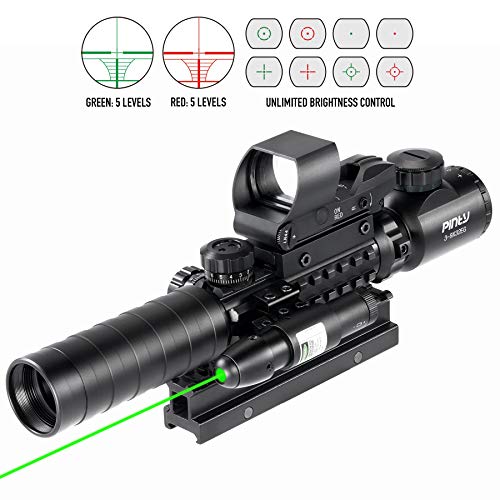
Pinty 3-9×32 Rifle Scope Rangefinder Illuminated Reflex Sight 4 Reticle Green Dot Laser Sight, 8 Packs
Laser class:Class IIIA
Fits 20mm standard picatinny rail
3-9x32EG Illuminated Rangefinder Rifle Scope
Magnification: 3x-9x
Obj. diameter: 32mm
Reticle type: Rangefinder
Brightness control: Red 5 levels / Green 5 levels
Lens color: Blue
Field of view: 13.41′ ~ 40.38′ @ 100yards
Eye relief: 3″ ~ 3.4″
Windage & elevation click value: 1/4′ @ 100 yards
Exit pupil: 3.3mm ~10mm
Weaver rail: 20mm
Battery required: 1x CR2032 battery (included)
Scope length: 12″/305mm
4 Reticle Red&Green Reflex Sight with on/off Button
Obj. aperture: 22 mm
Reticle : 4 types (as shown in the picture)
Brightness control: Red / Green (On/off button)
Field of view: 15.8m @100yds
Eye relief: Unlimited
Weaver rail: 20mm
Battery required: 3x AG13 batteries (included)
Green Dot Laser Sight
Color: Green
Output power: 5 mw
Wavelength: 532nm
Windage and elevation adjustable
Weaver rail: 20mm
Battery required: 1x 3V CR2 battery (included)
1″ High Riser 14 Slots
Material: Aluminum
Height: 1″
Rail Type: 20mm Picatinny/ 20mm Weaver
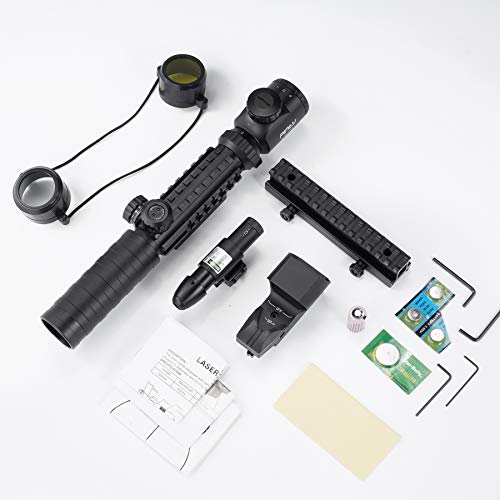
Package includes:
8x 3-9x32EG Illuminated Rangefinder Rifle Scope
8x 4 Reticle Red&Green Reflex Sight
8x Green Dot Laser Sight
8x 1″ high riser
3x Allen Wrenchs
8x Lens Cover
8x Cleaning Cloth
8x CR2032 Battery for Scope
24x AG13 Batteries for Reflex Sight
8x 3V CR2 Lithium Batteries for Laser
24x General Manuals
Rifle Scope Product Features
4 in 1, comes with a rangefinder riflescope, a green laser sight and a red/green dot sight everything you will ever need.
Magnifications from 3X up to 9X, green/red illuminations with 5 brightness adjustments for both the riflescope and electronic unlimited brightness control for the dot sight, 4 reticle patterns also available for the red/green dot sight.
Red/green dot reflex sight with bottom switch – highly accurate optic and substitute for overpriced holographic clear, high resolution image unlimited eye relief and wide field of view.
Picatinny mount easily mountable to any 22mm rails; Multi-coated optics with O-ring sealing and nitrogen filling ensures 100% water and fog-proof.
Unsurpassed light transmission, uncompromising mechanical performance and clarity.
About the Pinty Company
Pinty is a premium supplier for long gun scopes, optics, mounting solutions, and other add-ons used for guns like rifles and long guns. They design and supply their mounts, scopes, and related products by applying elements which are resilient and long lasting. This includes the Pinty 3-9×32 Rifle Scope Rangefinder Illuminated Reflex Sight 4 Reticle Green Dot Laser Sight, 8 Packs by Pinty. For more shooting products, visit their site.
Optic Info
Rifle scopes allow you to precisely aim a rifle at various targets by aligning your eye with the target over a distance. They do this through magnification by utilizing a series of lenses inside the scope. The scope’s positioning can be adapted to take into account varied ecological aspects like wind speed and elevation to account for bullet drop.
The scope’s purpose is to help the shooter understand precisely where the bullet will land based upon the sight picture you are viewing via the optic as you line up the scope’s crosshair or reticle with the intended point of impact. Many contemporary rifle scopes have about eleven parts which are found within and externally on the scope. These scope parts include the rifle scope’s body, lenses, elevation turrets or dials, focus rings, and other parts. See all eleven parts of scopes.
The Styles of Rifle Scopes
Rifle scopes can be either “first focal plane” or “second focal plane” type of scopes. Deciding on the optimal type of rifle optic is based on what type of shooting you plan to do.
First Focal Plane Glass
Focal plane scopes (FFP) feature the reticle in front of the magnification lens. This induces the reticle to increase in size based upon the extent of magnification being used. The outcome is that the reticle measurements are the same at the amplified distance as they are at the non magnified distance. One tick on a mil-dot reticle at one hundred yards without “zoom” is still the very same tick at 100 yards with 5x “zoom”. These kinds of scopes are useful for:
- Quick acquisition, long distance kinds of shooting
- Shooting circumstances where calculations are small
- Experienced shooters who understand their target “hold over” plus “lead” correlations for their long guns
- Shooters who do not mind the reticle is enlarged and occupies more visual sight room than a SFP reticle
Info About Second Focal Plane Glass
Second focal plane scopes (SFP) include the reticle behind the zoom lens. This causes the reticle to remain at the same size in relation to the level of magnification being used. The outcome is that the reticle dimensions adapt based upon the zoom employed to shoot over lengthier distances considering that the markings present different increments which differ with the zoom level. In the FFP example with the SFP scope, the 5x “zoom” 100 yard tick reticle measurement would be 1/5th of the non “zoom” tick reticle measurement. These particular sorts of optics work for:
- Long distance forms of shooting where shooters have more time to make ballistic calculations
- Shooting where most of the shots occur within much shorter proximities and ranges
- Shooters who choose a clearer optic sight picture without area used up by the enlarged FFP reticle
Ins and Outs of Rifle Scope Zoom
The quantity of zoom a scope supplies is figured out by the diameter, density, and curvatures of the lenses inside of the rifle scope. The zoom of the scope is the “power” of the scope.
Info About Fixed Power Lens Rifle Optics
A single power rifle scope or optic comes with a zoom number designator like 4×32. This implies the zoom power of the scope is 4x power and the objective lens is 32mm. The magnification of this type of optic can not adjust given that it is fixed.
Info About Variable Power Lens Rifle Scopes
Variable power rifle scopes have adjustable power. These types of scopes will note the zoom amount in a configuration like 2-10×32. These numbers imply the magnification of the scope can be adjusted between 2x and 10x power. This also utilizes the powers in-between 2 and 10. The power manipulation is accomplished utilizing the power ring component of the scope near the back of the scope by the eye bell.
The Power and Range of Rifle Glass
Here are some suggested scope power settings and the ranges where they can be efficiently used. High power optics will not be as useful as lower magnification level optics considering too much zoom can be a negative aspect depending on your shooting distance. The very same idea relates to extended distances where the shooter needs sufficient power to see where to best aim the rifle.
Lens Finish for Rifle Scopes
All top teir rifle optic lenses are layered. Lens coating can be a vital aspect of a shooting system when thinking about high end rifle optics and scope setups.
Info on Lens Coatings – HD Versus ED
Some scope makers also use “HD” or high-definition lens coverings which use different techniques, polarizations, chemicals, and elements to draw out various colors and viewable quality through the lens. Some scope makers use “HD” to refer to “ED” meaning extra-low dispersion glass.
Optic Lens Single Finish Versus Multi-Coating
Different optic lenses can also have various finishes applied to them. All lenses normally have at least some type of treatment or finish used to them before they are used in a rifle scope or optic.
This lens treatment can offer protection to the lens from scratches while lowering glare and other less beneficial things experienced in the shooting environment while sighting in with the scope. The quality of a single coated lens depends on the scope producer and how much you paid for it.
Some scope producers also make it a point to define if their optic lenses are covered or “multi” covered. Being “better” depends on the manufacturer’s lens treatment technology and the quality of products used in constructing the rifle scope.
Glass Lens Anti-water Finishing
Water on a lens doesn’t help with maintaining a clear sight picture through a scope at all. Lots of top of the line and military grade scope companies will coat their lenses with a hydrophobic or hydrophilic anti-water finish.
Options for Mounting Rifle Glass on Firearms
Mounting solutions for scopes come in a few options. There are the standard scope rings which are individually installed to the optic and one-piece scope mounts which cradle the scope. These different kinds of mounts also normally come in quick release variations which use toss levers which allow rifle operators to quickly mount and remove the optics.
Rifle Optic Mounting Solutions with Hex Key Rings
Standard, clamp style mounting optic rings use hex head screws to position to the flattop style Picatinny scope mounting rails on the tops of rifles. These varieties of scope mounts use two individual rings to support the scope, and are made from 7075 T6 billet aluminum or similar materials which are created for long distance precision shooting. This kind of scope mount is ideal for rifle systems which are in need of a long lasting, hard use mount which will not shift regardless of just how much the scope is moved or jarring the rifle takes. These are the type of mounts you should have for a specialized scope setup on a long distance scouting or competitors rifle which will pretty much never need to be modified or recalibrated. Blue 242 Loctite threadlocker can additionally be used on the mount screws to keep the hex screw threads from wiggling out after they are installed tightly in place. An example of these rings are the 30mm type from Vortex Optics. The set generally costs around $200 USD
Glass Mounting Solutions with Quick-Release Cantilever Rings
These types of quick-release rifle scope mounts can be used to rapidly connect and detach a scope from a rifle before reattaching it to a different rifle. Numerous scopes can even be swapped out if they all use a similar design mount. These types of mounts are convenient for rifles which are transported a lot, to swap out the optic from the rifle for protecting the scope, or for scopes which are used between several rifles or are situationally focused.
Sealing and Gas Purging for Rifle Glass Tubes
Moisture inside your rifle optic can mess up a day of shooting and your costly optic by triggering fogging and developing residue inside of the scope tube. Most scopes avoid wetness from going into the scope tube with a system of sealing O-rings which are water resistant.
Gas Purged Rifle Optic Tubes
Another element of avoiding the buildup of wetness inside of the rifle optic’s tube is filling the tube with a gas like nitrogen. Given that this space is already occupied by the gas, the scope is less affected by climate alterations and pressure variations from the outside environment which might possibly permit water vapor to leak in around the seals to fill the vacuum which would otherwise exist. These are good qualities of a good rifle scope to look for.


