




Description
Rifle Scope Product Details
Monstrum G2 1-6×24 First Focal Plane FFP Rifle Scope | ZR300 H-Series Offset Scope Mount | Bundle
Rifle Scope Product Features
About this item
High precision tactical rifle scope with 1-6x magnification, a 24mm objective lens, and an eye relief of 4-4.5 inches
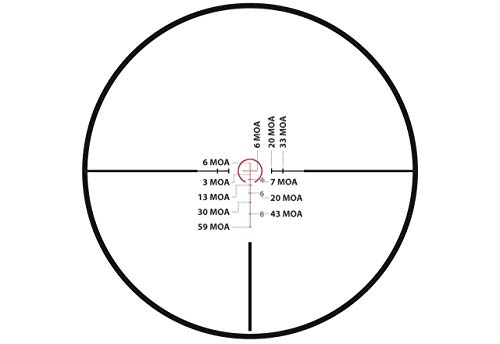
Functionally designed first focal plane rangefinder reticle, with easy-to-read ranging information that remains constant regardless of magnification, for faster range estimation and holdover correction
Dial controlled reticle illumination in both red and green with multiple brightness intensities, for better reticle visibility at night or in low light in environments
Package also includes a detachable honeycomb filter sunshade, a set of spring loaded flip-up lens covers, a lint free cleaning cloth, and one CR2032 3V battery
Product Bundle includes Monstrum H-Series One Piece Offset Scope Mount; comparable in weight to a pair of scope rings while maintaining the added rigidity and convenience of a one piece mount; Includes hardened steel Torx mounting hardware for mounting to any Picatinny rail platform.
Magnification: 1-6x
Objective Diameter: 24 mm
Length: 10.2 in
Weight: 1 lb 0 oz
Reticle: Illuminated BDC
Eye Relief: 4 – 4.5 in
Tube Diameter: 30 mm
Shock Water and Fog Proof Yes. Nitrogen Sealed.
Scope Range: Close-Mid Range. 400+ Yards
Color: Black or FDE
Included: FFPG21624-R Scope, Flip-Up Lens Covers, Heavy-Duty Scope Rings, CR2032 Battery, Honeycomb Shade, Manual
SKU: G2-FFPS1624-R
The G2 line of FFP Scopes are built to deliver premium high performance optics at the most affordable prices on the market. The G2-BFFPS1624-R includes a First Focal Plane reticle and an Adjustable Objective (AO) lens. Magnification range of 1-6x, capable of precision mid to long range target at distances of up to 400+ yards.
Included: Heavy-Duty High Profile Scope Rings, Spring-Loaded Flip-Up Lens Covers, CR2032 Battery, Honeycomb Shade, Manual
Scope Adjustments
This scope has a functionally designed first focal plane rangefinder reticle for faster range estimation and holdover correction. The etched black reticle is always visible without illumination or can be lit in red or green for better reticle visibility at night or low light environments. This scope has 1/2 MOA/click windage/elevation adjustments with the ability to reset the zero.
Adjustable objective (AO) lens – allows for a precise focus of the target image, elimination of parallax, and range estimation. Controlled by a side focus dial. Windage and Elevation dials are fast to adjust and the caps can be removed to reset the zero.
Illuminated Rangefinder Reticle
Functionally designed first focal plane rangefinder reticle for faster range estimation and holdover correction. The etched black reticle is always visible without illumination or can be lit red or green for better reticle visibility at night or low light environments. Full Multi-Layer lens coating reduces chromatic aberrations keeping the image sharp and focused. Included Honeycomb Sunshade further reduces glare.
1-4×24 FFP-G2 Scope 1-6×24 FFP-G2 Scope 1-4×24 FFP-G3 Scope 1-6×24 FFP-G3 Scope 1-4×24 FFP-GA Scope 1-6×24 FFP-GA Scope
Reticle BDC BDC BDC Custom Type-C Custom Type-C Custom Type-C
Magnification 1-4x 1-6x 1-4x 1-6x 1-4x 1-6x
Objective Diameter 24mm 24mm 24mm 24mm 24mm 24mm
Scope Range Short-Mid, 300+ Yards Short-Mid, 400+ Yards Short-Mid, 300+ Yards Short-Mid, 400+ Yards Short-Mid, 300+ Yards Short-Mid, 400+ Yards
Brass Internals
Anodization Type Standard Type-II Standard Type-II Standard Type-II MIL-STD 8625 Type-III Standard Type-II Standard Type-II
Heavy Duty Scope Rings Included
Flip-Up Lens Covers Included
Illuminated Reticle
Fully Multi-Layer Lens Coating
About the Monstrum Scope Maker
Monstrum is a premium manufacturer for weapon scopes, optics, mounting solutions, and other accessories used for firearms like rifles and long guns. They design and supply their products using materials which are resilient and long lasting. This includes the Monstrum G2 1-6×24 First Focal Plane FFP Rifle Scope | ZR300 H-Series Offset Scope Mount | Bundle by Monstrum. For additional shooting items, visit their website.
What You Need to Know About Scopes
Rifle scopes enable you to exactly align a rifle at various targets by lining up your eye with the target at range. They accomplish this through zoom by making use of a series of lenses inside the scope. The scope’s positioning can be adjusted to take into account various environmental considerations like wind and elevation increases to account for bullet drop.
The scope’s purpose is to help the shooter understand precisely where the bullet will hit based on the sight picture you are seeing using the optic as you align the scope’s crosshair or reticle with the target. Many contemporary rifle scopes and optics have around eleven parts which are found within and externally on the optic. These optic pieces consist of the rifle scope’s body, lenses, elevation turrets, focus rings, and other elements. See all eleven parts of scopes.
Rifle Scope Varieties
Rifle scopes can be either “first focal plane” or “second focal plane” type of optics. Opting for the best type of rifle scope is based around what type of shooting you plan on doing.
About First Focal Plane Scopes
First focal plane optics (FFP) include the reticle in front of the zoom lens. This triggers the reticle to increase in size based upon the level of zoom being used. The benefit is that the reticle measurements are the same at the magnified range as they are at the non magnified range. For example, one tick on a mil-dot reticle at one hundred yards without any “zoom” is still the same tick at 100 yards with 5x “zoom”. These kinds of scopes work for:
- Quick acquisition, long distance kinds of shooting
- Shooting circumstances where estimations are very little
- Experienced shooters who recognize their target “hold over” and also “lead” correlations for their firearms
- Shooters who don’t mind the reticle is enlarged and requires more visual eyesight area than a SFP reticle
Info About Second Focal Plane Optics
Second focal plane optics (SFP) feature the reticle behind the magnification lens. In the FFP example with the SFP scope, the 5x “zoom” one hundred yard tick would be 1/5th of the non “zoom” tick reticle measurement.
- Far away styles of shooting where shooters have more time to make ballistic computations
- Shooting where most of the shots happen within much shorter distances and ranges
- Shooters who prefer a clearer optic sight picture with less room used up by the larger sized FFP reticle
Rifle Scope Magnification
The amount of magnification a scope offers is figured out by the size, thickness, and curvatures of the lenses inside of the rifle scope. The magnification of the scope is the “power” of the scope.
Fixed Single Power Lens Rifle Glass Facts
A single power rifle scope or optic will have a magnification number designator like 4×32. This implies the magnification power of the scope is 4x power while the objective lens is 32mm. The magnification of this type of optic can not adjust since it is a set power scope.
Variable Power Lens Glass Details
Variable power rifle scopes have adjustable power. It will list the magnification level in a configuration like 2-10×32. These numbers indicate the zoom of the scope can be changed in between 2x and 10x power. This always includes the power levels in-between 2 and 10. The power adaptation is achieved by operating the power ring component of the scope near the rear of the scope by the eye bell.
Power Levels and Range Correlations
Here are some advised scope powers and the distances where they may be efficiently used. Bear in mind that higher power scopes will not be as efficient as lower powered glass since excessive magnification can be a negative thing in certain situations. The exact same concept applies to longer ranges where the shooter needs to have enough power to see precisely where to best aim the rifle at the target.
Details on Lens Coverings
All contemporary rifle scope lenses are layered. There are various types and qualities of lens coatings. When looking at high end rifle optical systems, Lens covering can be an essential aspect of defining the capability of the rifle. The lenses are among the most crucial components of the scope considering that they are what your eye sees through while sighting a rifle in on the point of impact. The finish on the lenses offers protection to the lens exterior as well as helps with anti glare from excess sunrays and color profiles.
Details on Rifle Glass Lens Coatings – HD Versus ED
Some scope makers likewise use “HD” or high-definition lens finishes which use various procedures, chemicals, polarizations, and elements to draw out different colors and viewable quality through the lens. Some scope makers use “HD” to refer to “ED” to signify the lens has extra-low dispersion glass.
Optic Lens Single Finish Versus Multi-Coating
Various optic lenses can likewise have different coatings applied to them. All lenses generally have at least some type of treatment or finish used to them prior to being used in a rifle scope or optic.
Single coated lenses have a treatment applied to them which is usually a protective and improving multi-purpose treatment. This lens treatment can safeguard the lens from scratches while reducing glare and other less beneficial things experienced in the shooting environment while sighting in with the optic. The quality of a single covered lens depends on the scope developer and the amount you spent paying for it. Both the make and cost are signs of the lens quality.
Some scope producers also make it a point to specify if their optic lenses are layered or “multi” covered. This indicates the lens has multiple treatments applied to them. If a lens receives several treatments, it can prove that a manufacturer is taking multiple steps to combat different natural elements like an anti-glare finishing, a scratch resistant anti-abrasion finishing, followed by a hydrophilic finishing. This also does not necessarily indicate the multi-coated lens will perform better than a single covered lens. Being “much better” hinges on the producer’s lens treatment solutions and the quality of products used in constructing the rifle glass.
Hydrophobic Covering for Glass
Water on a lens doesn’t help with preserving a clear sight picture through a scope at all. Numerous top of the line and high-end scope companies will coat their lenses with a hydrophilic or hydrophobic coating.
Alternatives for Installing Rifle Glass on Firearms
Mounting solutions for scopes are available in a few choices. There are the standard scope rings which are separately mounted to the optic and one-piece mounts which cradle the scope. These various types of mounts also typically are made in quick release variations which use throw levers which permit rifle shooters to rapidly install and remove the optics.
Scope Mounting Solutions with Hex Key Rings
Basic, clamp-on type mounting scope rings use hex head screws to position to the flattop style Picatinny scope mount rails on rifles. These forms of scope mounts use a pair of independent rings to support the optic, and are normally constructed from 7075 T6 billet aluminum which are developed for far away accuracy shooting. This type of scope mount is effective for rifle systems which need to have a long lasting, rock solid mount which will not change no matter how much the scope is moved or abuse the rifle takes. These are the style of mounts you want for a specialized scope setup on a far away scouting or competition rifle which will rarely need to be changed or recalibrated. Blue 242 Loctite threadlocker can additionally be used on the scope mount’s screws to stop the hex screw threads from wiggling out after they are mounted tightly in place. An example of these rings are the 30mm style made by the Vortex Optics company. The set normally costs around $200 USD
Quick-Release Cantilever Rifle Glass Ring Mounts
These types of quick-release rifle scope mounts can be used to quickly attach and detach a scope from a rifle before reattaching it to a different rifle. Several scopes can also be swapped out if they all use a similar style mount. These types of mounts come in handy for rifle platforms which are transferred a lot, to remove the optic from the rifle for protecting the scope, or for scopes which are used between several rifles.
Sealing and Gas Purging for Glass Tubes
Wetness inside your rifle scope can ruin a day of shooting and your costly optic by resulting in fogging and developing residue inside of the scope tube. A lot of optics prevent wetness from going into the scope tube with a system of sealing O-rings which are water resistant. Typically, these scopes can be immersed under 20 or 30 feet of water before the water pressure can force moisture past the O-rings. This should be sufficient wetness avoidance for basic use rifles for hunting and sporting purposes, unless you intend on taking your rifle aboard watercrafts and are worried about the scope still functioning if it goes over the side and you can still recover the rifle.
Gas Purged Rifle Scope Tubes
Another element of avoiding the accumulation of wetness inside of the rifle optic tube is filling the tube with a gas like nitrogen. Because this area is currently taken up by the gas, the optic is less impacted by condition shifts and pressure distinctions from the outdoor environment which might potentially permit water vapor to seep in around the seals to fill the void which would otherwise exist. These are good qualities of a good rifle scope to seek out.


