



Description
Rifle Scope Product Details
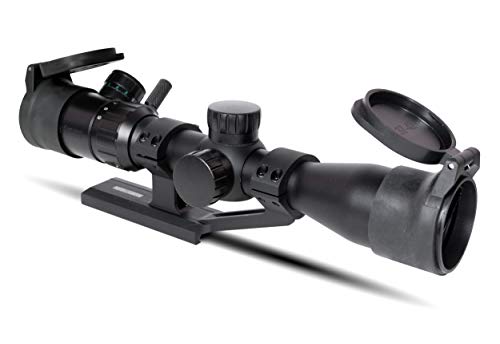
Monstrum 3-9×32 Rifle Scope with Rangefinder Reticle | ZR255 H-Series Offset Scope Mount | Monstrum Flip Up Lens Cover Set | Bundle
Rifle Scope Product Features
About this item
Tactical rifle scope providing crystal clear targeting at 3-9x magnification, with a 32mm objective diameter and an eye relief of 3.5-3.8 Inches
Glass rangefinder reticle for on-the-fly range estimation and long distance targeting
Dial controlled reticle illumination in both red and green with multiple brightness intensities
Product Bundle includes Monstrum H-Series One Piece Offset Scope Mount; comparable in weight to a pair of scope rings while maintaining the added rigidity and convenience of a one piece mount; Includes hardened steel Torx mounting hardware for mounting to any Picatinny rail platform.
Product bundle includes a matching set of Monstrum Rubberized Flip Up Lens Covers. Spring loaded flip-up lens covers that rubberized sleeves that conform neatly around your rifle scope tube, protecting your expensive optics from dust and abrasion
The Monstrum Tactical S3932-R-RG is a high performance tactical scope, providing crystal clear optics at 3 to 9 times magnification for close to mid range shooting.
Comes with a detachable throw lever for quick magnification adjustment.
It comes equipped with an illuminated Rangefinder reticle which can be viewed in red or green illumination and in multiple brightness intensities, or viewed in black without illumination, for a suitable sight picture regardless of lighting or environment.
Multi-layer lens coating, protects your scope lens from scratches, and fog, while improving the clarity of your vision.
All Monstrum scopes tubes are nitrogen filled for resistance to water and fog.
Includes: 3-9×32 Scope, Detachable Throw Lever, Standard Scope Rings, CR1632A Battery, Lens Cloth, Lens Cover
Reticle: Illuminated Range Finder
Materials: 6061 Aircraft Grade Aluminum
Compatibility: Rifles with Picatinny or Weaver Rails
Scope Range: Close to Mid Range, 300+ Yards
Magnification: 3-9x
Objective Diameter: 32 mm
Tube Size: 1 in
Eye Relief: 3.5-3.8 in
Weight: 13 oz
High Quality Construction
Crafted from aircraft grade aluminum, the scope is both sturdy and lightweight, with a 1 in sealed tube. The scope is 9.6″ in length, 2″ in width, 2″ in height and 12 oz in weight. It comes with lens covers and one 3V CR1632 battery.
About the Monstrum Manufacturer
Monstrum is a premium manufacturer for rifle scopes, optics, mounting solutions, and other accessories used for guns like rifles and long guns. They style and build their products choosing elements which are durable and long lasting. This includes the Monstrum 3-9×32 Rifle Scope with Rangefinder Reticle | ZR255 H-Series Offset Scope Mount | Monstrum Flip Up Lens Cover Set | Bundle by Monstrum. For more shooting products, visit their website.
What You Need to Know About Glass
Rifle scopes allow you to specifically aim a rifle at various targets by aligning your eye with the target over a distance. They accomplish this through magnifying the target by using a series of lenses within the scope. The scope’s alignment can be dialed in to account for numerous natural things like wind speed and elevation increases to make up for bullet drop.
The scope’s purpose is to help the shooter understand precisely where the bullet will land based on the sight picture you are viewing through the optic as you align the scope’s crosshair or reticle with the intended target. The majority of modern rifle optics have around eleven parts which are located within and outside of the scope body. These parts include the rifle scope’s body, lenses, windage and elevation dials, objective focus rings, and other elements. See all eleven parts of an optic.
About Rifle Optic Varieties
Rifle scopes can be either “first focal plane” or “second focal plane” kind of scopes. The sort of focal plane an optic has identifies where the reticle or crosshair lies in relation to the optic’s magnification. It actually suggests the reticle is situated behind or before the magnification lens of the scope. Choosing the most beneficial style of rifle scope is dependent on what variety of shooting or hunting you anticipate undertaking.
First Focal Plane Optic Details
First focal plane scopes (FFP) include the reticle in front of the zoom lens. This triggers the reticle to increase in size based upon the amount of zoom being used. The outcome is that the reticle measurements are the same at the magnified range as they are at the non magnified range. One tick on a mil-dot reticle at 100 yards without “zoom” is still the same tick at one hundred yards with 5x “zoom”. These kinds of scopes are practical for:
- Quick acquisition, long distance types of shooting
- Shooting circumstances where calculations are minor
- Experienced shooters who recognize their aim point “hold over” plus “lead” equations for their firearm
- Shooters who do not mind the reticle is enlarged and occupies more visual eyesight room than a SFP reticle
Info on Second Focal Plane Scopes
Second focal plane scopes (SFP) feature the reticle to the rear of the magnification lens. In the FFP example with the SFP scope, the 5x “zoom” one hundred yard tick reticle measurement would be 1/5th of the non “zoom” tick.
- Far away styles of shooting where shooters have extra time to make ballistic computations
- Shooting where most of the shots occur within much shorter proximities and ranges
- Shooters who prefer a clearer optic sight picture with less area used up by the bigger FFP reticle
Zoom for Rifle Optics
The quantity of zoom a scope provides is determined by the diameter, density, and curvatures of the lenses inside of the rifle scope. The zoom of the scope is the “power” of the scope.
Single Power Lens Rifle Scopes
A single power rifle optic and scope will have a magnification number designator like 4×32. This implies the zoom power of the scope is 4x power while the objective lens is 32mm. The zoom of this kind of scope can not adjust because it is a fixed power scope.
Variable Power Lens Scope Info
Variable power rifle scopes use enhanced power. The power adjustment is performed by the power ring part of the scope near the rear of the scope by the eye bell.
Power and Range
Here are some suggested scope power levels and the ranges where they can be efficiently used. Remember that high power scopes and optics will not be as practical as lower magnification level optics due to the fact that increased magnification can be a negative thing in certain situations. The same applies to longer distances where the shooter needs sufficient power to see exactly where to properly aim the rifle at the target.
Info on Rifle Optic Lens Coatings
All contemporary rifle optic and scope lenses are layered. There are various types and qualities of lens finishes. Lens coating can be a crucial aspect of a rifle’s setup when thinking about high-end rifle optics and scope units. The glass lenses are one of the most significant components of the glass due to the fact that they are what your eye sees through while sighting a rifle in on the target. The finishing on the lenses safeguards the lens exterior and also assists with anti glare from excess light and color visibility.
ED Versus HD Rifle Scopes
Some rifle scope manufacturers also use “HD” or high-definition glass finishes that employ different processes, polarizations, rare earth compounds, and aspects to draw out different color ranges and viewable definition through lenses. This high-def coating is commonly used with higher density glass which decreases light’s opportunity to refract by means of the lens glass. Some scope vendors use “HD” to refer to “ED” signifying extra-low dispersion glass. ED handles how colors are presented on the chromatic spectrum and the chromatic aberration or difference which is also called color distortion or fringing. Chromatic aberration may be visible around items with well defined shapes as light hits the item from specific angles.
Glass Lens Single Covering Versus Multi-Coating
Various scope lenses can even have various coatings applied to them. All lenses generally have at least some kind of treatment or coating applied to them before they are used in a rifle scope or optic assembly. This is since the lens isn’t simply a raw piece of glass. It is part of the carefully tuned optic. It must have a coating put on it so that the lens will be efficiently functional in many kinds of environments, degrees of sunshine (full light VS shade), and other shooting conditions.
This lens treatment can offer protection to the lens from scratches while reducing glare and other less beneficial things experienced in the shooting environment while sighting in with the scope. The quality of a single covered lens depends on the scope manufacturer and how much you paid for it.
Some scope makers also make it a point to specify if their optic lenses are covered or “multi” covered. Being “much better” depends on the manufacturer’s lens treatment technology and the quality of products used in constructing the rifle scope.
Hydrophobic Lens Finishing
Water on a lens does not assist with preserving a clear sight picture through a scope at all. Numerous top of the line and high-end optic makers will coat their lenses with a hydrophilic or hydrophobic anti-water finishing.
Choices for Installing Rifle Optics on Long Guns
Mounting approaches for scopes are available in a couple of options. There are the standard scope rings which are individually installed to the optic and one-piece scope mounts which cradle the scope. These different kinds of mounts also normally come in quick release variations which use toss levers which permit rifle shooters to rapidly mount and remove the optics.
Optic Mounts with Hex Key Rings
Standard, clamp style mounting scope rings use hex head screws to mount to the flattop design Picatinny scope mount rails on rifles. These types of scope mounts use a couple of different rings to support the optic, and are made from 7075 T6 billet aluminum which are developed for long distance precision shooting. This type of scope mount is excellent for rifles which require a resilient, sound mount which will not move no matter how much the scope is moved or abused.
Optic Mounts with Quick-Release Cantilever Rings
These types of quick-release rifle scope mounts can be used to rapidly connect and remove a scope from a rifle before reattaching it to a different rifle. Numerous scopes can even be switched out if they all use a compatible design mount. These types of mounts are handy for rifles which are transported a lot, to swap out the optic from the rifle for protection, or for scopes which are used in between several rifles or are situationally focused.
Optic Tube Sealing and Gas Purging
Moisture inside your rifle scope can wreck a day of shooting and your pricey optic by resulting in fogging and creating residue inside of the scope tube. A lot of optics prevent wetness from getting in the scope tube with a system of sealing O-rings which are water resistant. Usually, these water-resistant scopes can be submerged beneath 20 or 30 feet of water before the water pressure can push moisture past the O-rings. This should be ample humidity prevention for basic use rifles for hunting and sporting purposes, unless you plan on taking your rifle sailing and are worried about the scope still performing if it goes over the side and you can still retrieve the gun.
Gas Purged Rifle Scope Tubes
Another component of preventing the accumulation of wetness inside of the rifle optic tube is filling the tube with a gas like nitrogen. Considering that this space is already occupied by the gas, the optic is less altered by condition alterations and pressure differences from the outside environment which might potentially allow water vapor to permeate in around the seals to fill the vacuum which would otherwise be there. These are good qualities of a good rifle scope to look for.


