Description
Rifle Scope Product Details
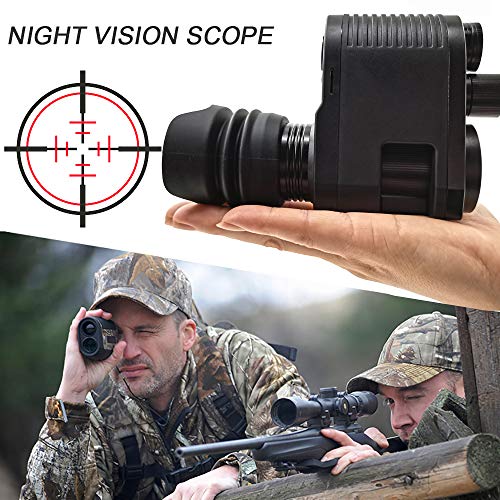
Infrared HD Night Vision Monocular Scope Video Record Hunting Optical Sight Camera 850nm Lase IR Riflescopes
Noted:If you are a hyperopic group,please contact our customer service to order another lens with focusing.
Packing List:
1* Video Record
1* 18650 Battery
1* Battery Charger
1* 32GB TF Card(Gift)
1* Card reader(Gift)
1* Focusing lens for hyperopic crowd(Optional)
LATEST UPDATE
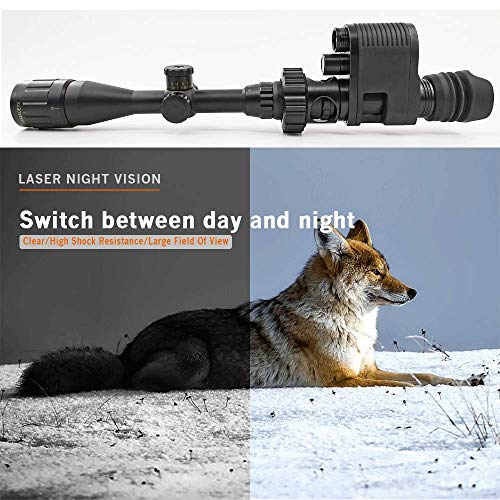
1. It is real digital 720P HD display,with video record and take photo function,Add more fun to your hunting activities.
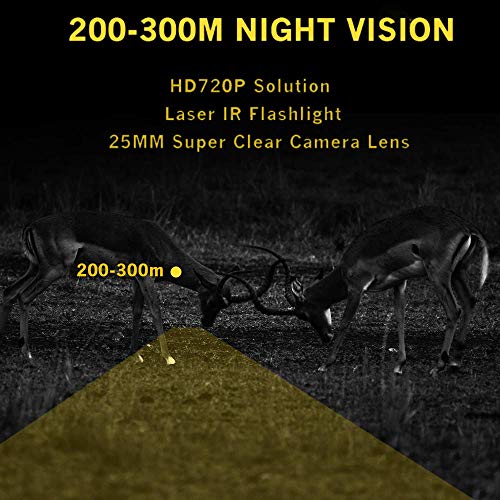
2. With Laser IR,200~300M view range in complete darkness.
3. Shockproof design,more durable.Just buy now! and experience the exciting hunting adventure with friends.
200-300M NIGHT VISION
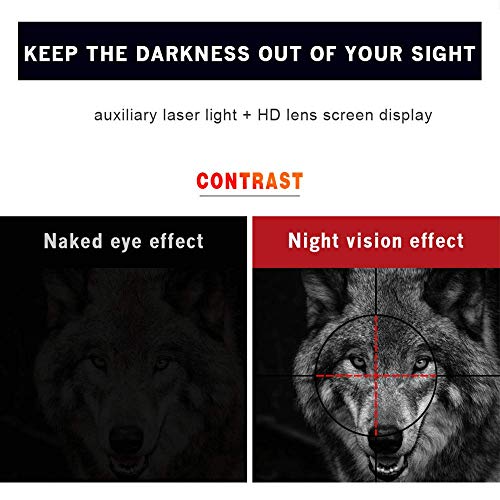
1. Ordinary infrared IR can only see about 100~150 meters,Our scope with laser IR and 25mm lens,can see 200-300 meters in complete darkness at night!
2. Most similar products use analog signal displays,which the effect like an old black and white TV. Our scope with high-solution 720P display,Say goodbye to the full-screen black and white snowflakes. You will not miss every wonderful moment of the hunting adventure.
ONE MINUTE INSTALLATION
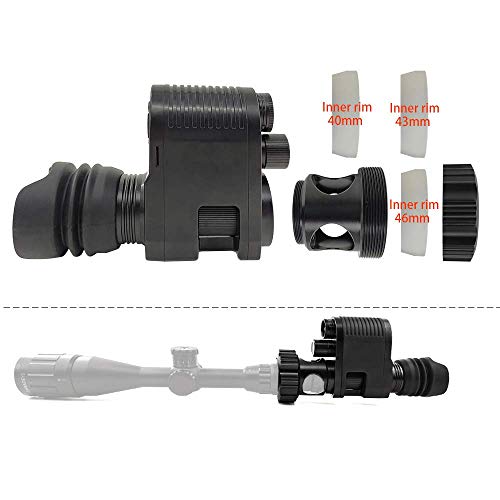
Our Night Vision Scope and Hunting Camera,with integrated design,you can quickly install in 1 minute.
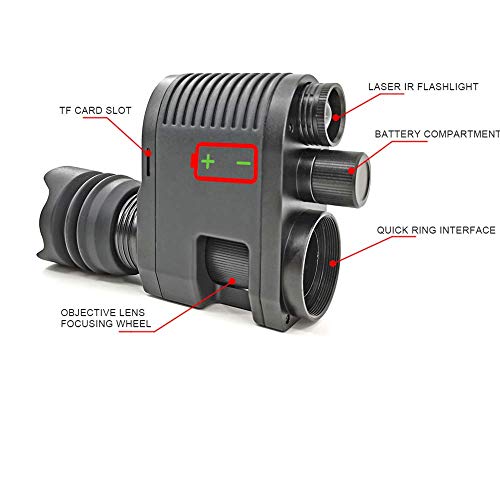
1. Put 1 pc of 18650 battery in battery compartment.
2. According to your rifle optic sight,select a suitable inner rim,then rotate the fixing ring to be fixed,then the installation is done.
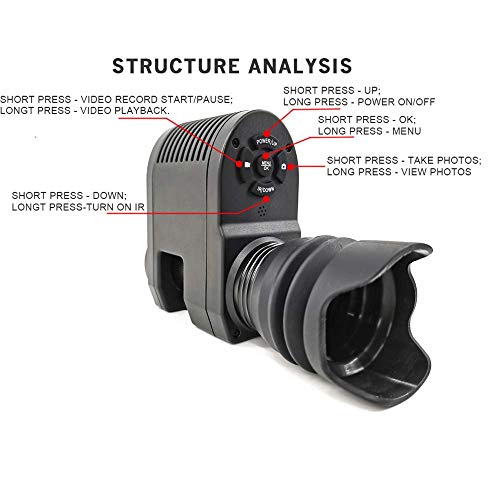
3. Turn on the device and rotate the lens of the camera to adjust the focus to get the sharp image.
Rifle Scope Product Features
Ordinary infrared IR can only see about 100~150 meters,this scope with laser IR and 25mm lens,can see 200-300 meters in complete darkness at night.
It is real digital 720P HD display,with video record and take photo function,Add more fun to your hunting activities.
Our Scope hunting camera with integrated design,you can quickly install in 1 minute.We provide multiple language options,included ENGLISH,GERMAN,RUSSIAN,SPANISH,FRENCH,PORTUGUESE,ITALIAN.
Taking HD photos and record videos with sound.Record your wonderful time of the hunting and share it with your friends.
Bestguarder service team provides professional 24-hour after-sales services on to promote you a hassle-free purchase experience.Please feel free to ask any questions and give us your valuable advice,thank you!
About the Melesplus Manufacturer
Melesplus is a premium maker for weapon scopes, optics, mounts, and other add-ons used for guns like rifles and long guns. They create and build their scopes and related products choosing elements which are durable and long lasting. This includes the Infrared HD Night Vision Monocular Scope Video Record Hunting Optical Sight Camera 850nm Lase IR Riflescopes by Melesplus. For additional shooting items, visit their website.
What You Need to Know About Optics
Rifle scopes enable you to precisely aim a rifle at different targets by lining up your eye with the target at range. They accomplish this through magnifying the target using a series of lenses within the scope. The scope’s alignment can be adjusted to account for separate natural considerations like wind speed and elevation decreases to account for bullet drop.
The scope’s purpose is to understand precisely where the bullet will land based upon the sight picture you are seeing through the scope as you line up the scope’s crosshair or reticle with the intended point of impact. Most modern-day rifle optics have around 11 parts which are located inside and on the exterior of the scope. These scope parts consist of the rifle scope’s body, lenses, modification turrets, focus rings, and other components. Learn about the eleven parts of rifle scopes.
Rifle Glass Types
Rifle scopes can be either “first focal plane” or “second focal plane” type of scopes. The type of focal plane a scope has establishes where the reticle or crosshair lies in connection with the scopes magnification. It actually indicates the reticle is located behind or in front of the magnification lens of the scope. Deciding upon the most reliable type of rifle glass is dependent on what form of shooting or hunting you anticipate undertaking.
First Focal Plane Glass Info
First focal plane optics (FFP) include the reticle in front of the magnifying lens. This causes the reticle to increase in size based on the amount of zoom being used. The outcome is that the reticle measurements are the same at the magnified range as they are at the non magnified range. For example, one tick on a mil-dot reticle at 100 yards without having “zoom” is still the exact same tick at one hundred yards using 5x “zoom”. These kinds of scopes work for:
- Quick acquisition, far away kinds of shooting
- Shooting situations where computations are small
- Experienced shooters who know their target “hold over” as well as “lead” equations for their firearms
- Shooters who do not mind the reticle is bigger and occupies more visual eyesight space than a SFP reticle
About Second Focal Plane Glass
Second focal plane optics (SFP) come with the reticle behind the magnification lens. In the FFP example with the SFP scope, the 5x “zoom” 100 yard tick reticle measurement would be 1/5th of the non “zoom” tick measurement.
- Long distance styles of shooting where shooters have additional time to make ballistic computations
- Shooting where most of the shots take place within much shorter distances and ranges
- Shooters who want a clearer optic picture with less room used up by the enlarged FFP reticle
Ins and Outs of Scope Magnification
The amount of magnification a scope offers is determined by the diameter, density, and curvatures of the lenses inside of the rifle scope. The magnification of the scope is the “power” of the scope.
Single Power Lens Rifle Scopes
A single power rifle scope and optic uses a zoom number designator like 4×32. This indicates the magnification power of the scope is 4x power and the objective lens is 32mm. The magnification of this type of scope can not change since it is a fixed power optic.
Variable Power Lens Rifle Glass Details
Variable power rifle scopes can be changed between magnification power levels. These types of scopes will note the zoom amount in a configuration like 2-10×32. These numbers imply the magnification of the scope could be adjusted between 2x and 10x power. This also incorporates the power levels in-between 2 and 10. The power shift is accomplished by applying the power ring part of the scope near the back of the scope by the eye bell piece.
Scope Power Level and Range Correlation
Here are some suggested scope power levels and the ranges where they can be effectively used. Always remember that higher power scopes and optics will not be as effective as lower powered scopes due to the fact that increased zoom can be a bad thing. The same concept applies to extended distances where the shooter needs to have sufficient power to see precisely where to best aim the rifle.
Scope Lens Finish
All modern-day rifle glass lenses are coated. Lens finish is an important aspect of a shooting platform when looking into high end rifle optics and scope systems.
HD Versus ED Glass Lens Coatings
Some optic companies also use “HD” or high-definition lens coatings which make the most of various processes, polarizations, chemicals, and components to extract various colors and viewable definition through the lens. This HD coating is typically used with more costly high density lens glass which lowers light’s potential to refract by means of the lens glass. Some scope brands use “HD” to refer to “ED” implying extra-low dispersion glass. ED deals with how colors are represented on the chroma spectrum and the chromatic aberration which is similarly called color distortion or fringing. Chromatic aberration may be visible over objects with hard edges and shapes as light hits the object from certain angles.
Single Coating Versus Multi-Coating
Different optic lenses can also have different coverings applied to them. All lenses usually have at least some kind of treatment or covering applied to them prior to being used in a rifle scope or optic assembly. Due to the fact that the lens isn’t simply a raw piece of glass, they require performance enhancing coatings. It is part of the finely tuned optic. It requires a coating to be applied to it so that the lens will be efficiently functional in many types of environments, degrees of sunshine (full VS shaded), and other shooting conditions.
Single covered lenses have a treatment applied to them which is typically a protective and boosting multi-purpose treatment. This lens treatment can safeguard the lens from scratches while minimizing glare and other less advantageous things experienced in the shooting environment while sighting in with the scope. The quality of a single layered lens depends upon the scope maker and how much you spent for it. Both the manufacturer and amount are indications of the lens quality.
Some scope producers similarly make it a point to specify if their optic lenses are coated or “multi” coated. Being “better” depends on the producer’s lens treatment innovation and the quality of materials used in building the rifle scope.
Hydrophobic Lens Coverings
Water on a lens does not assist with preserving a clear sight picture through a scope at all. Numerous top of the line and military grade optic companies will coat their lenses with a hydrophilic or hydrophobic finishing.
Options for Installing Scopes on Firearms
Installing options for scopes are available in a couple of choices. There are the basic scope rings which are separately installed to the optic and one-piece mounts which cradle the scope. These various kinds of mounts also usually are made in quick release versions which use toss levers which enable rifle shooters to quickly install and dismount the scope.
Scope Mounts with Hex Key Rings
Basic, clamp style mounting optic rings use hex head screws to fix to the flattop style Picatinny scope mount rails on rifles. These varieties of scope mounts use two separate rings to support the optic, and are usually constructed from 7075 T6 billet aluminum which are created for far away accuracy shooting. This form of scope mount is good for rifle systems which require a durable, hard use mount which will not move no matter just how much the scope is moved about or abuse the rifle takes. These are the type of mounts you should get for a devoted scope system on a long distance scouting or sniper competition firearm that will rarely need to be modified or adjusted. Blue 242 Loctite threadlocker can additionally be used on screws to stop the hex screws from backing out after they are installed tightly in position. An example of these mounting rings are the 30mm style from Vortex Optics. The set usually costs around $200 USD
Quick-Release Cantilever Rifle Optic Ring Mounting Solutions
These types of quick-release rifle scope mounts can be used to quickly remove a scope and connect it to a different rifle. Numerous scopes can even be swapped out if they all use a similar design mount. These types of mounts come in handy for rifles which are transferred a lot, to remove the optic from the rifle for protection, or for scopes which are used between several rifles or are situationally focused.
Rifle Optic Tube Sealing and Gas Purging
Wetness inside your rifle optic can ruin a day of shooting and your pricey optic by triggering fogging and developing residue inside of the scope tube. A lot of scopes prevent moisture from entering the scope tube with a system of sealing O-rings which are water resistant.
Glass Gas Purging
Another part of preventing the buildup of moisture within the rifle optic’s tube is filling the tube with a gas like nitrogen. Given that this space is currently occupied by the gas, the optic is less influenced by climate alterations and pressure differences from the outside environment which might possibly enable water vapor to seep in around the seals to fill the vacuum which would otherwise be there. These are good qualities of a decent rifle scope to look for.


