

Description
Rifle Scope Product Details
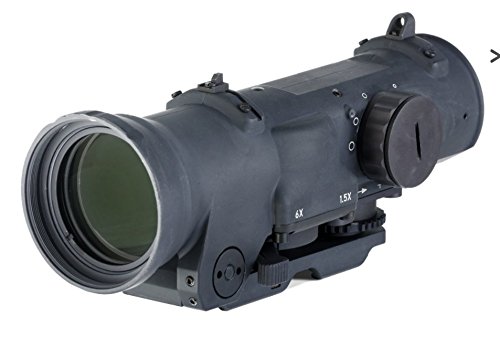
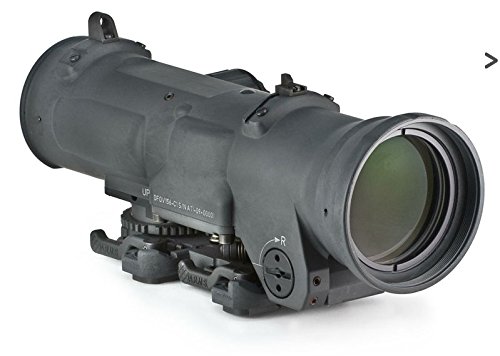
Elcan Specter Dual Role 1.5x/6x Optical Sight CX5455 Illuminated Crosshair Reticle DFOV156-C1
Magnification – 6x / 1.5x
Length – 183mm nominal
Width – 75mm nominal
Height – 73mm nominal
Weight – 705g nominal
Reticle – Dual-thickness ballistic crosshair with user-selectable red dot and VSOR rangefinder
Aiming Dot diameter – 1.5 MoA @ 6x, 6 MoA @ 1.5x
Ballistic correction:
DFOV156-C1: – CX5455 reticle: 100-1000m for 5.56 NATO
CQB offset – <44mm @ 60m
Field of View - 16 deg @ 1.5x, 4 deg @ 6x
FoV @ 6x - 7 m @ 100 m (21 ft @ 100 yds)
FoV @ 1.5x - 28.7 m @ 100 m (86 ft @ 100 yds)
Illumination source - Battery-powered LED
Crosshair illumination - 5 settings, AN/PVS-22 night vision compatible
Red Dot illumination - 5 settings, AN/PVS-22 night vision compatible
Eye Relief - 70 mm
Entrance pupil - 42mm
Exit pupil - 7mm
Nominal focus - 300m @ 6x, 105m @ 1.5x
Fixed focus range - 20m to infinity
Battery type - DL 1/3N (3v Lithium)
Battery life - 600 hours minimum, 3000 hours average
Exterior finish - Hard-anodized aluminum, gray/black color
Adjustment resolution - 0.5 minute of angle
Adjustment range - 120 minutes of angle
Base requirement - Mil-Std-1913 Picatinny Rail (Weaver compatible)
Attachment - ARMS Levers
Waterproof: - 66 ft for 2 hours
Shockproof: - 450 gs
Available accessory - ARD (Anti-Reflection Device)
Rifle Scope Product Features
*ITAR CONTROLLED ITEM, CANNOT BE EXPORTED FROM UNITED STATES*
About the Elcan Scope Maker
Elcan is a premium manufacturer for rifle scopes, optics, mounting solutions, and other accessories used for firearms like rifles and long guns. They design and supply their scopes, mounts, and related products making the most of building materials which are long lasting and durable. This includes the Elcan Specter Dual Role 1.5x/6x Optical Sight CX5455 Illuminated Crosshair Reticle DFOV156-C1 by Elcan. For additional shooting items, visit their site.
What You Need to Know About Rifle Optics
Rifle scopes enable you to exactly align a rifle at various targets by lining up your eye with the target at range. They do this through magnification by using a series of lenses inside the scope. The scope’s alignment can be adjusted for the consideration of many ecological factors like wind speed and elevation increases to make up for bullet drop.
The scope’s purpose is to understand exactly where the bullet will land based upon the sight picture you are viewing through the optic as you align the scope’s crosshair or reticle with the target. Many contemporary rifle optics have around eleven parts which are found internally and on the exterior of the scope body. These parts include the rifle scope’s body, lenses, adjustment turrets or dials, focus rings, and other components. Learn about the eleven parts of optics.
About Optic Types
Rifle scopes can be either “first focal plane” or “second focal plane” style of scopes. The kind of focal plane an optic has establishes where the reticle or crosshair lies relative to the optic’s zoom. It actually implies the reticle is situated behind or in front of the magnification lens of the scope. Selecting the most reliable kind of rifle scope is based upon what type of shooting or hunting you plan on doing.
First Focal Plane Glass Facts
Focal plane scopes (FFP) include the reticle in front of the magnification lens. These kinds of scopes are helpful for:
- Quick acquisition, long distance kinds of shooting
- Shooting circumstances where estimations are small
- Experienced shooters who understand their aim point “hold over” and also “lead” equations for their weapon
- Shooters who don’t mind the reticle is bigger and requires more visual sight space than a SFP reticle
Second Focal Plane Optics
Second focal plane optics (SFP) feature the reticle behind the magnification lens. This causes the reticle to remain at the very same overall size relative to the volume of magnification being used. The outcome is that the reticle dimensions adapt based on the zoom applied to shoot over greater ranges given that the reticle markings represent various increments which fluctuate with the magnification. In the FFP example with the SFP glass, the 5x “zoom” 100 yard tick measurement would be 1/5th of the non “zoom” tick reticle measurement. These sorts of optics are beneficial for:
- Long distance forms of shooting where shooters have additional time to make ballistic computations
- Shooting where most of the shots take place within shorter ranges and spaces
- Shooters who like a clearer optic sight picture without room taken up by the bigger FFP reticle
Zoom for Optics
The quantity of zoom a scope supplies is identified by the size, density, and curvatures of the lenses inside of the rifle scope. The zoom of the scope is the “power” of the scope.
Info About Fixed Power Lens Glass
A single power rifle optic uses a zoom number designator like 4×32. This indicates the magnification power of the scope is 4x power and the objective lens is 32mm. The magnification of this type of scope can not fluctuate given that it is a fixed power scope.
About Variable Power Lens Glass
Variable power rifle scopes can be modified between magnified settings. The power modification is performed by making use of the power ring part of the scope near the back of the scope by the eye bell.
Power Levels and Range Correlations
Here are some suggested scope power settings and the ranges where they may be successfully used. Always remember that higher power optics will not be as practical as lower powered glass due to the fact that excessive magnification can be a negative thing in certain situations. The same idea relates to longer ranges where the shooter needs to have increased power to see precisely where to properly aim the rifle.
Lens Finishing for Optics
All modern rifle scope lenses are layered. Lens finish can be an important element of a rifle when purchasing high end rifle optics and scope systems.
HD Versus ED Scope Lens Coatings
Some scope companies will also use “HD” or high-def glass coverings that employ various procedures, aspects, polarizations, and chemicals to extract numerous color ranges and viewable target definition through the lens. This high-definition finish is commonly used with more costly, high density lens glass which brings down light’s potential to refract through the lens glass. Some scope vendors use “HD” to refer to “ED” indicating extra-low dispersion glass. ED deals with how certain colors are represented on the chroma spectrum and the chromatic deviance or aberration which is similarly called color distortion or fringing. Chromatic aberration may be visible around objects with defined shapes as light hits the object from certain angles.
Single Finish Versus Multi-Coating
Different optic lenses can also have different coverings applied to them. All lenses normally have at least some type of treatment or finish applied to them before they are used in a rifle scope or optic.
Single coated lenses have a treatment applied to them which is normally a protective and enhancing multi-purpose treatment. This lens treatment can preserve the lens from scratches while decreasing glare and other less useful things experienced in the shooting environment while sighting in with the optic. The quality of a single coated lens depends on the scope producer and how much you spent on it. Both the manufacturer and amount are indicators of the lens quality.
Some scope makers similarly make it a point to specify if their optic lenses are coated or “multi” covered. Being “much better” depends on the maker’s lens treatment technology and the quality of products used in constructing the rifle scope.
Hydrophobic Lens Coating
Water on an optic’s lens does not improve retaining a clear sight picture through an optic whatsoever. Many top of the line and premium scope manufacturers will coat their lenses with a hydrophobic or hydrophilic coating. The Steiner Optics Nano-Protection is a fine example of this type of treatment. It provides protection for the exterior of the Steiner optic lens so the H2O molecules can not bind to it or develop surface tension. The result is that the water beads slide off of the scope to preserve a clear, water free sight picture.
Choices for Mounting Glass on Firearms
Mounting solutions for scopes are available in a few choices. There are the basic scope rings which are separately installed to the scope and one-piece mounts which cradle the scope. These different kinds of mounts also normally are made in quick release versions which use manual levers which enable rifle shooters to quickly mount and dismount the glass.
Hex Key Rifle Scope Ring Mounts
Standard, clamp-on design mounting scope rings use hex head screws to install to the flattop design Picatinny scope mounting rails on rifles. These varieties of scope mounts use two individual rings to support the optic, and are normally made from 7075 T6 billet aluminum or similar materials which are designed for far away accuracy shooting. This form of scope mount is ideal for rifles which are in need of a resilient, hard use mount which will not move no matter how much the scope is moved about or abuse the rifle takes. These are the type of mounts you want for a faithful scope setup on a far away hunting or competition firearm which will hardly ever need to be altered or recalibrated. Blue 242 Loctite threadlocker can also be used on the screws to stop the hex screw threads from backing out after they are mounted firmly in position. An example of these mounting rings are the 30mm style from Vortex Optics. The set usually costs around $200 USD
Quick-Release Cantilever Rifle Glass Ring Mounting Solutions
These kinds of quick-release rifle scope mounts can be used to rapidly remove a scope from a rifle and reattach it to a different rifle. If they all use a comparable style mount, a number of scopes can often be switched out in the field. The quick detach mount style is CNC crafted from anodized 6061 T6 aluminum and the mounting levers attach securely to a flat top style Picatinny rail. This enables the scope to be sighted in while on the rifle, removed from the rifle, and remounted back on the rifle while keeping the original sighting settings. These types of mounts are useful and handy for shooting platforms which are transferred between vehicles a lot, to remove the glass from the rifle for protection, or for sight systems which are adopted between several rifles. An example of this mount type is the 30mm mount designed by the Vortex Optics manufacturer. It typically costs around $250 USD
Rifle Optic Tube Sealing and Gas Purging
Moisture inside your rifle optic can spoil a day of shooting and your expensive optic by causing fogging and making residue inside of the scope tube. A lot of scopes protect against moisture from getting in the scope tube with a system of sealing O-rings which are water resistant. Generally, these water resistant optics can be immersed underneath 20 or 30 feet of water before the water pressure can force moisture past the O-rings. This should be plenty of moisture content avoidance for conventional use rifles for hunting and sporting purposes, unless you plan on taking your rifle aboard watercrafts and are concerned about the optic still working if it is submerged in water and you can still salvage the firearm.
Rifle Glass Gas Purging
Another part of preventing the buildup of moisture inside of the rifle optic’s tube is filling the tube with a gas like nitrogen. Because this space is currently occupied by the gas, the scope is less influenced by climate changes and pressure distinctions from the outside environment which may possibly enable water vapor to permeate in around the seals to fill the vacuum which would otherwise be there. These are good qualities of a good rifle scope to seek out.


