


Description
Rifle Scope Product Details
DJym High-Definition Night Vision Infrared Night Shooting Hunting Night Vision, Night Vision Monoculars (Sight Accessories)
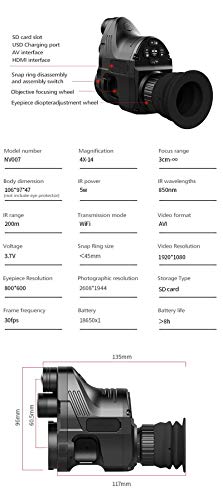
Magnification: 4X-14
Focus range: 3cm-
Dimensions: 106 * 97 * 47
Infrared Power: 5w
Infrared wavelength: 850nm
Transmission: WiFi
Recording Format: AVI
Voltage: 3.7V
Collar size: <45mm
Video resolution: 1920 * 1080
Eyepiece Resolution: 800 * 600
Camera resolution: 2608 * 1944
Storage type: SD card
Frame rate: 30fps
Battery: 18650x1
When using long:> 8h
Super Laser: Point indicates the specific location of the prey, to see the red dot to find convenient and practical
TCpick:
1. Welcome to purchase, we will send you the product as soon as possible, if you have any questions, we will reply within 24 hours, we wish you a happy shopping
2. If you are satisfied with our products, please leave your valuable feedback or product reviews, thank you for your support.
3. Our have more products are welcome
Rifle Scope Product Features
HIGH-STRENGTH EARTHQUAKE-RESISTANT: Earthquake-resistant 9000 joules, each factory undergoes strict seismic test
HIGH-DEFINITION LOW-ILLUMINANCE SENSOR: True black environment restoration, shooting video 1920X1080 FHD camera 2608x1944FHD
ALL-GLASS 8P TENS OF MILLIONS OF HIGH-DEFINITION LENSES: Optical glass lenses have high color reproduction, and the upgraded version has a wider viewing angle and clearer picture.
CONVENIENT AND EASY TO DISASSEMBLE: Black and white, no need to remove from the light sight during the day, can be used directly. Does not affect the accuracy (suitable for the outer diameter of the eyepiece 25-46mm)
THIRD GEAR FILL LIGHT: Adjustable invisible fill light, in the dark can adjust according to the needs of the light source without disturbing the prey, the lamp head has the stretching focus function, can strengthen the fill light intensity, enhance the night vision picture
About the DJym Manufacturer
DJym is a premium manufacturer for long gun scopes, optics, mounts, and other components used for firearms like rifles and long guns. They create and build their products using materials which are long lasting and durable. This includes the DJym High-Definition Night Vision Infrared Night Shooting Hunting Night Vision, Night Vision Monoculars (Sight Accessories) by DJym. For more shooting goods, visit their site.
What You Need to Know About Glass
Rifle scopes allow you to exactly align a rifle at various targets by lining up your eye with the target over a distance. They do this through magnification using a set of lenses within the scope. The scope’s positioning can be adjusted for consideration of numerous natural considerations like wind and elevation increases to account for bullet drop.
The scope’s function is to help shooters understand precisely where the bullet will land based upon the sight picture you are seeing through the optic as you align the scope’s crosshair or reticle with the intended target. A lot of contemporary rifle scopes have around eleven parts which are located within and on the exterior of the scope. These optic pieces include the rifle scope’s body, lenses, windage and elevation turrets, focus rings, and other parts. Learn about the eleven parts of scopes.
Rifle Scope Styles
Rifle scopes can be either “first focal plane” or “second focal plane” type of scopes. The sort of focal plane an optic has establishes where the reticle or crosshair lies relative to the optic’s zoom. It literally indicates the reticle is located behind or in front of the magnifying lens of the scope. Considering the most beneficial kind of rifle optic is based upon what form of shooting or hunting you anticipate undertaking.
About First Focal Plane Glass
First focal plane glass (FFP) come with the reticle before the magnifying lens. This induces the reticle to increase in size based upon the extent of magnification being used. The benefit is that the reticle measurements are the same at the amplified range as they are at the non magnified range. For instance, one tick on a mil-dot reticle at 100 yards without having “zoom” is still the exact same tick at 100 yards using 5x “zoom”. These kinds of scopes are practical for:
- Quick acquisition, long distance kinds of shooting
- Shooting circumstances where calculations are minimal
- Experienced shooters who know their target “hold over” plus “lead” equations for their rifles
- Shooters who do not mind the reticle is bigger and occupies more visual eyesight space than a SFP reticle
Info About Second Focal Plane Glass
Second focal plane optics (SFP) come with the reticle to the rear of the zoom lens. In the FFP example with the SFP scope, the 5x “zoom” one hundred yard tick reticle measurement would be 1/5th of the non “zoom” tick measurement.
- Long distance kinds of shooting where shooters have increased time to make ballistic computations
- Shooting where most shots happen within shorter spaces and ranges
- Shooters who like a clearer optic sight picture without room taken up by the enlarged FFP reticle
Details on Rifle Scope Magnification
The measure of scope magnification you need on your optic depends upon the kind of shooting you choose to do. Pretty much every kind of rifle scope provides some degree of magnification. The quantity of magnification a scope delivers is established by the dimension, density, and curves of the lens glass inside of the rifle scope. The magnification level of the optic is the “power” of the glass. This suggests what the shooter is looking at through the scope is magnified times the power element of what can typically be seen by human eyes.
Fixed Power Lens Scopes
A single power rifle scope or optic will have a zoom number designator like 4×32. This implies the zoom power of the scope is 4x power and the objective lens is 32mm. The magnification of this kind of scope can not adjust since it is a fixed power optic.
Variable Power Lens Optics
Variable power rifle scopes use variable power levels. The power change is achieved by making use of the power ring part of the scope near the back of the scope by the eye bell.
The Power Level and Range Correlation of Optics
Here are some recommended scope powers and the distances where they could be successfully used. High power scopes will not be as useful as lower magnification level scopes due to the fact that too much zoom can be a negative aspect depending on your shooting distance. The same idea applies to longer distances where the shooter needs sufficient power to see precisely where to best aim the rifle at the target.
Lens Covering for Optics
All cutting-edge rifle scope lenses are layered. Lens coating is a crucial aspect of a shooting platform when thinking about high end rifle optics and scope systems.
Info on Rifle Scope Lens Coatings – HD Versus ED
Some scope producers also use “HD” or high-definition lens finishes which use various methods, chemicals, polarizations, and aspects to draw out separate colors and viewable quality through the lens. Some scope producers use “HD” to refer to “ED” to signify the lens has extra-low dispersion glass.
Scope Lens Single Finish Versus Multi-Coating
Different optic lenses can likewise have different finishings used to them. All lenses typically have at least some type of treatment or finish applied to them before they are used in a rifle scope or optic.
Single layered lenses have a treatment applied to them which is normally a protective and enhancing multi-purpose treatment. This lens treatment can shield the lens from scratches while lowering glare and other less advantageous things experienced in the shooting environment while sighting in with the scope. The quality of a single layered lens depends upon the scope company and just how much you spent for it. Both the make and cost are indications of the lens quality.
Some scope makers also make it a point to specify if their optic lenses are covered or “multi” covered. Being “better” depends on the manufacturer’s lens treatment technology and the quality of materials used in building the rifle scope.
Anti-water Lens Coatings
Water on a lens doesn’t help with keeping a clear sight picture through a scope at all. Many top of the line and military grade optic makers will coat their lenses with a hydrophilic or hydrophobic anti-water finish.
Optic Mounting Options
Mounting options for scopes are available in a few options. There are the standard scope rings which are individually installed to the scope and one-piece scope mounts which cradle the scope. These different types of mounts also usually are made in quick release versions which use manual levers which allow rifle operators to rapidly install and dismount the scopes.
Optic Mounts with Hex Key Rings
Normal, clamp design mounting scope rings use hex head screws to mount to the flattop design Picatinny scope mount rails on rifles. These types of scope mounts use a couple of separate rings to support the optic, and are made from 7075 T6 billet aluminum which are designed for long distance accuracy shooting. This type of scope mount is fine for rifles which require a resilient, sound mounting solution which will not move no matter how much the scope is moved or abused.
Quick-Release Cantilever Rifle Scope Rings
These types of quick-release rifle scope mounts can be used to rapidly connect and take off a scope from a rifle. If they all use a comparable design mount, a number of scopes can also be swapped out in the field. The quick detach design is CNC machined from anodized 6061 T6 aluminum and the mounting levers connect securely to a flat top design Picatinny rail. This lets the scope to be sighted in while on the rifle, removed from the rifle, and remounted back on the rifle while maintaining accuracy. These kinds of mounts come in beneficial for shooting platforms which are hauled around a lot, to remove the glass from the rifle for protection, or for scopes which are utilized between numerous rifles. An example of this mount type is the 30mm mount from the Vortex Optics manufacturer. It typically costs around $250 USD
Details on Rifle Glass Tube Sealing and Gas Purging
Moisture inside your rifle scope can mess up a day of shooting and your costly optic by triggering fogging and producing residue inside of the scope tube. Most scopes prevent wetness from getting in the scope tube with a system of sealing O-rings which are waterproof.
Info Around Rifle Glass Tube Gas Purging
Another element of preventing the buildup of moisture inside of the rifle scope tube is filling the tube with a gas like nitrogen. Because this area is currently taken up by the gas, the scope is less impacted by temperature level alterations and pressure differences from the external environment which may potentially permit water vapor to permeate in around the seals to fill the void which would otherwise be there. These are good qualities of a good rifle scope to seek out.


