


Description
Rifle Scope Product Details
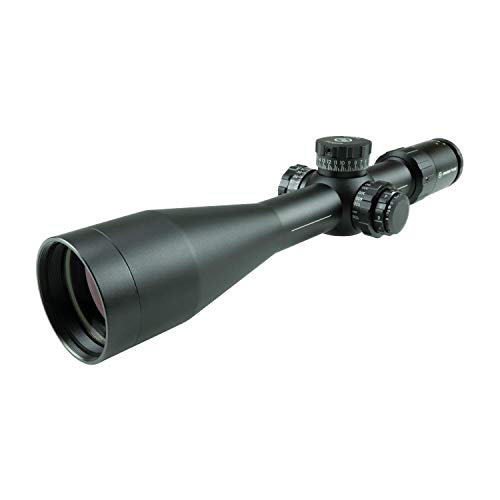
Crimson Trace Optics Sport Riflescope 6-24x56mm MOA/FFP with MR1-MOA with Illuminated Reticle, 2 Series CSA-2624
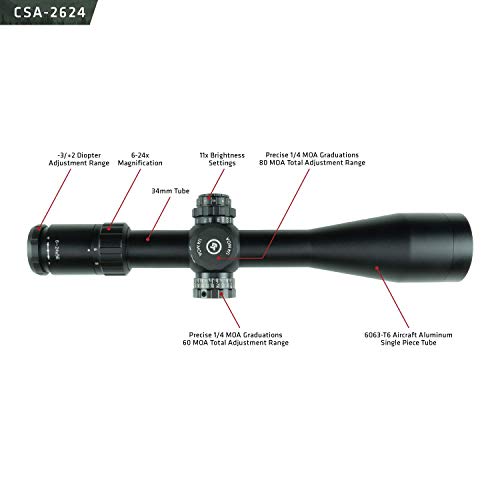
The CSA-2624 2 Series is a feature rich 6-24x56mm long-range rifle scope that has been purposefully built from the ground up. The scopes first Focal Plane (FFP) and impressive Japanese Ed glass clarity makes for an unparalleled shooting experience. The custom designed mr1-moa advanced reticle is fully illuminated and offers quick hold-over points for windage and elevation. The exposed . 25 MOA tactical turrets provide a precise and rugged feel when dialing for the most accurate of shots. The entire Crimson Trace scope line offers EZ mount leveling indicators for quick and exact mounting and rar tech (Red alignment ring) for proper eye placement. All Crimson Trace Scopes are covered under a Full Lifetime Warranty.
Rifle Scope Product Features
About this item
Power: the 6-24x56mm scope makes objects seem six to twenty-four times closer than with the naked Eye, featuring a 56mm objective lens
First focal plane (ffp): glass etched, mr1-moa advanced illuminated reticle sits in front of the magnification mechanism, scaling to provide correct Ballistic hold points at any range
Exposed turrets with mr1-moa advanced reticle:
Quality manufacturing: single piece 34mm anodized aluminum main tube is constructed to handle the most demanding environments
: Crimson Trace Lifetime protection and free batteries for life s a Lifetime of performance
GUARANTEED: All Crimson Trace Scopes are covered under a Full Lifetime Warranty. For questions or warranty contact us at support@crimsontrace.com
About the Crimson Trace Brand
Crimson Trace is a premium maker for weapon scopes, optics, mounting solutions, and other add-ons used for guns like rifles and long guns. They create and make their products working with building materials which are long lasting and durable. This includes the Crimson Trace Optics Sport Riflescope 6-24x56mm MOA/FFP with MR1-MOA with Illuminated Reticle, 2 Series CSA-2624 by Crimson Trace. For more shooting goods, visit their site.
Scope Details
Rifle scopes permit you to exactly align a rifle at various targets by lining up your eye with the target at range. They do this through magnifying the target by utilizing a series of lenses within the scope. The scope’s alignment can be dialed in to account for separate ecological factors like wind speed and elevation increases or decreases to account for bullet drop.
The scope’s function is to help shooters understand precisely where the bullet will land based on the sight picture you are viewing using the scope as you line up the scope’s crosshair or reticle with the target. Many modern rifle scopes and optics have about eleven parts which are arranged internally and outside of the scope body. These optic pieces include the rifle scope’s body, lenses, elevation dials or turrets, focus rings, and other components. Learn about the eleven parts of rifle glass.
The Varieties of Rifle Scopes
Rifle scopes can be either “first focal plane” or “second focal plane” style of scopes. The type of focal plane an optic has determines where the reticle or crosshair lies in relation to the optic’s zoom. It simply implies the reticle is situated behind or before the magnifying lens of the optic. Deciding on the most desired type of rifle scope is dependent on what sort of hunting or shooting you intend on doing.
About First Focal Plane Glass
Focal plane scopes (FFP) feature the reticle in front of the magnifying lens. This triggers the reticle to increase in size based upon the extent of zoom being used. The benefit is that the reticle measurements are the same at the amplified range as they are at the non amplified range. One tick on a mil-dot reticle at 100 yards without “zoom” is still the exact same tick at one hundred yards with 5x “zoom”. These kinds of scopes work for:
- Quick acquisition, far away kinds of shooting
- Shooting circumstances where estimations are small
- Experienced shooters who recognize their target “hold over” plus “lead” correlations for their firearm
- Shooters who do not mind the reticle is bigger and takes up more visual eyesight area than a SFP reticle
Second Focal Plane Glass Details
Second focal plane optics (SFP) feature the reticle behind the magnification lens. In the FFP example with the SFP scope, the 5x “zoom” one hundred yard tick reticle measurement would be 1/5th of the non “zoom” tick reticle measurement.
- Long distance forms of shooting where shooters have extra time to make ballistic estimations
- Shooting where most shots occur within much shorter spaces and ranges
- Shooters who select a clearer optic picture without room taken up by the bigger FFP reticle
Glass Zoom
The amount of magnification a scope provides is figured out by the diameter, density, and curvatures of the lenses inside of the rifle scope. The magnification of the scope is the “power” of the scope.
About Single Power Lens Rifle Glass
A single power rifle optic uses a magnification number designator like 4×32. This suggests the zoom power of the scope is 4x power and the objective lens is 32mm. The zoom of this kind of optic can not adjust because it is a fixed power scope.
Variable Power Lens Rifle Optics
Variable power rifle scopes have adjustable power. It will list the magnification amount in a format such as 2-10×32. These numbers imply the zoom of the scope can be changed in between 2x and 10x power. This also utilizes the powers in-between 2 and 10. The power modification is accomplished utilizing the power ring part of the scope near the back of the scope by the eye bell piece.
Power and Range Correlations
Here are some recommended scope power levels and the distances where they could be successfully used. High power glass will not be as useful as lower powered optics given that too much magnification can be a negative aspect depending on your shooting distance. The exact same concept relates to longer ranges where the shooter needs sufficient power to see precisely where to properly aim the rifle at the target.
Info on Lens Coatings
All contemporary rifle scope lenses are covered in special coatings. There are different types and qualities of glass lens finishings. Lens coating can be an essential aspect of a rifle when considering high-end rifle optics and targeting equipment. The lenses are among the most vital pieces of the scope given that they are what your eye looks through while sighting a rifle in on the target. The coating on the lenses protects the lens surface area and also improves anti glare capabilities from excess sunshine and color discernibility.
ED Versus HD Scopes
Some glass makers even use “HD” or high-def lense coverings that apply various processes, chemicals, components, and polarizations to draw out various color ranges and viewable target visibility through the lens. This high-def finish is commonly used with more costly high density lens glass which reduces light’s potential to refract through the lens glass. Some scope producers use “HD” to describe “ED” implying extra-low dispersion glass. ED handles how certain colors are represented on the chroma spectrum and the chromatic difference or aberration which is also called color distortion or fringing. Chromatic aberration is often visible around things with hard edges and shapes as light hits the item from specific angles.
Single Rifle Optic Lens Coating Versus Multi-Coating
Different optic lenses can likewise have various coatings applied to them. All lenses normally have at least some type of treatment or finishing applied to them before they are used in a rifle scope or optic.
Single coated lenses have a treatment applied to them which is usually a protective and improving multi-purpose treatment. This lens treatment can preserve the lens from scratches while reducing glare and other less helpful things experienced in the shooting environment while sighting in with the optic. The quality of a single coated lens depends on the scope designer and the amount you spent for it. Both the manufacturer and amount are indicators of the lens quality.
Some scope makers similarly make it a point to define if their optic lenses are coated or “multi” covered. Being “much better” depends on the producer’s lens treatment innovation and the quality of materials used in constructing the rifle scope.
Details on Hydrophobic Covering
Water on a scope’s lens doesn’t support preserving a clear sight picture through a scope whatsoever. Numerous top of the line and high-end scope producers will coat their lenses with a hydrophobic or hydrophilic coating. The Steiner Optics Nano-Protection is a fine example of this kind of treatment. It treats the surface of the Steiner glass lens so the water molecules can not bind to it or create surface tension. The result is that the water beads slide off of the scope to preserve a clear, water free sight picture.
Choices for Installing Rifle Scopes on Long Guns
Mounting options for scopes can be found in a few choices. There are the basic scope rings which are separately mounted to the scope and one-piece scope mounts which cradle the scope. These different types of mounts also usually come in quick release variations which use toss levers which enable rifle operators to rapidly install and remove the optics.
Hex Key Scope Rings
Basic, clamp design mounting optic rings use hex head screws to fix to the flattop style Picatinny scope mount rails on rifles. These varieties of scope mounts use two detached rings to support the optic, and are normally made from 7075 T6 billet aluminum which are designed for long distance accuracy shooting. This form of scope mount is very good for rifle systems which are in need of a resilient, unfailing mount which will not change despite just how much the scope is moved about or abuse the rifle takes. These are the type of mounts you should get for a specialized scope system on a far away scouting or interdiction rifle which will hardly ever need to be altered or adjusted. Blue 242 Loctite threadlocker can also be used on the scope mount screws to keep the hex screws from backing out after they are mounted firmly in place. An example of these mounting rings are the 30mm style from the Vortex Optics brand. The set usually costs around $200 USD
Quick-Release Cantilever Optic Ring Mounts
These kinds of quick-release rifle scope mounts can be used to rapidly take off a scope from a rifle and reattach it to a different rifle. If they all use a comparable design mount, a number of scopes can also be swapped in the field. The quick detach mount style is CNC crafted from anodized 6061 T6 aluminum and the mounting levers fasten firmly to a flat top type Picatinny rail. This allows the scope to be sighted in while on the rifle, removed from the rifle, and remounted while retaining precision. These kinds of mounts come in convenient for shooting platforms which are shipped a lot, to remove the glass from the rifle for protection, or for optics which are employed between a number of rifles. An example of this mount style is the 30mm mount from Vortex Optics. It normally costs around $250 USD
What to Know About Rifle Optic Tube Sealing and Gas Purging
Moisture inside your rifle optic can wreck a day of shooting and your pricey optic by inducing fogging and generating residue within the scope’s tube. Many optics prevent moisture from getting in the scope tube with a series of sealing O-rings which are water resistant. Typically, these optics can be submerged underneath 20 or 30 feet of water before the water pressure can push moisture past the O-rings. This should be sufficient wetness avoidance for basic use rifles, unless you anticipate taking your rifle on your motorboat and are worried about the optic still working if it is submerged in water and you can still salvage the gun.
Rifle Glass Gas Purging
Another part of preventing the accumulation of wetness inside of the rifle scope’s tube is filling the tube with a gas like nitrogen. Since this space is already occupied by the gas, the scope is less influenced by temperature level alterations and pressure differences from the external environment which may possibly allow water vapor to permeate in around the seals to fill the void which would otherwise be there. These are good qualities of a good rifle scope to look for.


