

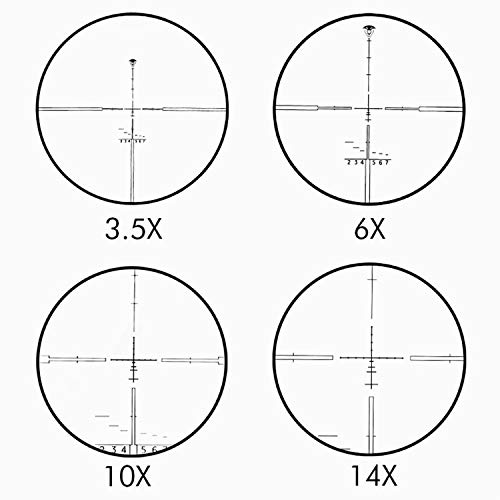
Description
Rifle Scope Product Details
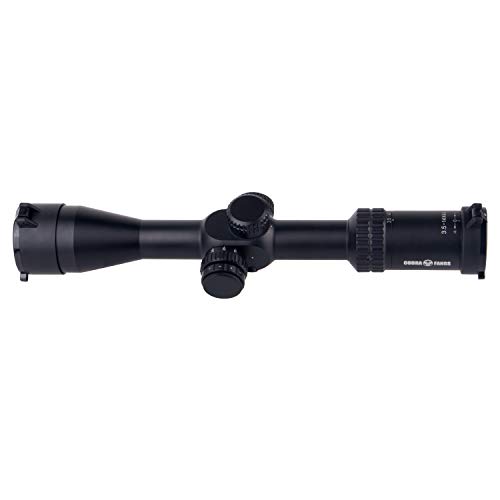
COBRA FANGS 3.5-14X44E FFP Rifle Scopes, Objective Lens 40mm, Pipe Diameter 30mm, Illuminated Cross Line, Outdoor Hunting Scopes
Why not choose COBRA FANGS 3.5-14X44E rifle scope when you want to choose a good scope
The magnification of 3.5-14 satisfies your daily hunting requirements perfectly. The eye relief distance of 80 mm is matched with the objective lens of 44 mm to make the target clear and image while ensuring your safety.
COBRA FANGS is not only handsome in appearance, but also excellent in windproof, waterproof and fog-proof sealing. How can jungle games lose him
Specific parameters
Red Rifle scope Side AO 1/4MOA Mil-dot 30MM Tube
NoMZJ-RSP-216
Magnification (Zoom):3.5-14X
Objective Lens:44mm
Tube Diameter:30mm
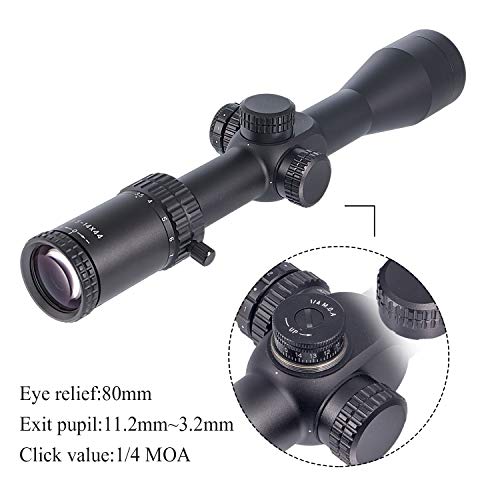
Eye Relief:80mm
Exit Pupil:11.2mm~3.2mm
Click Value:1/4 MOA
Up /down adjustment: 30 MOA
Left /right adjustment: 30 MOA
Parallax Setting:Illuminated Red MOA Reticle
Reticle Illumination:Yes
Reticle Color:Pro 5-Step Red
Reticle Construction:Glass Etched
Turret Style:External
Focal Plane:Second
Optical Coating:Fully Green Multi-Coated
Parallax Adjustment:Side
Waterproof:Yes
Fogproof:Yes
ShockProof:Yes
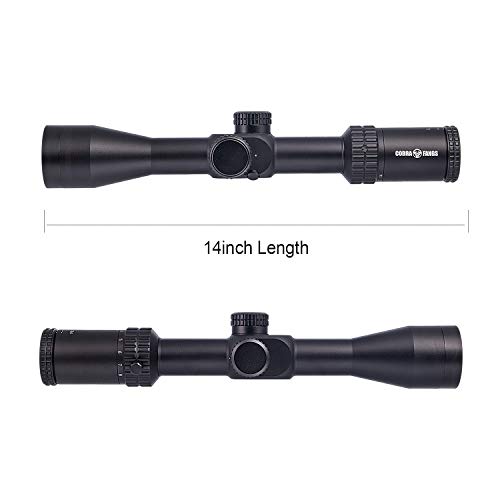
Length:13.7inch
Product Weight:730g
Package Weight:1200g
Package Size:46x12x9cm/18×4.7×3.5in
Finish:Black Matte
Product contains:
1.Flip-Up Scope Caps1
2.Lens Cloth(1)
3.Set of Rings1
4.Allen Wrench 1
Rifle Scope Product Features
Magnification: 3.5-14X, Objective Diameter: 44mm, Tube Diameter: 30mm/1.18 inchClick Value: 0~1/4 inch @ 100 yards,Eye Rifle (mm):80, Exit Pupil (mm):11.2~3.2
Fog proof with shock resistant housing, nitrogen purged with O-ring sealed. The lens in the scope is green, multi-coated & scratch resistant to provide high quality light transfer for best clarity
Durable all metal construction, high-grade optical lens and integrated mount for quick and secure attachment to any Picatinny or Weaver rails
Reticle is partially illuminated in green,reticle color is Pro 5-step red powered by the CR2032 battery(no included )
Accessories Included :Flip-up scope caps,lens cloth,set of rings(30mm),allen wrench
Style Name: 3-9×40-R4 FFP
Magnification3X to 9X with 40mm Objective Diameter.
3.3-2.7 Inches Eye Relief and 1/4″100YD Adjustment Click Value.
The Reticle Type is Crosshair, it Also Support Adjustment Objective and Ocular Focus.
3-9×40-R4 FFP
4-24x50E SFP
6-24x50E FFP
3.5-14X44E FFP
Why Choose Us
High Quality Material
Perfect design, black matte finish. A single piece tube constructed from aircraft grade aluminum ensures strength and shockproof performance.
Weather Resist
Built on True Strength Platform, Completely Sealed and Nitrogen Filled, Shockproof, Fog proof and Rainproof.
Included Accessories
lip-up scope caps/Lens cloth/Weaver rings /Allen wrench.There no battery.
Go Anywhere You Want
Outdoor hunting/shooting training/jungle exploration/CS games
About the COBRA FANGS Scope Maker
COBRA FANGS is a premium company for rifle scopes, optics, mounts, and other components used for guns like rifles and long guns. They create and make their scopes, mounts, and related products by using elements which are long lasting and resilient. This includes the COBRA FANGS 3.5-14X44E FFP Rifle Scopes, Objective Lens 40mm, Pipe Diameter 30mm, Illuminated Cross Line, Outdoor Hunting Scopes by COBRA FANGS. For additional shooting items, visit their website.
What You Need to Know About Rifle Scopes
Rifle scopes allow you to exactly aim a rifle at different targets by lining up your eye with the target over a range. They do this through magnification by making use of a set of lenses inside the scope. The scope’s alignment can be adjusted to take into account separate natural considerations like wind and elevation increases to make up for bullet drop.
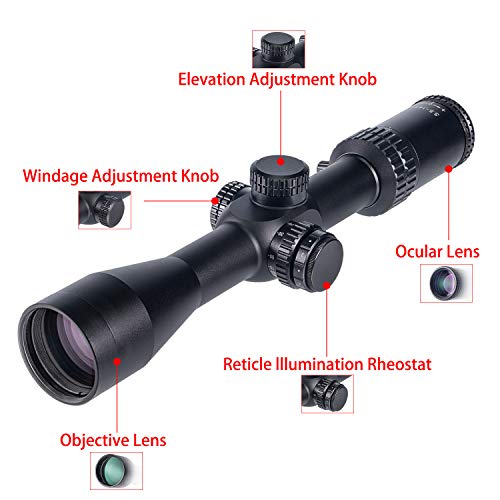
The scope’s purpose is to help the shooter understand precisely where the bullet will hit based on the sight picture you are seeing via the optic as you line up the scope’s crosshair or reticle with the target. A lot of contemporary rifle scopes and optics have about 11 parts which are located internally and externally on the optic. These parts include the rifle scope’s body, lenses, elevation turrets, focus rings, and other elements. See all eleven parts of a scope.
About Rifle Scope Varieties
Rifle scopes can be either “first focal plane” or “second focal plane” type of scopes. Choosing the optimal type of rifle scope is based around what type of shooting you plan to do.
First Focal Plane Glass Info
First focal plane scopes (FFP) feature the reticle before the magnification lens. This triggers the reticle to increase in size based on the amount of magnification being used. The benefit is that the reticle measurements are the same at the magnified distance as they are at the non amplified range. One tick on a mil-dot reticle at one hundred yards with no “zoom” is still the same tick at one hundred yards with 5x “zoom”. These kinds of scopes work for:
- Quick acquisition, long distance kinds of shooting
- Shooting scenarios where calculations are small
- Experienced shooters who understand their aim point “hold over” and also “lead” relationships for their long guns
- Shooters who don’t mind the reticle is bigger and takes up more visual eyesight room than a SFP reticle
Second Focal Plane Scope Details
Second focal plane optics (SFP) feature the reticle to the rear of the magnifying lens. This induces the reticle to stay at the exact same overall size relative to the quantity of zoom being used. The end result is that the reticle dimensions evolve based on the magnification chosen to shoot over longer ranges since the reticle markings present various increments which differ with the zoom. In the FFP example with the SFP optic, the 5x “zoom” one hundred yard tick reticle measurement would be 1/5th of the non “zoom” tick. These types of optics work for:
- Long distance types of shooting where shooters have extra time to make ballistic estimations
- Shooting where most shots happen within much shorter ranges and proximities
- Shooters who want a clearer optic picture with less area used up by the enlarged FFP reticle
Ins and Outs of Optic Zoom
The amount of magnification a scope supplies is figured out by the diameter, thickness, and curvatures of the lenses inside of the rifle scope. The zoom of the scope is the “power” of the scope.
Fixed Power Lens Rifle Glass Info
A single power rifle scope comes with a zoom number designator like 4×32. This indicates the zoom power of the scope is 4x power while the objective lens is 32mm. The zoom of this type of optic can not adjust because it is a fixed power optic.
Variable Power Lens Rifle Optic Facts
Variable power rifle scopes can be adjusted between magnification increments. These types of scopes will list the magnification degree in a configuration like 2-10×32. These numbers indicate the zoom of the scope could be changed in between 2x and 10x power. This always incorporates the powers in-between 2 and 10. The power modification is achieved by working with the power ring component of the scope near the rear of the scope by the eye bell.
Rifle Optic Power Level and Range Correlation
Here are some suggested scope power settings and the ranges where they may be effectively used. High power optics will not be as effective as lower magnification level glass since too much zoom can be a bad thing. The same concept applies to longer ranges where the shooter needs adequate power to see precisely where to properly aim the rifle at the target.
Rifle Glass Lens Coating
All top teir rifle scope lenses are covered. Lens coating is a vital element of a rifle when thinking about high end rifle optics and scope setups.
HD Versus ED Scope Lens Coatings
Some optic producers even use “HD” or high-definition lens finishes which use different procedures, aspects, polarizations, and chemical applications to enhance a wide range of color ranges and viewable target definition through lenses. This high-definition finish is normally used with increased density lens glass which brings down light’s chance to refract through the lens glass. Some scope suppliers use “HD” to describe “ED” signifying extra-low dispersion glass. ED deals with how certain colors are presented on the chroma spectrum and the chromatic aberration or difference which is also called color distortion or fringing. Chromatic aberration may be visible around objects with well defined outlines as light hits the object from various angles.
Scope Lens Single Finish Versus Multi-Coating
Various optic lenses can also have various finishings applied to them. All lenses normally have at least some type of treatment or finish used to them before they are used in a rifle scope or optic.
This lens treatment can protect the lens from scratches while reducing glare and other less useful things experienced in the shooting environment while sighting in with the scope. The quality of a single coated lens depends on the scope maker and how much you paid for it.
Some scope makers likewise make it a point to specify if their optic lenses are covered or “multi” coated. This suggests the lens has numerous treatments applied to the surfaces. If a lens receives several treatments, it can prove that a maker is taking multiple steps to combat different environmental factors like an anti-glare coating, a scratch resistant anti-abrasion finishing, followed by a hydrophilic coating. This additionally doesn’t always suggest the multi-coated lens will perform much better than a single covered lens. Being “better” is dependent on the maker’s lens treatment innovation and the quality of components used in building the rifle scope.
Optic Lens Anti-water Finishing
Water on a lens does not help with preserving a clear sight picture through a scope at all. Numerous top of the line and military grade optic makers will coat their lenses with a hydrophilic or hydrophobic coating which is water repellent.
Alternatives for Mounting Glass on Long Guns
Installing solutions for scopes come in a couple of choices. There are the standard scope rings which are individually installed to the scope and one-piece mounts which cradle the scope. These various types of mounts also typically come in quick release versions which use toss levers which allow rifle operators to quickly install and dismount the optics.
Hex Key Rifle Glass Rings
Standard, clamp-on style mounting scope rings use hex head screws to fix to the flattop design Picatinny scope mounting rails on the tops of rifles. These forms of scope mounts use two separate rings to support the optic, and are normally constructed from 7075 T6 billet aluminum which are developed for long distance accuracy shooting. This form of scope mount is great for rifles which are in need of a durable, unfailing mount which will not shift regardless of how much the scope is moved about or abuse the rifle takes. These are the style of mounts you should get for a faithful scope setup on a far away hunting or tournament firearm which will rarely need to be modified or recalibrated. Blue 242 Loctite threadlocker can also be used on the screws to protect against the hex screw threads from backing out after they are installed securely in position. An example of these rings are the 30mm type made by the Vortex Optics company. The set normally costs around $200 USD
Quick-Release Cantilever Glass Rings
These types of quick-release rifle scope mounts can be used to rapidly remove a scope and connect it to a different rifle. Numerous scopes can even be swapped out if they all use a similar style mount. These types of mounts are handy for rifle platforms which are transported a lot, to remove the optic from the rifle for protecting the scope, or for scopes which are used between numerous rifles or are situationally focused.
Sealing and Gas Purging for Rifle Optic Tubes
Moisture inside your rifle glass can ruin a day of shooting and your highly-priced optic by resulting in fogging and making residue within the scope’s tube. The majority of optics prevent humidity from getting in the optical tube with a series of sealing O-rings which are waterproof. Generally, these water resistant optics can be immersed underneath 20 or 30 feet of water before the water pressure can force moisture past the O-rings. This should be plenty of wetness avoidance for basic use rifles, unless you plan on taking your rifle aboard watercrafts and are concerned about the scope still working if it goes over the side and you can still salvage the firearm.
Gas Purged Optic Tubes
Another component of avoiding the accumulation of moisture within the rifle scope’s tube is filling the tube with a gas like nitrogen. Considering that this area is currently occupied by the gas, the glass is less altered by climate alterations and pressure distinctions from the outside environment which could possibly permit water vapor to permeate in around the seals to fill the void which would otherwise be there. These are good qualities of a decent rifle scope to look for.


