


Description
Rifle Scope Product Details
Bestsight DIY Digital Night Vision Scope for Rifle Hunting with Camera and 5″ Portable Display Screen
Rifle Scope Product Features
About this item
Day and Night New upgrade hunting night vision be used in day and night and it can provide a color view in the daytime.The actual effect of hunting night vision is better than professional night vision device.
Detailed Instructions Easy to use,Can be assembled quickly by detailed instructions for a few minutes
High Quality Night Captures Give you a perfect visual experience,you can observe target in complete darkness. Ideal for a wide variety of uses such as surveillance, nighttime hunting wildlife observation and exploring caves.
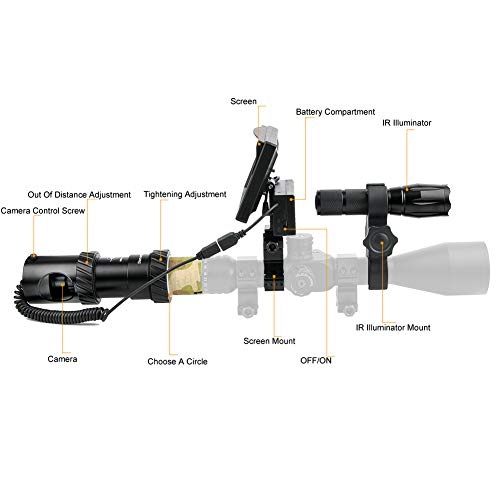
Multi Features 5.0 inches clear display screen captures ,360 degrees adjustable camera, 5W extended sliding infrared flashlight.If you want to get more night vision range, I suggest you buy an additional 5W IR illuminators, or better.
Does not include battery The package does not contain a battery. Please purchase it separately on Amazon.
Night Vision Camera For Hunting
BESTSIGHT Night Vision
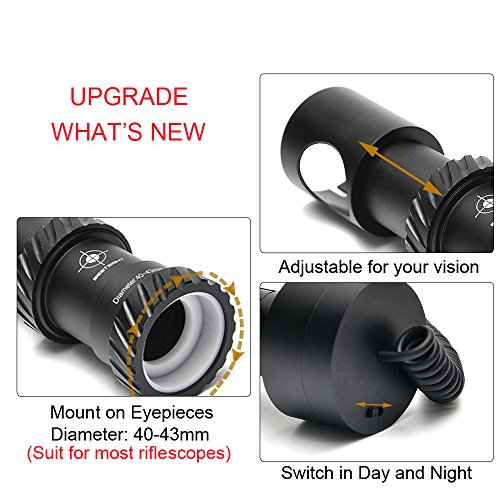
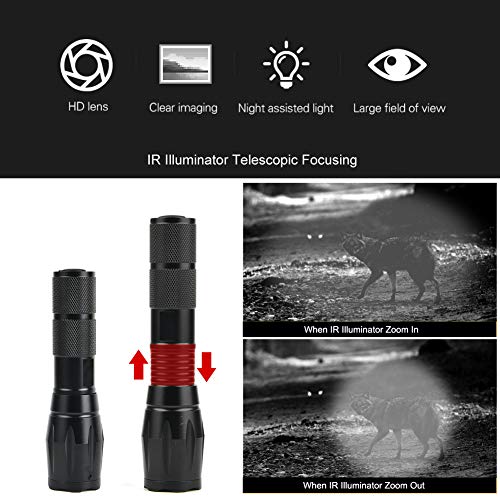
BESTSIGHT Night Visight has a day / nigh switch at the rear of the camera, which supports day/night use. The camera lens is 3MP, 16MM has a great improvement in pixels and field of view, the imaging effect is better and clearer, and the field of view is wider. At present, we have 5W infrared illuminator in our package, no need to use infrared illuminator when it is about 15 yards. When you observe a target more than 20 yards, you need to turn on the infrared illuminator. The infrared illuminator has adjustable focusing range.
Use a distance of more than 100 yards, a small beamSpotlight is recommended it will be impossible to observe / unclear / blur. When the distance is less than 100 yards, make the beam largerFlood light, otherwise the screen will turn white.Please refer to the figure below
Night Vision IR
For fixed distance targets, the IR light condensing / flooding will make the screen imaging have different effects. Close spotlighting will make the screen white, and flooding will make the target clear (as shown on the right). Use spotlight from a distance to make the target clear. Specific debugging please debug according to the actual distance and environment
Night Vision Camera
Night Vision Camera
There are 4 points to note when adjusting sharpness:
1, oscilloscope magnification
2, oscilloscope focus
3. Oscilloscope diopter
4, camera focus
BESTSGITH DIY Night Vision Camera
Pixel: 3 million
Imaging effect: HD
Size: 16mm
Adjustable focus
Day and night switch
PACKAGE LIST AND NOTES
Package list:
1xCamera
2xEyepiece tube
1xCamouflage tape (Random Color)
1xNight vision screen
1xNight vision support
1xInfrared flashlight
About the BESTSIGHT Brand
BESTSIGHT is a premium manufacturer for weapon scopes, optics, mounting solutions, and other add-ons used for guns like rifles and long guns. They innovate and build their products making the most of building materials which are resilient and long lasting. This includes the Bestsight DIY Digital Night Vision Scope for Rifle Hunting with Camera and 5″ Portable Display Screen by BESTSIGHT. For additional shooting products, visit their website.
All About Rifle Scopes
Rifle scopes enable you to specifically align a rifle at different targets by lining up your eye with the target at range. They do this through magnifying the target by employing a set of lenses inside the scope. The scope’s alignment can be adapted for the consideration of separate natural considerations like wind speed and elevation increases to account for bullet drop.
The scope’s purpose is to understand precisely where the bullet will hit based on the sight picture you are seeing with the scope as you line up the scope’s crosshair or reticle with the intended point of impact. Many modern-day rifle optics have around 11 parts which are found inside and externally on the optic. These optic pieces consist of the rifle scope’s body, lenses, modification turrets or dials, focus rings, and other parts. Learn about the eleven parts of rifle glass.
About Rifle Optic Types
Rifle scopes can be either “first focal plane” or “second focal plane” type of scopes. Considering the perfect type of rifle optic is based around what type of shooting you plan to do.
First Focal Plane Scopes
Focal plane scopes (FFP) feature the reticle in front of the magnification lens. This causes the reticle to increase in size based on the amount of zoom being used. The benefit is that the reticle measurements are the same at the amplified distance as they are at the non amplified range. For example, one tick on a mil-dot reticle at 100 yards without “zoom” is still the exact same tick at 100 yards with 5x “zoom”. These kinds of scopes work for:
- Quick acquisition, far away types of shooting
- Shooting situations where calculations are marginal
- Experienced shooters who know their aim point “hold over” as well as “lead” equations for their firearm
- Shooters who do not mind the reticle is enlarged and uses up more visual eyesight room than a SFP reticle
About Second Focal Plane Glass
Second focal plane scopes (SFP) include the reticle to the rear of the magnification lens. In the FFP example with the SFP scope, the 5x “zoom” 100 yard tick reticle measurement would be 1/5th of the non “zoom” tick measurement.
- Long distance types of shooting where shooters have additional time to make ballistic calculations
- Shooting where most shots take place within shorter proximities and ranges
- Shooters who select a clearer optic sight picture with less space used up by the larger size FFP reticle
Zoom for Optics
The quantity of zoom a scope provides is figured out by the diameter, thickness, and curvatures of the lenses inside of the rifle scope. The magnification of the scope is the “power” of the scope.
Fixed Single Power Lens Glass
A single power rifle optic comes with a zoom number designator like 4×32. This suggests the zoom power of the scope is 4x power while the objective lens is 32mm. The zoom of this type of scope can not adjust since it is a fixed power optic.
Adjustable Power Lens Scope Info
Variable power rifle scopes can be tweaked between magnified levels. The power change is achieved by making use of the power ring part of the scope near the back of the scope by the eye bell.
Power Levels and Range
Here are some advised scope powers and the ranges where they may be efficiently used. Highly magnified glass will not be as useful as lower magnification level glass considering that too much magnification can be a negative aspect depending on your shooting distance. The exact same concept applies to extended ranges where the shooter needs to have increased power to see precisely where to properly aim the rifle.
Scope Lens Finish
All contemporary rifle glass lenses are coated. Lens finish is a crucial aspect of a rifle system when considering high end rifle optics and scope setups.
HD Versus ED Lens Coatings
Some scope manufacturers likewise use “HD” or high-definition lens finishings which use different processes, aspects, polarizations, and chemicals to draw out separate colors and viewable definition through the lens. Some scope makers use “HD” to refer to “ED” indicating extra-low dispersion glass.
Single Rifle Scope Lens Covering Versus Multi-Coating
Various optic lenses can also have various finishes used to them. All lenses generally have at least some type of treatment or finish used to them before they are used in a rifle scope or optic.
Single covered lenses have a treatment applied to them which is generally a protective and enhancing multi-purpose treatment. This lens treatment can shield the lens from scratches while minimizing glare and other less helpful things experienced in the shooting environment while sighting in with the optic. The quality of a single coated lens depends on the scope developer and the amount you spent paying for it. Both the make and cost are indications of the lens quality.
Some scope manufacturers also make it a point to define if their optic lenses are covered or “multi” covered. Being “much better” depends on the manufacturer’s lens treatment technology and the quality of products used in developing the rifle scope.
Hydrophobic Finish for Rifle Scopes
Water on a scope’s lens doesn’t improve preserving a clear sight picture through a scope whatsoever. Numerous top of the line and premium scope producers will coat their lenses with a hydrophobic or hydrophilic coating. The Steiner Optics Nano-Protection is a fine example of this kind of treatment. It treats the surface of the Steiner scope lens so the H2O particles can not bind to it or develop surface tension. The result is that the water beads sheet off of the scope to preserve a clear, water free sight picture.
Choices for Installing Rifle Scopes on Long Guns
Installing options for scopes come in a couple of options. There are the standard scope rings which are separately installed to the optic and one-piece scope mounts which cradle the scope. These various kinds of mounts also usually can be found in quick release variations which use toss levers which permit rifle operators to quickly install and dismount the scope.
Hex Key Rifle Optic Rings
Basic, clamp-on type mounting scope rings use hex head screws to mount to the flattop design Picatinny scope mount rails on rifles. These forms of scope mounts use two independent rings to support the optic, and are usually constructed from 7075 T6 billet aluminum or similar materials which are developed for far away precision shooting. This form of scope mount is good for rifles which are in need of a long lasting, hard use mount which will not move despite just how much the scope is moved about or jarring the rifle takes. These are the design of mounts you really want to have for a dedicated optics system on a far away scouting or sniper competition rifle that will rarely need to be modified or adjusted. Blue 242 Loctite threadlocker can additionally be used to keep the hex screws from wiggling out after they are mounted tightly in position. An example of these mounting rings are the 30mm style from Vortex Optics. The set normally costs around $200 USD
Quick-Release Cantilever Rifle Glass Ring Mounts
These types of quick-release rifle scope mounts can be used to rapidly detach a scope from a rifle and reattach it to a different rifle. If they all use a similar style mount, multiple scopes can often be switched in the field. The quick detach design is CNC machined from anodized 6061 T6 aluminum and the mounting levers connect tightly to a flat top style Picatinny rail. This allows the scope to be sighted in while on the rifle, removed from the rifle, and remounted back on the rifle while preserving the original sighting settings. These types of mounts are useful and practical for rifles which are transferred between vehicles a lot, to take off the glass from the rifle for protection, or for aiming systems which are used between multiple rifles. An example of this mount style is the 30mm mount from Vortex Optics. It normally costs around $250 USD
Sealing and Gas Purging for Optic Tubes
Moisture inside your rifle scope can ruin a day of shooting and your costly optic by bringing about fogging and creating residue inside of the scope tube. Most scopes prevent wetness from entering the scope tube with a system of sealing O-rings which are water resistant.
Gas Purged Optic Tubes
Another component of avoiding the accumulation of moisture inside of the rifle optic’s tube is filling the tube with a gas like nitrogen. Considering that this area is currently taken up by the gas, the optic is less impacted by condition shifts and pressure variations from the outdoor environment which might possibly allow water vapor to permeate in around the seals to fill the void which would otherwise exist. These are good qualities of a decent rifle scope to look for.


