



Description
Rifle Scope Product Details
Barska AC10776 Illuminated Reticle Rifle Scope 6-20×50 First Focal Plane Mil-Dot Reticle, Black Matte
The 6-20x50mm IR TC Riflescope from Barska is a perfect choice for serious shooters and hunters who are looking for as much control as possible for any type of shooting. Boasting a fast focus eyeball and side parallax settings, this Scope has been designed and engineered for accuracy, reliability and durability. This scope offers a 1 inch single tube construction with an Illuminated Mil-Dot Reticle in the first focal plane. The first focal plane reticle allows accurate ranging and adjustments.
Rifle Scope Product Features
About this item
Long Range Precision: The 6-20x magnification scope features side adjustable parallax and 1/4 MOA click adjustments to improve accuracy.
Quality Construction: The scope comes with fully multi-coated optics, providing impressive viewing clarity. Tube diameter 1″.
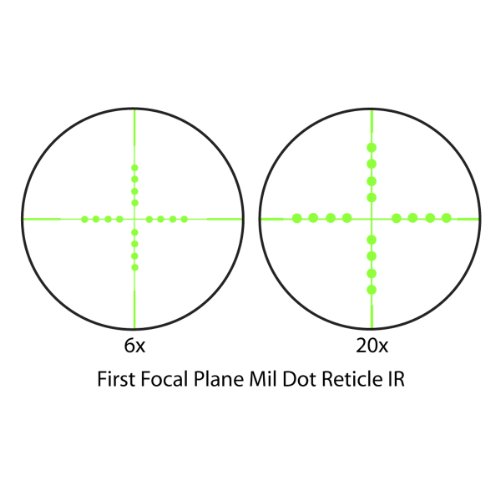
IR-FFP Reticle: The illuminated first focal plane mil-dot glass-etched reticle allows using the rangefinding capability at all magnifications.
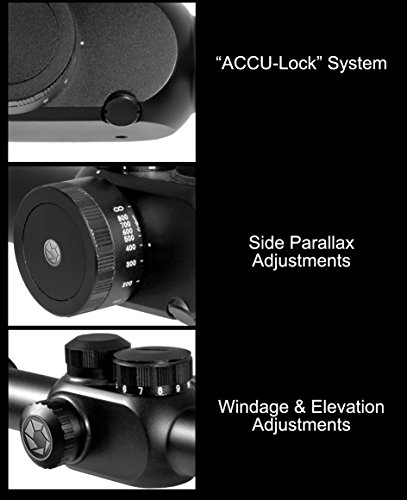
ACCU-LOCK: The scope features a coil spring positioning system to securely lock the inner tube, allowing the scope to stay locked dead-on after firing.
Robust Design: The scope is built with extra-rigid construction, being waterproof, fogproof, and shockproof.
department name: Mounts
material type: Aluminum
sport type: Hunting
AC10776
Specs
Item: AC10776
Field of View(ft@100yds): 16ft@ 6x, 5ft@ 20x
Eye Relief: 3.1 in
Exit Pupil: 8.3mm – 2.5mm
Click Value: 1/4 MOA
Focal Plane: First
Length: 16.3″ ; Weight: 26.87 oz ; 1″ Tube Diameter
Included: Mounting Rings ; CR2032 3V Lithium battery ; Lens Cloth ; Scope Caps
6-20×50 IR Scope with First Focal Plane Mill-Dot Reticle
by Barska
The 6-20×50 IR Riflescope from Barska is a perfect choice for shooters and hunters who are looking for as much control as possible for extreme type shooting. Boasting a fast focus eyebell and side parallax settings, this scope has been designed and engineered for accuracy, reliability and durability. This scope offers a 1 inch single tube construction with an Illuminated Mil-Dot Reticle in the first focal plane, allowing the size of the pattern to increase as the magnification is increased.
6-20x Magnification
50mm Objective Lens
First Focal Plane Illuminated Green Mil-Dot Reticle
Side Adjustable Parallax
Fully Multi-Coated Optics
Waterproof, Fogproof and Shockproof
5/8″ Mounting Rings
Accu-Lock System
Durable, Light Weight Riflescope
This 6-20×50 First Focal Plane riflescope is durable and lightweight, perfect for hunting or target practice.
Side Parallax Adjustment
Parallax Adjustment allows user to adjust according to distance they are shooting at from.
Zoom Adjustment
6-20x adjustable zoom allows users to get up close to the target, suitable for mid- to long-range targeting.
Glass-Etched Reticle
The scope comes with Illuminated First Focal Plane Mil Dot Glass-Etched Reticle, allowing reticle to maintain the same measurements at all magnifications.
AC10776 AC10770 AC10778 AC12464 AC10700 AC12140
Magnification 6-20x 1.5-4.5x 6.5-20x 6-24x 6-24x 6-36x
Objective Lens 50mm 20mm 40mm 50mm 60mm 52mm
Lens Coating Fully Multi-Coated Fully Multi-Coated Fully Multi-Coated Fully Multi-Coated Fully Multi-Coated Fully Multi-Coated
Click Value 1/4 MOA 1/2 MOA 1/4 MOA 1/4 MOA 1/8 MOA 1/8 MOA
Reticle First Focal Plane Illuminated Mil-Dot First Focal Plane Mil-Dot First Focal Plane Illuminated Mil-Dot Illuminated Mil-Dot Illuminated Mil-Dot Illuminated Mil-Dot
Turret Capped Capped Capped External Locking Capped External Locking
Length 16.3″ 10.3″ 16.0″ 15.25″ 16″ 17″
Product Weight 26.87 oz 12.55 oz 21.87 oz 20.2 oz 28.9 oz 35.2 oz
About the BARSKA Scope Maker
BARSKA is a premium company for rifle scopes, optics, mounts, and other accessories used for guns like rifles and long guns. They design and build their scopes, mounts, and related products working with building materials which are resilient and long lasting. This includes the Barska AC10776 Illuminated Reticle Rifle Scope 6-20×50 First Focal Plane Mil-Dot Reticle, Black Matte by BARSKA. For more shooting items, visit their website.
About Glass
Rifle scopes enable you to exactly align a rifle at different targets by lining up your eye with the target over a distance. They do this through magnifying the target by employing a set of lenses within the scope. The scope’s positioning can be dialed in to account for various environmental things like wind speed and elevation increases or decreases to make up for bullet drop.
The scope’s purpose is to help the shooter understand precisely where the bullet will land based on the sight picture you are seeing with the optic as you align the scope’s crosshair or reticle with the target. A lot of modern-day rifle optics have about 11 parts which are arranged inside and on the exterior of the scope. These parts include the rifle scope’s body, lenses, elevation dials, objective focus rings, and other components. Learn about the eleven parts of rifle glass.
The Types of Rifle Scopes
Rifle scopes can be either “first focal plane” or “second focal plane” style of scopes. The style of focal plane a scope has determines where the reticle or crosshair is located in relation to the scopes magnification. It literally means the reticle is behind or in front of the magnification lens of the optic. Selecting the most ideal form of rifle scope depends upon what form of shooting or hunting you plan on doing.
First Focal Plane Glass Details
Focal plane scopes (FFP) include the reticle in front of the zoom lens. These types of scopes are helpful for:
- Quick acquisition, far away kinds of shooting
- Shooting circumstances where calculations are minor
- Experienced shooters who know their aim point “hold over” and “lead” correlations for their firearms
- Shooters who don’t mind the reticle is bigger and occupies more visual eyesight area than a SFP reticle
Info on Second Focal Plane Scopes
Second focal plane optics (SFP) include the reticle behind the zoom lens. In the FFP example with the SFP scope, the 5x “zoom” 100 yard tick measurement would be 1/5th of the non “zoom” tick reticle measurement.
- Long distance styles of shooting where shooters have increased time to make ballistic estimations
- Shooting where most shots take place within much shorter ranges and proximities
- Shooters who want a clearer optic sight picture without room taken up by the enlarged FFP reticle
Glass Magnification
The level of scope zoom you need on your scope depends upon the style of shooting you intend to do. Practically every style of rifle optic provides some degree of magnification. The level of zoom a scope delivers is established by the diameter, thickness, and curves of the lenses within the rifle optic. The magnifying level of the scope is the “power” of the opic. This signifies what the shooter is checking out through the scope is amplified times the power factor of what can generally be seen by human eyes.
Fixed Power Lens Rifle Scopes
A single power rifle optic and scope uses a zoom number designator like 4×32. This means the magnification power of the scope is 4x power while the objective lens is 32mm. The magnification of this kind of optic can not change since it is a fixed power optic.
Adjustable Power Lens Rifle Glass Facts
Variable power rifle scopes can be tweaked between magnified settings. The power change is achieved using the power ring part of the scope near the rear of the scope by the eye bell.
Power and Range
Here are some recommended scope power settings and the distances where they may be efficiently used. Highly magnified rifle scope glass will not be as useful as lower magnification glass considering too much magnification can be a bad thing. The exact same concept relates to longer distances where the shooter needs to have enough power to see precisely where to properly aim the rifle at the target.
Lens Coating for Rifle Glass
All contemporary rifle optic lenses are coated. Lens finishing is an important aspect of a rifle system when thinking about high end rifle optics and scope systems.
HD Versus ED Rifle Optic Lens Coatings
Some glass companies even use “HD” or high-definition lens coverings that make the most of various processes, rare earth compounds, elements, and polarizations to draw out separate color ranges and viewable definition through lenses. This high-definition finishing is commonly used with higher density glass which drops light’s ability to refract through the lens glass. Some scope manufacturers use “HD” to refer to “ED” implying extra-low dispersion glass. ED handles how colors are represented on the chromatic spectrum and the chromatic aberration or deviance which is similarly called color distortion or fringing. Chromatic aberration is often visible around things with well defined shapes as light hits the object from certain angles.
What to Know About Single Finish Versus Multi-Coating
Various optic lenses can likewise have various finishings applied to them. All lenses typically have at least some type of treatment or finishing used to them prior to being used in a rifle scope or optic.
This lens treatment can offer protection to the lens from scratches while decreasing glare and other less helpful things experienced in the shooting environment while sighting in with the scope. The quality of a single coated lens depends on the scope manufacturer and how much you paid for it.
Some scope makers similarly make it a point to define if their optic lenses are layered or “multi” covered. Being “better” depends on the maker’s lens treatment technology and the quality of materials used in developing the rifle scope.
What to Know About Anti-water Finish
Water on an optical lens does not support keeping a clear sight picture through a scope whatsoever. Numerous top of the line or high-end scope producers will coat their lenses with a hydrophilic or hydrophobic finish. The Steiner Optics Nano-Protection is a good example of this kind of treatment. It deals with the surface area of the Steiner scope lens so the water particles can not bind to it or create surface tension. The outcome is that the water beads move off of the scope to maintain a clear, water free sight picture.
Alternatives for Mounting Rifle Scopes on Long Guns
Mounting options for scopes come in a couple of options. There are the standard scope rings which are separately installed to the optic and one-piece scope mounts which cradle the scope. These various kinds of mounts also usually can be found in quick release versions which use throw levers which permit rifle operators to rapidly mount and dismount the scopes.
Rifle Scope Mounting Solutions with Hex Key Rings
Basic, clamp-on type mounting optic rings use hex head screws to mount to the flattop style Picatinny scope mounting rails on the tops of rifles. These kinds of scope mounts use two separate rings to support the scope, and are usually constructed from 7075 T6 billet aluminum or similar materials which are manufactured for long distance precision shooting. This type of scope mount is effective for rifles which require a durable, rock solid mount which will not move regardless of how much the scope is moved or jarring the rifle takes. These are the design of mounts you should get for a devoted optics system on a far away scouting or competitors long gun that will pretty much never need to be modified or adjusted. Blue 242 Loctite threadlocker can also be used on screws to stop the hex screw threads from backing out after they are mounted firmly in position. An example of these mounting rings are the 30mm type made by the Vortex Optics brand. The set normally costs around $200 USD
Quick-Release Cantilever Scope Rings
These types of quick-release rifle scope mounts can be used to rapidly detach a scope from a rifle and reattach it to a different rifle. Several scopes can also be swapped out if they all use a complementary style mount. The quick detach mount style is CNC crafted from anodized 6061 T6 aluminum and the mounting levers connect nicely to a flat top design Picatinny rail. This enables the scope to be sighted in while on the rifle, removed from the rifle, and remounted while retaining accuracy. These kinds of mounts are useful and handy for shooting platforms which are carried a lot, to remove the scope from the rifle for protection, or for sight systems which are chosen for use between several rifles. An example of this mount type is the 30mm mount designed by Vortex Optics. It generally costs around $250 USD
Rifle Scope Tube Sealing and Gas Purging
Moisture inside your rifle glass can spoil a day of shooting and your costly optic by causing fogging and generating residue within the scope’s tube. Many optics protect against humidity from getting in the scope tube with a system of sealing O-rings which are waterproof. Normally, these optics can be immersed under 20 or 30 feet of water before the water pressure can force moisture past the O-rings. This should be sufficient moisture prevention for common use rifles for hunting and sporting purposes, unless you plan on taking your rifle on boats and are worried about the scope still functioning if it falls overboard and you can still salvage the rifle.
Gas Purged Glass Tubes
Another element of preventing the buildup of wetness within the rifle scope’s tube is filling the tube with a gas like nitrogen. Because this space is already occupied by the gas, the optic is less affected by climate shifts and pressure differences from the outdoor environment which might possibly allow water vapor to permeate in around the seals to fill the void which would otherwise exist. These are good qualities of a good rifle scope to seek out.


