Description
Rifle Scope Product Details
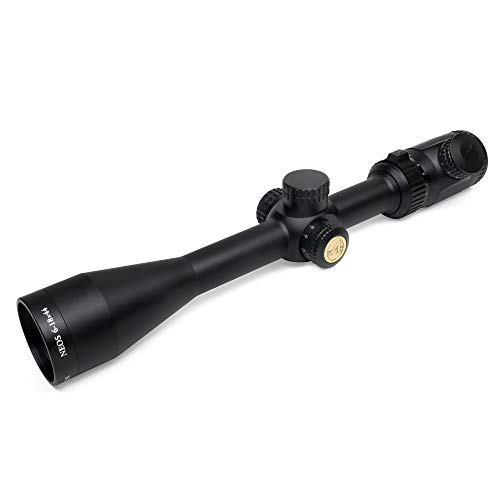
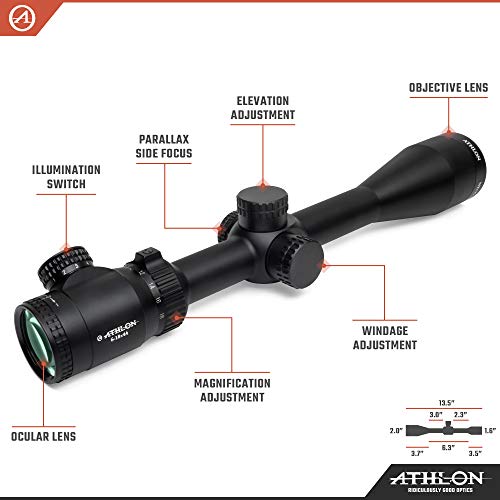
Athlon Optics Neos 6-18×44 Second Focal Plane Riflescopes
Rifle Scope Product Features
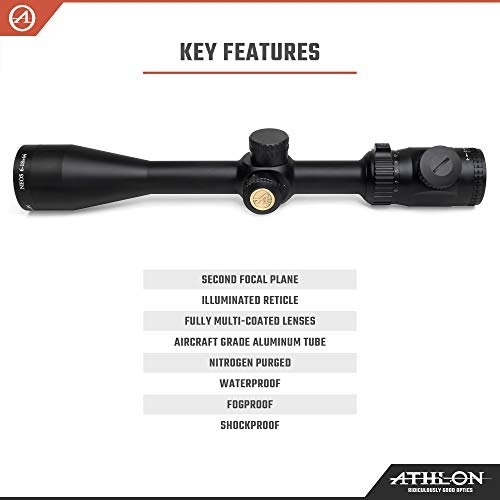
Fully multi-coated lenses gives you better light transmission to bring optimum brightness and true color across the entire light Spectrum
Reticle etched on the Glass that provides excellent backing support for complex reticle design and offers great durability and much higher shock resistance to Recoil
Heat treated one piece tube gives the scope extra strength over multi-piece tubes. A one piece tube also is better at keeping moisture out thus keeping your scope fog proof for the life of the product
Nitrogen purging dramatically reduces the moisture inside the tube and helps maintaining Fog proof and waterproof
Aircraft grade aluminum tube that has exceptional strength and superior mechanical integrity will protect these world class optics no matter what punishment you Throw at it
Sport type: Hunting
Neos
Increasing your success while hunting doesn’t necessarily have to decrease your savings account. The perfect example of that is the Neos series. This is the perfect scope for those who want quality and features all while staying on budget. The Neos has an impressive list of features which are designed and built to endure. It has a one piece aluminum tube. The lenses are Fully Multi Coated. Some of the models even have the latest side parallax focus technology. What about the cost Let’s just say the scope isn’t the only thing that looks good, with ruggedness and precision we are proud of!
Key Features
Fully Multi-coated
Fully Multi-coated optics effectively reduces reflected light and increases the transmission of light giving you a brighter image than normal single coated lenses.
Waterproof
Waterproof to protect the scope in the harshest weather conditions or if accidentally submerged underwater.
Nitrogen Purged
Nitrogen purging dramatically reduces the moisture inside the tube and helps maintaining fogproof and waterproof.
Center X
Center X reticle is a perfect choice for shooters wishing to have a clear field of view with a more traditional crosshair. The Center X reticle allows shooters to quickly view their target while maintaining one distinct aiming point on their reticle. The heavy posts stand out nicely against cover and in twilight conditions, pointing boldly to the intersection.
Subtensions in MOA: A1 (0.18); A2 (0.7); C1 (4.5); C2 (9).
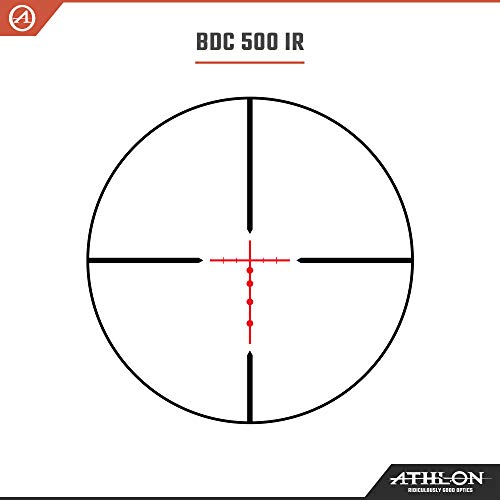
BDC 500 IR
BDC 500 IR was designed to deliver a high level of precision at extended targets that can be used with today’s most popular rifle cartridges.
Subtensions in MOA: A1 0.3); A1 (0.8); B1 (0.8); B2 (1); C1 (1.5); C2 (3.5); C3 (6.25); C4 (9.5); C5 (13.6); C6 (1); C7 (2); D1 (1).
3-9×40 Center X 3-9×40 BDC 500 IR 4-12×40 Center X 4-12×40 BDC 500 IR 6-18×44 Center X 6-18×44 BDC 500 IR
Tube Diameter 1 inch 1 inch 1 inch 1 inch 1 inch 1 inch
Focal Plane Second Second Second Second Second Second
FoV at 100Y 37.8-12.6′ 37.8-12.6′ 27.3-8.9′ 27.3-8.9′ 17.5-5.9′ 17.5-5.9′
Eye Relief 2.99-3.07″ 2.99-3.07″ 3.11-3.15″ 3.11-3.15″ 3.39-3.19″ 3.39-3.19″
Turret Style Capped Capped Capped Capped Capped Capped
Length 12.4″ 12.4″ 12.4″ 12.4″ 13.5″ 13.5″
Weight 17 oz 17 oz 18.1 oz 18.1 oz 21.7 oz 21.7 oz
About the Athlon Optics Scope Maker
Athlon Optics is a premium maker for long gun scopes, optics, mounting solutions, and other accessories used for firearms like rifles and long guns. They create and make their products making the most of elements which are long lasting and resilient. This includes the Athlon Optics Neos 6-18×44 Second Focal Plane Riflescopes by Athlon Optics. For additional shooting products, visit their website.
All About Optics
Rifle scopes permit you to precisely align a rifle at various targets by lining up your eye with the target at range. They do this through magnification by employing a series of lenses inside the scope. The scope’s positioning can be dialed in to take into account many environmental elements like wind and elevation to account for bullet drop.
The scope’s function is to understand precisely where the bullet will hit based upon the sight picture you are viewing through the optic as you align the scope’s crosshair or reticle with the intended target. Many modern rifle scopes and optics have about eleven parts which are found internally and on the exterior of the scope body. These optic pieces consist of the rifle scope’s body, lenses, modification turrets, objective focus rings, and other elements. Learn about the eleven parts of glass.
About Optic Types
Rifle scopes can be either “first focal plane” or “second focal plane” type of optics. Deciding on the perfect type of rifle scope is based around what type of shooting you plan on doing.
First Focal Plane Optic Details
Focal plane scopes (FFP) feature the reticle in front of the zoom lens. These styles of scopes are useful for:
- Quick acquisition, long distance types of shooting
- Shooting scenarios where estimations are marginal
- Experienced shooters who have an idea for their target “hold over” and “lead” ratios for their firearm
- Shooters who don’t mind the reticle is enlarged and occupies more visual sight area than a SFP reticle
Second Focal Plane Glass Facts
Second focal plane optics (SFP) feature the reticle to the rear of the zoom lens. In the FFP example with the SFP scope, the 5x “zoom” 100 yard tick would be 1/5th of the non “zoom” tick measurement.
- Far away types of shooting where shooters have additional time to make ballistic computations
- Shooting where most shots happen within shorter proximities and ranges
- Shooters who desire a clearer optic sight picture with less room used up by the bigger FFP reticle
Zoom for Optics
The measure of scope zoom you need on your optic is based on the kind of shooting you intend to do. Nearly every style of rifle optic supplies some amount of zoom. The volume of zoom a scope delivers is determined by the dimension, density, and curves of the lens glass within the rifle optic. The magnification level of the optic is the “power” of the opic. This denotes what the shooter is observing through the scope is magnified times the power aspect of what can usually be seen by human eyes.
About Fixed Single Power Lens Rifle Optics
A single power rifle scope comes with a magnification number designator like 4×32. This suggests the zoom power of the scope is 4x power and the objective lens is 32mm. The magnification of this type of scope can not fluctuate considering that it is a set power scope.
Adjustable Power Lens Rifle Scopes
Variable power rifle scopes can be tweaked between magnified levels. The power change is handled by using the power ring part of the scope near the back of the scope by the eye bell.
The Power and Range of Scopes
Here are some suggested scope power levels and the ranges where they could be effectively used. Keep in mind that higher power optics and scopes will not be as effective as lower powered scope and optics because too much magnification can be a detractor. The very same idea applies to longer distances where the shooter needs increased power to see where to best aim the rifle.
Details on Scope Lens Coatings
All modern rifle optic and scope lenses are coated. There are various types and qualities of lens coatings. When looking at high end rifle targeting devices, Lens finish can be a crucial element of a rifle. The glass lenses are one of the most significant pieces of the scope since they are what your eye sees through while sighting a rifle in on the point of impact. The covering on the lenses protects the lens exterior and improves anti glare capabilities from refracted sunrays and color exposure.
HD Versus ED Lens Coatings
Some optic suppliers even use “HD” or high-def lens finishes that use various procedures, components, polarizations, and chemical applications to enhance separate colors and viewable target definition through lenses. This high-definition coating is normally used with more costly, high density glass which drops light’s opportunity to refract by means of the lens glass. Some scope corporations use “HD” to describe “ED” indicating extra-low dispersion glass. ED deals with how colors are represented on the chroma spectrum and the chromatic deviance or aberration which is similarly called color distortion or fringing. Chromatic aberration may be visible around objects with hard edges and shapes as light hits the object from specific angles.
Single Finishing Versus Multi-Coating for Rifle Glass
Various optic lenses can likewise have various finishes used to them. All lenses usually have at least some type of treatment or finish applied to them prior to being used in a rifle scope or optic.
Single layered lenses have a treatment applied to them which is typically a protective and improving multi-purpose treatment. This lens treatment can safeguard the lens from scratches while lowering glare and other less advantageous things experienced in the shooting environment while sighting in with the optic. The quality of a single coated lens depends on the scope developer and the amount you spent paying for it. Both the make and cost are indicators of the lens quality.
Some scope makers similarly make it a point to specify if their optic lenses are coated or “multi” covered. Being “much better” depends on the manufacturer’s lens treatment technology and the quality of materials used in developing the rifle scope.
Anti-water Lens Finishing
Water on an optic’s lens doesn’t assist with retaining a clear sight picture through a scope whatsoever. Numerous top of the line or premium optic producers will coat their lenses with a hydrophobic or hydrophilic finishing. The Steiner Optics Nano-Protection is a good example of this sort of treatment. It treats the surface of the Steiner glass lens so the H2O molecules can not bind to it or create surface tension. The result is that the water beads slide off of the scope to keep a clear, water free sight picture.
Glass Mounting Alternatives
Installing options for scopes are available in a few choices. There are the standard scope rings which are separately mounted to the scope and one-piece scope mounts which cradle the scope. These different types of mounts also usually can be found in quick release versions which use manual levers which enable rifle operators to rapidly mount and remove the scopes.
Scope Mounts with Hex Key Rings
Normal, clamp style mounting scope rings use hex head screws to mount to the flattop style Picatinny scope mount rails on rifles. These types of scope mounts use a couple of different rings to support the optic, and are often made from 7075 T6 billet aluminum which are created for long range precision shooting. This type of scope mount is fine for rifles which need a long lasting, sound mounting solution which will not move no matter how much the scope is moved or abuse the rifle takes.
Quick-Release Cantilever Rifle Scope Rings
These types of quick-release rifle scope mounts can be used to rapidly take off a scope and attach it to a different rifle. Multiple scopes can also be swapped out if they all use a similar design mount. These types of mounts come in handy for rifle platforms which are transported a lot, to swap out the optic from the rifle for protecting the scope, or for scopes which are used between several rifles.
Rifle Scope Tube Sealing and Gas Purging
Wetness inside your rifle scope can ruin a day of shooting and your expensive optic by bringing about fogging and creating residue inside of the scope tube. A lot of scopes avoid moisture from getting in the scope tube with a system of sealing O-rings which are water resistant.
Gas Purged Rifle Glass Tubes
Another part of preventing the buildup of wetness within the rifle optic tube is filling the tube with a gas like nitrogen. Since this space is currently taken up by the gas, the scope is less impacted by temperature alterations and pressure differences from the external environment which may potentially allow water vapor to permeate in around the seals to fill the void which would otherwise exist. These are good qualities of a good rifle scope to look for.


