
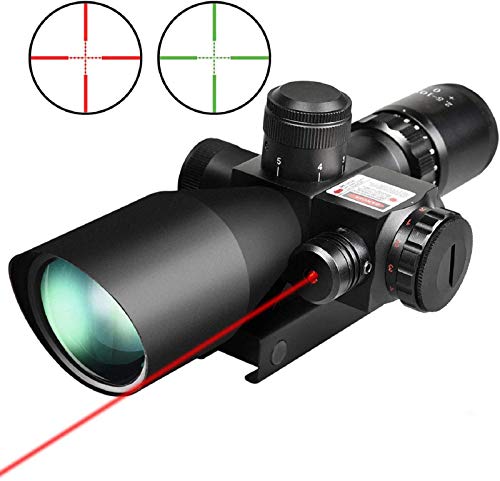


Description
Rifle Scope Product Details
QILU Compact Laser Rifle Scope 2.5-10X40 Riflescope Illuminated Riflescope with Green Laser Hunting Scope
Specification
Magnification: 2.5x-10x
Objective Diameter: 40mm
Lens Type: Multi-coated Green Lens
Eye Relief: 4” @ 2.5x – 3”@ 10x
Exit Pupil: 0.52” @ 2.5x – 0.17” @ 10x
Field Of View: 100 Yards Of 34.86′ @2.5x – 11.53′ @10
Illuminated Level: 5 Intensity (Red) And 5 Intensity (Green)
Reticle Type: Mil-dot
Click Value: 1/4inch@100 Yds
Laser Class: Class IIIA
Laser Power: 2mW
Laser Wavelength:650 Nm
Dimensions: 8.5″ X 3″x 3″
Net Weight: 20.5oz(approx.)
Tube Diameter: 1.57”
Finsh: Black Matte
Special Design
Bullet Drop Compensator: Allows Quick Adjustments Of The Reticle For Shooting Targets At Specific Distances(100-500 Yds).
Multi-coated Green Lens: With Much Higher Light Transimittance Compared With Normal Blue Lens, Allows Clearer Image.
Special 2 In 1 Design: Scope And Gun Sight Laser Built Together To Ensure Precise Shooting.
0.79” (20mm) Mounts Included
Package Include
1 X 2.5-10x40e Rifle Scope
1 X Lens Cover
Battery: CR 2032 X 1(reticle); LR1130 X3(gun Sight Laser)
1 X Scope Mounts For 20mm Picatinny Or Weaver Rail
1 X Allen Key
1 X Cleaning Cloth
Rifle Scope Product Features
Field Of View:100 Yards Of 32.5 @ 2.5x – 8.9 @10x; Laser: 2mW, Class IIIA, Reaching 100 Yards
Magnification: 2.5-10X; Objective Diameter: 40mm; AO: NO
Clearer Image: Multi-coated Green Lens Boast Much Higher Light Transmittance Compard With Blue Lens
Illumination Modes: Red & Green (5 Intensity)
Durable: Made Of High Strength Aircraft Aluminum
About the QILU Scope Maker
QILU is a premium maker for firearm scopes, optics, mounts, and other components used for firearms like rifles and long guns. They innovate and make their mounts and related products using building materials which are durable and long lasting. This includes the QILU Compact Laser Rifle Scope 2.5-10X40 Riflescope Illuminated Riflescope with Green Laser Hunting Scope by QILU. For additional shooting goods, visit their site.
Information About Glass
Rifle scopes enable you to exactly aim a rifle at different targets by lining up your eye with the target at range. They accomplish this through magnifying the target by utilizing a series of lenses inside the scope. The scope’s positioning can be adapted to take into account various natural aspects like wind speed and elevation increases or decreases to make up for bullet drop.
The scope’s function is to help the shooter understand exactly where the bullet will land based upon the sight picture you are seeing via the scope as you align the scope’s crosshair or reticle with the intended target. The majority of modern rifle scopes and optics have about eleven parts which are located within and externally on the scope. These scope parts consist of the rifle scope’s body, lenses, windage and elevation dials, focus rings, and other components. Learn about the eleven parts of rifle scopes.
The Types of Rifle Scopes
Rifle scopes can be either “first focal plane” or “second focal plane” kind of scopes. The kind of focal plane a scope has determines where the reticle or crosshair is located in relation to the optic’s zoom. It actually indicates the reticle is behind or before the magnification lens of the optic. Selecting the most ideal type of rifle scope is dependent on what form of hunting or shooting you plan on undertaking.
Info on First Focal Plane Optics
Focal plane scopes (FFP) feature the reticle in front of the magnification lens. This triggers the reticle to increase in size based upon the amount of magnification being used. The result is that the reticle measurements are the same at the amplified range as they are at the non magnified range. One tick on a mil-dot reticle at one hundred yards without “zoom” is still the same tick at 100 yards with 5x “zoom”. These types of scopes are practical for:
- Quick acquisition, long distance kinds of shooting
- Shooting circumstances where estimations are very little
- Experienced shooters who recognize their aim point “hold over” and also “lead” correlations for their long guns
- Shooters who do not mind the reticle is enlarged and requires more visual sight space than a SFP reticle
About Second Focal Plane Glass
Second focal plane optics (SFP) feature the reticle behind the magnification lens. In the FFP example with the SFP scope, the 5x “zoom” one hundred yard tick would be 1/5th of the non “zoom” tick.
- Far away styles of shooting where shooters have additional time to make ballistic calculations
- Shooting where most of the shots take place within shorter ranges and distances
- Shooters who want a clearer optic sight picture with less area used up by the larger sized FFP reticle
Ins and Outs of Glass Zoom
The amount of magnification a scope provides is determined by the size, thickness, and curvatures of the lenses inside of the rifle scope. The zoom of the scope is the “power” of the scope.
Single Power Lens Scopes
A single power rifle optic and scope comes with a zoom number designator like 4×32. This suggests the zoom power of the scope is 4x power and the objective lens is 32mm. The magnification of this type of scope can not fluctuate considering that it is a fixed power optic.
About Variable Power Lens Scopes
Variable power rifle scopes have adjustable power. These types of scopes will list the zoom amount in a format like 2-10×32. These numbers mean the zoom of the scope can be changed between 2x and 10x power. This additionally involves the power levels in-between 2 and 10. The power adaptation is accomplished by working with the power ring component of the scope near the rear of the scope by the eye bell.
The Power and Range of Glass
Here are some suggested scope powers and the distances where they can be efficiently used. Keep in mind that higher magnification scopes and optics will not be as effective as lower powered scopes due to the fact that excessive zoom can be a detractor. The very same idea goes for longer distances where the shooter needs to have adequate power to see where to best aim the rifle.
Details on Lens Coating
All cutting-edge rifle glass lenses are coated. Lens coating is an important element of a shooting system when considering high end rifle optics and scope systems.
ED Versus HD Rifle Glass
Some optic companies will also use “HD” or high-definition lense finishings which make the most of various procedures, polarizations, components, and chemicals to extract various colors and viewable target definition through the lens. This HD covering is often used with more costly, high density glass which reduces light’s potential to refract by means of the lens glass. Some scope brands use “HD” to describe “ED” signifying extra-low dispersion glass. ED handles how certain colors are presented on the chroma spectrum and the chromatic difference or aberration which is also called color distortion or fringing. Chromatic aberration may be noticeable around items with well defined shapes as light hits the object from particular angles.
Single Finishing Versus Multi-Coating
Different scope lenses can also have different finishes applied to them. All lenses usually have at least some type of treatment or coating applied to them before they are used in a rifle scope or optic. This is due to the fact that the lens isn’t just a raw piece of glass. It is part of the finely tuned optic. It must have a covering placed on it so that it will be optimally functional in lots of types of environments, degrees of sunlight (full VS shaded), and other shooting conditions.
Single covered lenses have a treatment applied to them which is normally a protective and boosting multi-purpose treatment. This lens treatment can shield the lens from scratches while decreasing glare and other less advantageous things experienced in the shooting environment while sighting in with the optic. The quality of a single covered lens depends upon the scope manufacturer and just how much you spent paying for it. The scope’s maker and cost are indicators of the lens quality.
Some scope makers also make it a point to specify if their optic lenses are coated or “multi” covered. Being “much better” depends on the manufacturer’s lens treatment innovation and the quality of materials used in constructing the rifle scope.
Anti-water Lens Coatings
Water on a scope lens does not improve preserving a clear sight picture through an optic whatsoever. Lots of top of the line or high-end scope producers will coat their lenses with a hydrophobic or hydrophilic covering. The Steiner Optics Nano-Protection is a good example of this type of treatment. It provides protection for the surface of the Steiner glass lens so the water particles can not bind to it or create surface tension. The result is that the water beads roll off of the scope to keep a clear, water free sight picture.
Rifle Optic Mounting Choices
Installing options for scopes are available in a few choices. There are the standard scope rings which are individually mounted to the scope and one-piece scope mounts which cradle the scope. These different kinds of mounts also generally can be found in quick release variations which use throw levers which enable rifle shooters to quickly install and remove the optics.
Hex Key Rifle Glass Rings
Normal, clamp design mounting scope rings use hex head screws to mount to the flattop style Picatinny scope installation rails on rifles. These types of scope mounts use two separate rings to support the optic, and are made from 7075 T6 billet aluminum which is created for long range precision shooting. This type of scope mount is wonderful for rifles which need a long lasting, rock solid mounting solution which will not move no matter how much the scope is moved or abused.
Quick-Release Cantilever Scope Rings
These types of quick-release rifle scope mounts can be used to rapidly connect and take off a scope from a rifle before reattaching it to a different rifle. Several scopes can also be switched out if they all use a similar style mount. These types of mounts are handy for long guns which are transported a lot, to remove the optic from the rifle for protecting the scope, or for optics which are used between multiple rifles or are situationally focused.
Scope Tube Sealing and Gas Purging
Wetness inside your rifle scope can destroy a day of shooting and your pricey optic by bringing about fogging and creating residue inside of the scope tube. A lot of scopes prevent moisture from entering the scope tube with a system of sealing O-rings which are water resistant.
Gas Purged Scope Tubes
Another element of avoiding the accumulation of wetness within the rifle scope’s tube is filling the tube with a gas like nitrogen. Considering that this space is already occupied by the gas, the glass is less influenced by temp changes and pressure variations from the outdoor environment which may potentially permit water vapor to permeate in around the seals to fill the vacuum which would otherwise be there. These are good qualities of a decent rifle scope to look for.


