



Description
Rifle Scope Product Details
Red Dot Sight 1X25 Sights Reflex with 20mm Rail Mount & Increase Riser Rail
4 MOA red dot sight zorgt voor nauwkeurig fotograferen met beide ogen open. Onbeperkte oogafstand zorgt voor een snelle acquisitie van doelen. Krasbestendige lens met meerdere lagen zorgt voor een verbeterde beeldhelderheid en verhoogt de lichttransmissie bij weinig licht.
De kleine maar aanpasbare optiek is perfect voor een breed scala aan toepassingen overdag, waaronder jagen, tactische scenario’s en precisieschieten. Ideaal voor korte afstanden en algemene opnamen.
Magnification: 1x
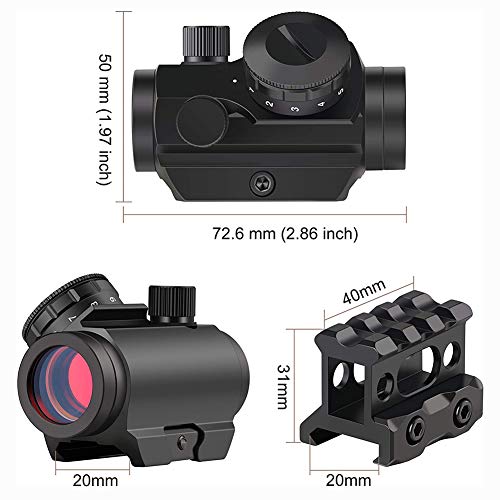
Objective Lens Dia: 20mm
Length: 2.7in
Reticle: 3-4 MOA
Field of View @ 100 yards: 10.7
Parallax Free@20 yards:20
Eye Relief: Unlimited
Exit Pupil: 22mm
Windage/Elevation Click Value: 1 MOA per click
Adj. Range: +/- 35 MOA
Rifle Scope Product Features
4 MOA red dot sight allows for accurate, both-eyes-open shooting. Unlimited eye relief makes for quick target acquisition. Multi-coated scratch resistant lens provides enhanced image clarity and increases light transmission during low light situations.
The small but adaptable optics are perfect for a wide range of daytime applications including hunting, tactical scenarios and precision shooting. Ideal for close-range and general shooting.
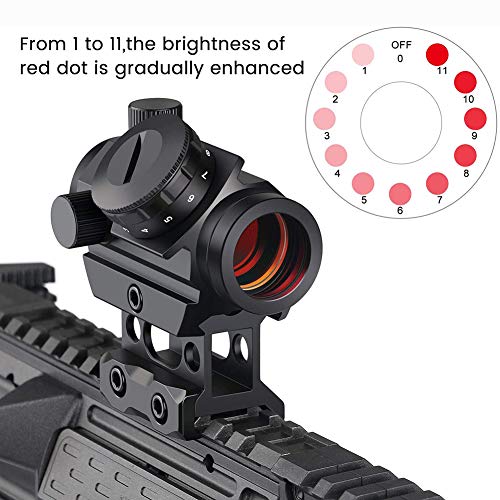
11 red dot brightness settings provide optimal visibility in any light conditions, let shooters cater the dot intensity to the situation at hand.
A shockproof aluminum body displays extreme durability. Nitrogen purged and O-rong sealed. Fully waterproof with sealed housing.Matte black anodized finish resists scratches while keeping a stealthy profile.
Offers two height options (Low and Lower 1/3 Co-Witness), lending its functionality on any platform.
About the MUJING Manufacturer
MUJING is a premium manufacturer for long gun scopes, optics, mounting solutions, and other accessories used for guns like rifles and long guns. They design and manufacture their products using building materials which are durable and long lasting. This includes the Red Dot Sight 1X25 Sights Reflex with 20mm Rail Mount & Increase Riser Rail by MUJING. For more shooting items, visit their site.
Rifle Scope Details
Rifle scopes permit you to precisely align a rifle at various targets by lining up your eye with the target over a distance. They accomplish this through magnifying the target by utilizing a set of lenses inside the scope. The scope’s positioning can be adapted for consideration of various natural things like wind speed and elevation decreases to make up for bullet drop.
The scope’s purpose is to help the shooter understand precisely where the bullet will hit based on the sight picture you are seeing using the scope as you line up the scope’s crosshair or reticle with the intended target. A lot of contemporary rifle scopes and optics have around eleven parts which are found internally and externally on the scope. These scope parts consist of the rifle scope’s body, lenses, elevation turrets, focus rings, and other elements. Learn about the eleven parts of rifle optics.
About Optic Styles
Rifle scopes can be either “first focal plane” or “second focal plane” type of scopes. Opting for the optimal type of rifle scope is based on what type of shooting you plan on doing.
Info About First Focal Plane Scopes
First focal plane optics (FFP) include the reticle before the zoom lens. This triggers the reticle to increase in size based upon the amount of magnification being used. The result is that the reticle measurements are the same at the enhanced distance as they are at the non magnified distance. One tick on a mil-dot reticle at one hundred yards with no “zoom” is still the identical tick at one hundred yards with 5x “zoom”. These kinds of scopes are valuable for:
- Quick acquisition, long distance types of shooting
- Shooting circumstances where computations are small
- Experienced shooters who recognize their aim point “hold over” and also “lead” correlations for their rifles
- Shooters who do not mind the reticle is enlarged and takes up more visual sight room than a SFP reticle
Second Focal Plane Glass
Second focal plane optics (SFP) feature the reticle to the rear of the zoom lens. In the FFP example with the SFP scope, the 5x “zoom” one hundred yard tick reticle measurement would be 1/5th of the non “zoom” tick.
- Far away forms of shooting where shooters have increased time to make ballistic computations
- Shooting where most of the shots happen within much shorter distances and ranges
- Shooters who would like a clearer optic picture without room used up by the larger size FFP reticle
Zoom for Glass
The quantity of zoom a scope supplies is identified by the size, density, and curvatures of the lenses inside of the rifle scope. The magnification of the scope is the “power” of the scope.
About Fixed Power Lens Rifle Scopes
A single power rifle scope and optic comes with a magnification number designator like 4×32. This means the zoom power of the scope is 4x power and the objective lens is 32mm. The magnification of this kind of scope can not change because it is fixed.
Variable Power Lens Rifle Scopes
Variable power rifle scopes can be adjusted between magnification levels. It will note the zoom degree in a configuration such as 2-10×32. These numbers imply the magnification of the scope could be adjusted between 2x and 10x power. This additionally includes the power levels in-between 2 and 10. The power modification is achieved by employing the power ring part of the scope near the back of the scope by the eye bell piece.
Rifle Scope Power Level and Ranges
Here are some suggested scope power settings and the ranges where they can be efficiently used. Keep in mind that higher power optics will not be as efficient as lower magnification level scopes due to the fact that too much zoom can be a bad thing. The same concept goes for longer distances where the shooter needs to have increased power to see exactly where to best aim the rifle.
Lens Covering for Rifle Scopes
All contemporary rifle scope lenses are coated. Lens covering is an essential aspect of a rifle system when considering high end rifle optics and scope setups.
HD Versus ED Lens Coatings
Some glass makers even use “HD” or high-definition glass finishes which apply different processes, polarizations, aspects, and chemicals to extract numerous color ranges and viewable target visibility through the lens. This high-def covering is commonly used with more costly, high density lens glass which lowers light’s potential to refract by means of the lens glass. Some scope manufacturers use “HD” to refer to “ED” meaning extra-low dispersion glass. ED deals with how colors are represented on the chromatic spectrum and the chromatic difference or aberration which is also called color distortion or fringing. Chromatic aberration is often obvious over things with hard shapes as light hits the object from certain angles.
Info on Single Coating Versus Multi-Coating
Different scope lenses can even have different coverings applied to them. All lenses usually have at least some kind of treatment or coating applied to them before they are used in a rifle scope or optic. Since the lens isn’t just a raw piece of glass, they require performance enhancing coatings. It is part of the finely tuned optic. It requires a coating to be applied to it so that the lens will be optimally usable in lots of kinds of environments, degrees of sunshine (full VS shaded), and other shooting conditions.
This lens treatment can safeguard the lens from scratches while minimizing glare and other less advantageous things experienced in the shooting environment while sighting in with the scope. The quality of a single layered lens depends on the scope manufacturer and how much you paid for it.
Some scope manufacturers also make it a point to define if their optic lenses are layered or “multi” coated. This means the lens has multiple treatments applied to the surfaces. If a lens gets multiple treatments, it can prove that a manufacturer is taking multiple actions to fight various environmental elements like an anti-glare coating, a scratch resistant anti-abrasion covering, followed by a hydrophilic finishing. This additionally does not necessarily imply the multi-coated lens is better than a single covered lens. Being “better” depends upon the producer’s lens treatment techniques and the quality of products used in constructing the rifle scope.
Anti-water Lens Covering
Water on an optic’s lens doesn’t assist with retaining a clear sight picture through an optic whatsoever. Many top of the line and high-end scope makers will coat their lenses with a hydrophobic or hydrophilic finishing. The Steiner Optics Nano-Protection is a good example of this kind of treatment. It treats the surface area of the Steiner scope lens so the H2O molecules can not bind to it or develop surface tension. The outcome is that the water beads slide off of the scope to preserve a clear, water free sight picture.
Rifle Scope Installing Choices
Mounting solutions for scopes are available in a couple of options. There are the basic scope rings which are separately installed to the scope and one-piece scope mounts which cradle the scope. These various kinds of mounts also typically are made in quick release versions which use throw levers which enable rifle operators to quickly mount and dismount the scopes.
Rifle Optic Mounts with Hex Key Rings
Standard, clamp design mounting scope rings use hex head screws to mount to the flattop design Picatinny scope mount rails on rifles. These types of scope mounts use a couple of separate rings to support the optic, and are made from 7075 T6 billet aluminum which is developed for long distance precision shooting. This type of scope install is perfect for rifles which require a long lasting, sound mounting solution which will not move no matter how much the scope is moved or abuse the rifle takes.
Quick-Release Cantilever Rifle Scope Ring Mounts
These types of quick-release rifle scope mounts can be used to quickly remove a scope and connect it to a different rifle. Several scopes can even be swapped out if they all use a compatible design mount. These types of mounts are handy for long guns which are transferred a lot, to swap out the optic from the rifle for protection, or for scopes which are used between numerous rifles.
What to Know About Optic Tube Sealing and Gas Purging
Wetness inside your rifle glass can destroy a day on the range and your highly-priced optic by triggering fogging and creating residue inside of the scope’s tube. A lot of optics prevent moisture from getting in the scope tube with a series of sealing O-rings which are water resistant. Normally, these water-resistant scopes can be submerged under 20 or 30 feet of water before the water pressure can force moisture past the O-rings. This should be plenty of humidity avoidance for basic use rifles for hunting and sporting purposes, unless you plan on taking your rifle on a boat and are concerned about the scope still functioning if it is submerged in water and you can still rescue the gun.
Rifle Glass Gas Purging
Another part of avoiding the buildup of moisture inside of the rifle scope’s tube is filling the tube with a gas like nitrogen. Considering that this space is currently occupied by the gas, the glass is less altered by condition alterations and pressure variations from the external environment which could possibly allow water vapor to leak in around the seals to fill the vacuum which would otherwise exist. These are good qualities of a decent rifle scope to look for.


