


Description
Rifle Scope Product Details
Hawke Sidewinder ED SF IR Riflescope 30m
Rifle Scope Product Features
GUN SCOPE SPECIFICALLY DESIGNED FOR LONG-RANGE SHOOTING – with world class optics for outstanding vi
BRIGHT, CLEAR, SHARP IMAGES – Optics on this long range riflescope feature Extra-low Dispersion (ED) glass for a sharper, crisper view and 18 layers of advanced coatings on each lens for superb light transmission and bright detailed images.
SUPPLIED WITH THREE INTERCHANGEABLE TURRETS – Switch from MOA to MOA or 1/10 MRAD according to your preference. All three of these patented turrets are exposed for quick yet precise adjustments.
ILLUMINATED GLASS ETCHED RETICLE – TMX reticle is specially developed for long range shooting, with illuminated aim points and additional windage and holdover marks.
HAWKE LIFETIME WORLDWIDE WARRANTY – Genuine product from the brand leader in high performance gun scopes, spotting scopes and binoculars
Designed for full-bore target and FT shooting, Sidewinder ED’s are packed with performance-enhancing features required for accuracy.
This high magnification side focus riflescope is designed to meet the very specific requirements and demands of target shooters with precision engineered components, a unique illuminated (red) glass etched reticle and chromatic aberration reducing Extra-low Dispersion (ED) glass.
The Sidewinder ED features the TMX reticle, developed for long-range target shooting and around the common principles of Mil-Dot spacing when magnification is set to 20x.
Patented exposed, locking and interchangeable turrets give the user an option to customize the click value from MOA to either MOA or 110MRAD.
TMX RETICLE
The TMX reticle was developed for long-range, centrefire shooting and around the common principles of Mil-Dot spacing. As with Mil-Dot spacing, the series of hash marks represent a unit of angle called an MRAD (milliradian) or mil for short. This is equal to a gap of 3.6 inches at 100 yards, or 3 feet at 1,000 yards. This is equivalent to 10cm at 100m, or 1m at 1,000m.
When magnification is set to 10x the TMX reticle allows for 16 mil spacing of hold-over to the outer edge of the field of view, along with 6 mil spacing of windage in each direction.
INTERCHANGEABLE, LOCKING AND RESETTABLE TURRETS
Hawke’s patented interchangeable turrets allow for changing between MOA to either MOA or 110 MRAD to suit your shooting preference.
By simply unscrewing the locking collar the turret can be lifted off and removed from the scope. Each turret has indexed teeth to ensure that the location and alignment are kept during installation. Push down on the turret, screw the locking collar back down and the scope is ready for use.
NO FAULT PEACE OF MIND
British brand Hawke makes innovative, feature-rich precision instruments that offer great value for money. Exceptional engineering and build quality means that Hawke rifle scopes give you the accurate and precise vision you need.
All Hawke riflescopes are fully assured”for life. In the event your product becomes damaged or defective Hawke will repair it at no charge to you. It doesn’t matter how it happened or whose fault it was ” you are covered.
WHAT’S IN THE BOX
Lens cloth
4″ Sunshade
Metal flip-up lens covers
Flip-up removal tool
4″ Sidewheel
1/10 MRAD turrets, 1/8 MOA turrets, MOA Turrets
Pointer
Hex keys
0-rings
CR2032 batteries
TECHNICAL
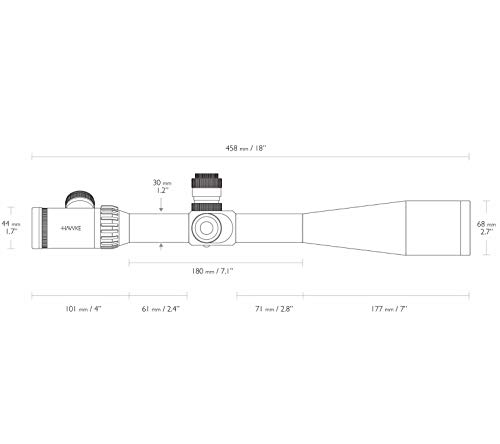
Chassis: 30mm Mono-tube
Optical System: 10-50x
Objective: 60mm
Illumination: Red – Stepless
Focus/Parallax: Side Focus – 9m / 10yds to Infinity
Field of View: m @100m / ft @100yds3.9 – 0.8m / 11.7 – 2.4ft
Eye relief: 95mm / 3.7″
Length: 458mm / 18″
Weight: 980g / 34.6oz
Waterproof, Shockproof, Nitrogen purged. All calibre rated.
FULL FEATURE LIST
High magnification precision optical system.
Extra-low Dispersion (ED) glass for optimum clarity.
Interchangeable, locking and resettable turrets.
14 MOA fitted (18 MOA & 110 MRAD included)
Side focus control for parallax adjustment to infinity. (Patented removable side wheel, with different sizes available)
30mm mono-tube chassis for superior strength.
Glass etched reticle with red illumination.
Stepless IR rheostat offers total brightness control.
Locking ocular and high torque zoom ring.
Includes screw-in metal flip-up lens covers.
About the Hawke Brand
Hawke is a premium manufacturer for rifle scopes, optics, mounting solutions, and other accessories used for firearms like rifles and long guns. They innovate and build their scopes, mounts, and related products by making the most of building materials which are resilient and long lasting. This includes the Hawke Sidewinder ED SF IR Riflescope 30m by Hawke. For more shooting items, visit their site.
What You Need to Know About Rifle Optics
Rifle scopes permit you to precisely align a rifle at different targets by lining up your eye with the target over a range. They accomplish this through magnification by making use of a set of lenses inside the scope. The scope’s positioning can be adapted for the consideration of different natural factors like wind and elevation increases or decreases to make up for bullet drop.
The scope’s purpose is to help shooters understand precisely where the bullet will hit based upon the sight picture you are seeing via the scope as you line up the scope’s crosshair or reticle with the intended point of impact. A lot of contemporary rifle scopes have around eleven parts which are found internally and on the exterior of the optic. These parts consist of the rifle scope’s body, lenses, windage dials, objective focus rings, and other parts. See all eleven parts of an optic.
Rifle Scope Types
Rifle scopes can be either “first focal plane” or “second focal plane” type of scopes. The style of focal plane a scope has identifies where the reticle or crosshair is located in connection with the optic’s magnification. It literally implies the reticle is situated behind or before the magnifying lens of the optic. Selecting the most ideal style of rifle glass depends upon what form of shooting or hunting you anticipate doing.
First Focal Plane Glass Info
Focal plane scopes (FFP) feature the reticle in front of the magnification lens. These kinds of scopes are useful for:
- Quick acquisition, long distance types of shooting
- Shooting situations where calculations are minimal
- Experienced shooters who know their aim point “hold over” plus “lead” correlations for their rifles
- Shooters who do not mind the reticle is enlarged and occupies more visual eyesight room than a SFP reticle
Second Focal Plane Glass
Second focal plane scopes (SFP) feature the reticle behind the magnification lens. In the FFP example with the SFP scope, the 5x “zoom” 100 yard tick measurement would be 1/5th of the non “zoom” tick reticle measurement.
- Far away styles of shooting where shooters have extra time to make ballistic calculations
- Shooting where most of the shots take place within shorter ranges and distances
- Shooters who prefer a clearer optic picture with less space used up by the larger sized FFP reticle
Scope Zoom
The amount of magnification a scope provides is identified by the diameter, thickness, and curvatures of the lenses inside of the rifle scope. The magnification of the scope is the “power” of the scope.
Info About Fixed Single Power Lens Optics
A single power rifle optic and scope uses a magnification number designator like 4×32. This indicates the zoom power of the scope is 4x power while the objective lens is 32mm. The zoom of this kind of optic can not adjust because it is a set power scope.
Info on Variable Power Lens Rifle Glass
Variable power rifle scopes can be changed between magnification levels. These types of scopes will list the zoom degree in a configuration such as 2-10×32. These numbers mean the zoom of the scope can be set in between 2x and 10x power. This additionally utilizes the powers in-between 2 and 10. The power manipulation is achieved by employing the power ring part of the scope near the rear of the scope by the eye bell piece.
Optic Power Level and Range Correlation
Here are some recommended scope power settings and the ranges where they may be efficiently used. Keep in mind that higher magnification optics will not be as effective as lower magnification level glass since too much magnification can be a negative thing in certain situations. The exact same concept goes for extended distances where the shooter needs to have adequate power to see exactly where to properly aim the rifle at the target.
Details on Lens Finishes
All modern-day rifle glass lenses are covered. Lens covering can be an essential element of a shooting platform when purchasing high end rifle optics and scope setups.
HD Versus ED Rifle Glass Lens Coatings
Some scope brands likewise use “HD” or high-definition lens coatings which use different processes, polarizations, aspects, and chemicals to draw out different colors and viewable definition through the lens. Some scope makers use “HD” to refer to “ED” meaning extra-low dispersion glass.
Single Covering Versus Multi-Coating for Rifle Scopes
Various scope lenses can even have various coverings applied to them. All lenses usually have at least some type of treatment or finishing applied to them prior to being used in a rifle scope or optic. This is because the lens isn’t simply a raw piece of glass. It becomes part of the finely tuned optic. It needs to have a finishing placed on it so that it will be efficiently functional in numerous kinds of environments, degrees of sunlight (full VS shade), and other shooting conditions.
This lens treatment can protect the lens from scratches while decreasing glare and other less useful things experienced in the shooting environment while sighting in with the scope. The quality of a single layered lens depends on the scope producer and how much you paid for it.
Some scope producers similarly make it a point to specify if their optic lenses are layered or “multi” covered. Being “better” depends on the maker’s lens treatment innovation and the quality of products used in building the rifle scope.
Details on Hydrophobic Finishing
Water on a lens doesn’t assist with maintaining a clear sight picture through a scope at all. Numerous top of the line and military grade scope companies will coat their lenses with a hydrophilic or hydrophobic finish which is water repellent.
Glass Mounting Alternatives
Mounting options for scopes come in a few choices. There are the standard scope rings which are separately installed to the optic and one-piece scope mounts which cradle the scope. These various types of mounts also usually are made in quick release variations which use toss levers which permit rifle operators to quickly install and remove the optics.
Hex Key Optic Ring Mounting Solutions
Basic, clamp style mounting scope rings use hex head screws to mount to the flattop style Picatinny scope mount rails on the tops of rifles. These forms of scope mounts use two detached rings to support the optic, and are normally constructed from 7075 T6 billet aluminum or similar materials which are made for far away precision shooting. This type of scope mount is very good for rifle systems which require a durable, unfailing mount which will not move despite how much the scope is moved or abuse the rifle takes. These are the type of mounts you should get for a devoted optics system on a far away hunting or hard target interdiction firearm which will pretty much never need to be changed or recalibrated. Blue 242 Loctite threadlocker can additionally be used on the scope mount’s screws to stop the hex screw threads from backing out after they are mounted firmly in position. An example of these rings are the 30mm style from Vortex Optics. The set normally costs around $200 USD
Rifle Optic Mounting Solutions with Quick-Release Cantilever Rings
These types of quick-release rifle scope mounts can be used to rapidly take off a scope and connect it to a different rifle. Multiple scopes can also be switched out if they all use a compatible style mount. These types of mounts are convenient for rifles which are carried a lot, to swap out the optic from the rifle for protecting the scope, or for optics which are used in between several rifles or are situationally focused.
Rifle Glass Tube Sealing and Gas Purging
Wetness inside your rifle optic can destroy a day on the range and your expensive optic by resulting in fogging and producing residue within the scope tube. A lot of scopes prevent wetness from getting in the scope tube with a system of sealing O-rings which are waterproof. Usually, these water-resistant optics can be submerged beneath 20 or 30 feet of water before the water pressure can force moisture past the O-rings. This should be more than enough moisture avoidance for standard use rifles for hunting and sporting purposes, unless you plan on taking your rifle on your motorboat and are worried about the scope still performing if it goes over the side and you can still retrieve the firearm.
Rifle Glass Gas Purging
Another part of avoiding the buildup of moisture inside of the rifle scope tube is filling the tube with a gas like nitrogen. Given that this space is already taken up by the gas, the glass is less impacted by temperature alterations and pressure variations from the outside environment which could potentially allow water vapor to leak in around the seals to fill the vacuum which would otherwise exist. These are good qualities of a good rifle scope to seek out.


