
Description
Rifle Scope Product Details
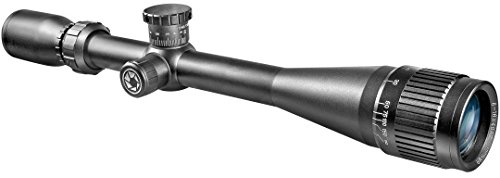
BARSKA 6-18×40 mm AO Hot Magnum .17 And .22 Interchangeable 30/30 Rifle Scope
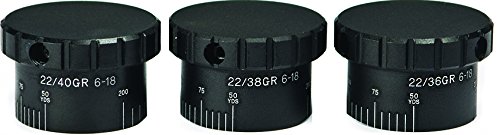
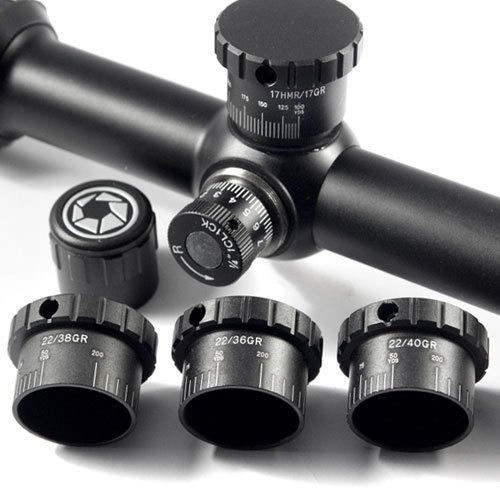
6-18×40 AO, Hot Magnum , Black Matte, 30/30, Engineered with revolutionary Bullet Drop Technology, interchangeable .22 BDC elevation knobs for 40GR, 38GR and 36GR .22 bullets, high density optical glass for crisp edge-to-edge clarity, Pre-calculated trajectory compensation from 100 to 300 yards, multi-coated optics for brighter viewing and adjustable objective (AO) for parallax correction, Backed by BARSKA’s Limited Lifetime Warranty. Specifications: – Magnification: 6-18x – Objective Lens: 40mm – Waterproof: Yes – Fogproof: Yes – Reticle: 30/30 – Exit Pupil: 6.67-2.2mm – Optical Coating: Multi Coated – Field of View (ft100yds/m100m): 14.5/4.86x, 4.5/1.518x – Eye Relief: 3.1 inch – Click Value: 1/4″ – Adjustment Knob: Adj. obj. lens, adj. parallax, adj. elevation – Tube Diameter: 1 inch – Finish: Black Matte – Weight: 20.48 oz. – Length: 15.65 inch – Included Accessories: interchangeable .22 BDC elevation knobs for 40GR, 38GR and 36GR .22 bullets, Lens Covers and Lens Cloth – Warranty: Limited Lifetime Warranty
Rifle Scope Product Features
6-18x variable magnification with large 40mm objective lens in a 100% waterproof and fogproof extra rigid shockproof construction
Multi-coated optics with 30/30 reticles.
Adjustable Objective lens for parallax correction.
Specifically engineered for .17 Magnum Rimfire Rifle and Pre-calculated trajectory compensation form 100 to 300 yards by turn of a dail
Bullet Drop Technology.Made in China
AC10850
Specs
Item: AC10850
Field of View(ft @ 100yds): 14.5 @ 6x , 4.5 @ 18x
Eye Relief: 3.1 inch
Exit Pupil: 6.67mm – 2.2mm
Click Value: 1/4 MOA
Focal Plane: Second
Length: 15.65″ ; Weight: 20.48 oz ; 1″ Tube Diameter
Included: Scope Caps ; BDC Turrets ; Lens Cloth
6-18x40mm AO Hot Magnum .17 HMR / .22 BDC Rifle Scope
by Barska
Engineered with revolutionary bullet-drop technology, Hot Magnum scopes will make you an extreme performer when it comes to .22 cal and .17 cal Magnum rimfire shooting.To provide extreme accuracy, the scope’s elevation knob is precisely calculated to compensate for the elliptical drop of the .17 Magnum rimfire with a 17 grain bullet, as well as 40, 38, & 36 grain bullets of .22 caliber. Also features high density optical glass, multi-coated optics and adjustable objective.
6-18x Magnification
40mm Objective Lens
Multi-coated Optics
Interchangeable .17 HMR / .22 BDC
30/30 Reticle
Adjustable Objective
Waterproof, Fogproof and Shockproof
Durable, Light Weight Riflescope
This 6-18×40 riflescope is durable and lightweight, perfect for hunting or target practice.
BDC Elevation
The scope comes with interchangeable .17 and .22 BDC knobs, featuring pre-calculated trajectory compensation for 17 grain bullets of .17 Magnum rimfire, as well as 40, 38, and 36 grain .22 bullets.
Zoom Adjustment
6-18x adjustable zoom allows users to get up close to the target, suitable for mid- to long-range targeting.
Reticle
The scope comes with a crosshair 30/30 reticle, allowing the shooter to easily aim at the target.
AC10850 AC10848 AC10846 AC10776 AC11392 AC11380
Magnification 6-18x 3-12x 2-7x 6-20x 6-24x 6-24x
Objective Lens 40mm 40mm 32mm 50mm 40mm 44mm
Lens Coating Multi-Coated Multi-Coated Multi-Coated Fully Multi-Coated Fully Multi-Coated Fully Multi-Coated
Click Value 1/4 MOA 1/4 MOA 1/4 MOA 1/4 MOA 1/8 MOA 1/8 MOA
Reticle 30/30 30/30 30/30 First Focal Plane Illuminated Mil-Dot Illuminated 3G P4
Turret .17 HMR / .22 BDC .17 HMR / .22 BDC .17 HMR / .22 BDC Capped .223 B.D.C. External Locking
Length 15.65″ 13.75″ 12″ 16.3″ 14.25″ 14″
Product Weight 20.48 oz 18.88 oz 16.64 oz 26.87 oz 21.89 oz 22.57 oz
About the BARSKA Manufacturer
BARSKA is a premium manufacturer for firearm scopes, optics, mounts, and other add-ons used for firearms like rifles and long guns. They innovate and manufacture their products using building materials which are durable and long lasting. This includes the BARSKA 6-18×40 mm AO Hot Magnum .17 And .22 Interchangeable 30/30 Rifle Scope by BARSKA. For additional shooting products, visit their website.
Info About Rifle Glass
Rifle scopes allow you to specifically align a rifle at different targets by lining up your eye with the target over a range. They do this through magnifying the target by making use of a set of lenses inside the scope. The scope’s alignment can be dialed in for consideration of various natural factors like wind speed and elevation increases to account for bullet drop.
The scope’s purpose is to help the shooter understand exactly where the bullet will land based upon the sight picture you are seeing with the scope as you align the scope’s crosshair or reticle with the target. A lot of contemporary rifle scopes have around 11 parts which are found internally and on the exterior of the scope body. These optic pieces consist of the rifle scope’s body, lenses, windage and elevation dials or turrets, objective focus rings, and other elements. See all eleven parts of optics.
Rifle Optic Styles
Rifle scopes can be either “first focal plane” or “second focal plane” kind of scopes. The form of focal plane an optic has establishes where the reticle or crosshair lies relative to the optic’s magnifying adjustments. It literally means the reticle is located behind or in front of the magnifying lens of the scope. Selecting the very best sort of rifle scope is dependent on what type of shooting or hunting you plan on doing.
First Focal Plane Glass
Focal plane scopes (FFP) come with the reticle in front of the magnifying lens. This causes the reticle to increase in size based upon the extent of zoom being used. The outcome is that the reticle measurements are the same at the amplified range as they are at the non magnified distance. For example, one tick on a mil-dot reticle at one hundred yards with no “zoom” is still the exact same tick at 100 yards using 5x “zoom”. These types of scopes work for:
- Quick acquisition, long distance kinds of shooting
- Shooting scenarios where calculations are small
- Experienced shooters who understand their aim point “hold over” plus “lead” equations for their weapon
- Shooters who don’t mind the reticle is bigger and uses up more visual eyesight room than a SFP reticle
About Second Focal Plane Optics
Second focal plane glass (SFP) come with the reticle to the rear of the zoom lens. This causes the reticle to stay at the same overall size in relation to the amount of magnification being used. The end result is that the reticle dimensions adjust based on the magnification employed to shoot over longer ranges considering that the reticle markings present different increments which change with the zoom level. In the FFP example with the SFP optic, the 5x “zoom” one hundred yard tick would be 1/5th of the non “zoom” tick measurement. These particular styles of scopes work for:
- Far away forms of shooting where shooters have extra time to make ballistic calculations
- Shooting where most of the shots happen within shorter ranges and distances
- Shooters who want a clearer optic sight picture without space used up by the larger size FFP reticle
Zoom for Rifle Optics
The extent of scope magnification you need on your glass depends upon the style of shooting you choose to do. Nearly every style of rifle scope supplies some level of zoom. The level of zoom a scope offers is determined by the diameter, thickness, and curvatures of the lenses inside of the rifle scope. The zoom of the optic is the “power” of the opic. This suggests what the shooter is checking out through the scope is magnified times the power factor of what can generally be seen by human eyes.
Single Power Lens Rifle Optic Facts
A single power rifle optic and scope uses a zoom number designator like 4×32. This indicates the magnification power of the scope is 4x power and the objective lens is 32mm. The zoom of this type of optic can not fluctuate considering that it is a set power scope.
Info About Variable Power Lens Scopes
Variable power rifle scopes can be modified between magnified levels. The power adjustment is accomplished by making use of the power ring part of the scope near the rear of the scope by the eye bell.
The Power and Range of Rifle Optics
Here are some recommended scope power levels and the ranges where they could be efficiently used. Highly magnified glass will not be as beneficial as lower magnification optics because too much zoom can be a negative aspect depending on your shooting distance. The exact same concept goes for longer ranges where the shooter needs to have sufficient power to see precisely where to best aim the rifle at the target.
Details on Rifle Scope Lens Finishes
All modern-day rifle optic and scope lenses are covered in special coatings. There are various types and qualities of glass coverings. When looking at high end rifle scope setups, Lens finishing can be a vital component of defining the capability of the rifle. The glass lenses are one of the most vital components of the scope considering they are what your eye sees through while sighting a rifle in on the point of impact. The finish on the lenses offers protection to the lens surface as well as improves anti glare capabilities from excess daylight and color discernibility.
HD Versus ED Lens Coatings
Some scope makers likewise use “HD” or high-definition lens coatings which use different methods, aspects, chemicals, and polarizations to draw out different colors and viewable definition through the lens. Some scope producers use “HD” to refer to “ED” indicating extra-low dispersion glass.
Single Finish Versus Multi-Coating
Different optic lenses can also have different coverings used to them. All lenses normally have at least some type of treatment or finish used to them prior to being used in a rifle scope or optic.
Single layered lenses have a treatment applied to them which is typically a protective and boosting multi-purpose treatment. This lens treatment can shield the lens from scratches while reducing glare and other less useful things experienced in the shooting environment while sighting in with the optic. The quality of a single layered lens depends on the scope developer and how much you spent paying for it. The scope’s maker and cost are indications of the lens quality.
Some scope manufacturers likewise make it a point to define if their optic lenses are coated or “multi” covered. This means the lens has multiple treatments applied to the surfaces. If a lens gets numerous treatments, it can show that a maker is taking multiple steps to fight different environmental aspects like an anti-glare coating, a scratch resistant anti-abrasion coating, followed by a hydrophilic covering. This also does not always suggest the multi-coated lens is much better than a single coated lens. Being “much better” is dependent on the maker’s lens treatment techniques and the quality of components used in developing the rifle glass.
Rifle Scope Lens Anti-water Covering
Water on a lens doesn’t help with keeping a clear sight picture through a scope whatsoever. Many top of the line and premium optic makers will coat their lenses with a hydrophobic or hydrophilic finish. The Steiner Optics Nano-Protection is a good example of this type of treatment. It deals with the surface of the Steiner optic lens so the H2O particles can not bind to it or develop surface tension. The outcome is that the water beads slide off of the scope to maintain a clear, water free sight picture.
Rifle Scope Installing Options
Installing options for scopes can be found in a couple of choices. There are the basic scope rings which are individually mounted to the optic and one-piece scope mounts which cradle the scope. These various types of mounts also usually come in quick release variations which use manual levers which permit rifle operators to rapidly mount and dismount the optics.
Hex Key Rifle Optic Rings
Normal, clamp design mounting scope rings use hex head screws to mount to the flattop style Picatinny scope installation rails on rifles. These types of scope mounts use two separate rings to support the optic, and are often made from 7075 T6 billet aluminum which are designed for long distance accuracy shooting. This type of scope mount is wonderful for rifles which need a resilient, sound mounting solution which will not move no matter how much the scope is moved or abused.
Quick-Release Cantilever Glass Ring Mounts
These types of quick-release rifle scope mounts can be used to rapidly take off a scope and connect it to a different rifle. Multiple scopes can even be swapped out if they all use a similar style mount. These types of mounts are convenient for rifles which are transported a lot, to swap out the optic from the rifle for protecting the scope, or for optics which are used between numerous rifles or are situationally focused.
Rifle Optic Tube Sealing and Gas Purging
Moisture inside your rifle scope can destroy a day of shooting and your expensive optic by bringing about fogging and creating residue inside of the scope tube. A lot of scopes avoid wetness from getting in the scope tube with a system of sealing O-rings which are water resistant.
Gas Purged Glass Tubes
Another component of preventing the buildup of wetness inside of the rifle scope’s tube is filling the tube with a gas like nitrogen. Because this space is already occupied by the gas, the optic is less impacted by temperature level alterations and pressure distinctions from the outdoor environment which may potentially enable water vapor to permeate in around the seals to fill the void which would otherwise exist. These are good qualities of a good rifle scope to seek out.


