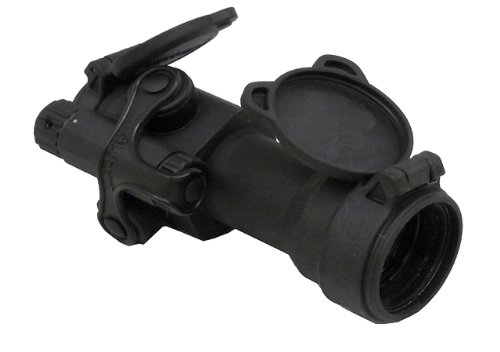
Description
Rifle Scope Product Details
Aimpoint 2 Minute of Angle CompML3 Sight
The CompML3 features our breakthrough Advanced Circuit Efficiency Technology (ACET) that gives the sight unparalleled battery life and ease of use. Built primarily for use in daylight and in low light conditions for law enforcement and military applications, the CompML3 will hold up under the roughest physical handling and most severe weather conditions. It is the perfect choice for professionals, hunters and sport shooters who don’t need night vision device compatibility but want an extremely tough and reliable sight. For night vision compatibility we recommend the CompM3. The CompML3 comes with a replaceable outer black rubber cover, which protects it from scratching and adds an additional stealth factor. The outer cover is also available in Dark Earth Brown ” perfect camo for use in the desert and in the jungle. Unique features for CompML3 New technology called ACET allows 50,000 hours of operation on one battery. Outer rubber cover now available in earth brown.
Rifle Scope Product Features
Designed for day use, including dusk and dawn
Available in 2 dot sizes (2 and 4 MOA)
Submersible to 135 feet (45 meters)
Comes with replaceable outer black rubber cover
Reduced training time and ammunition
About the Aimpoint Company
Aimpoint is a premium supplier for rifle scopes, optics, mounting solutions, and other accessories used for guns like rifles and long guns. They style and manufacture their mounts and related products making the most of materials which are resilient and long lasting. This includes the Aimpoint 2 Minute of Angle CompML3 Sight by Aimpoint. For additional shooting items, visit their site.
Information About Rifle Optics
Rifle scopes permit you to precisely align a rifle at different targets by lining up your eye with the target at range. They accomplish this through magnifying the target by utilizing a series of lenses inside the scope. The scope’s alignment can be adjusted for consideration of many natural considerations like wind speed and elevation increases to account for bullet drop.
The scope’s purpose is to help shooters understand exactly where the bullet will land based on the sight picture you are seeing through the optic as you align the scope’s crosshair or reticle with the intended target. Many modern-day rifle optics have about 11 parts which are arranged inside and outside of the scope. These parts consist of the rifle scope’s body, lenses, adjustment turrets or dials, objective focus rings, and other parts. See all eleven parts of a rifle scope.
About Optic Types
Rifle scopes can be either “first focal plane” or “second focal plane” type of scopes. Deciding upon the optimal type of rifle scope is based around what type of shooting you plan to do.
About First Focal Plane Scopes
Focal plane scopes (FFP) come with the reticle in front of the zoom lens. This causes the reticle to increase in size based upon the extent of zoom being used. The outcome is that the reticle measurements are the same at the magnified distance as they are at the non amplified distance. One tick on a mil-dot reticle at 100 yards with no “zoom” is still the very same tick at one hundred yards with 5x “zoom”. These types of scopes work for:
- Quick acquisition, long distance kinds of shooting
- Shooting circumstances where calculations are small
- Experienced shooters who recognize their target “hold over” as well as “lead” equations for their weapon
- Shooters who do not mind the reticle is enlarged and uses up more visual sight area than a SFP reticle
Second Focal Plane Optic Facts
Second focal plane scopes (SFP) include the reticle to the rear of the magnification lens. This causes the reticle to stay at the very same size in relation to the level of zoom being used. The end result is that the reticle dimensions shift based upon the magnification employed to shoot over lengthier ranges because the markings represent distinct increments which differ with the magnification. In the FFP illustration with the SFP glass, the 5x “zoom” 100 yard tick would be 1/5th of the non “zoom” tick reticle measurement. These types of glass work for:
- Far away kinds of shooting where shooters have extra time to make ballistic computations
- Shooting where most of the shots take place within shorter spaces and ranges
- Shooters who select a clearer optic sight picture without room taken up by the larger size FFP reticle
About Rifle Optic Magnification
The amount of zoom a scope offers is determined by the diameter, thickness, and curvatures of the lenses inside of the rifle scope. The magnification of the scope is the “power” of the scope.
About Fixed Single Power Lens Optics
A single power rifle scope and optic comes with a zoom number designator like 4×32. This means the zoom power of the scope is 4x power while the objective lens is 32mm. The magnification of this kind of scope can not change given that it is a fixed power optic.
About Adjustable Power Lens Rifle Scopes
Variable power rifle scopes have adjustable power. It will list the zoom amount in a configuration such as 2-10×32. These numbers mean the magnification of the scope could be set between 2x and 10x power. This always incorporates the power levels in-between 2 and 10. The power manipulation is achieved by operating the power ring component of the scope near the rear of the scope by the eye bell.
Power and Range Correlations
Here are some recommended scope powers and the distances where they may be successfully used. High power scopes will not be as useful as lower magnification optics because too much zoom can be a bad thing. The same idea applies to extended distances where the shooter needs to have increased power to see precisely where to best aim the rifle at the target.
Lens Finishing for Rifle Scopes
All cutting-edge rifle scope and optic lenses are layered. Lens covering can be an essential aspect of a rifle system when considering high end rifle optics and scope equipment.
HD Versus ED Lenses
Some glass makers even use “HD” or high-def lens finishes which make the most of different procedures, elements, compounds, and polarizations to enhance various color ranges and viewable definition through the lens. This high-definition finish is frequently used with higher density glass which brings down light’s potential to refract through the lens glass. Some scope vendors use “HD” to refer to “ED” indicating extra-low dispersion glass. ED deals with how colors are represented on the chroma spectrum and the chromatic deviance or aberration which is similarly called color distortion or fringing. Chromatic aberration may be obvious around objects with hard outlines as light hits the object from specific angles.
Glass Lens Single Covering Versus Multi-Coating
Different optic lenses can even have various finishings applied to them. All lenses usually have at least some kind of treatment or finishing applied to them prior to being used in a rifle scope or optic. This is due to the fact that the lens isn’t simply a raw piece of glass. It becomes part of the carefully tuned optic. It must have a finishing put on it so that the lens will be efficiently usable in numerous kinds of environments, degrees of sunshine (full VS shaded), and other shooting conditions.
This lens treatment can protect the lens from scratches while reducing glare and other less useful things experienced in the shooting environment while sighting in with the scope. The quality of a single coated lens depends on the scope manufacturer and how much you paid for it.
Some scope producers also make it a point to define if their optic lenses are coated or “multi” coated. This means the lens has had numerous treatments applied to the surfaces of the glass. If a lens gets multiple treatments, it can establish that a manufacturer is taking several steps to combat different natural elements like an anti-glare covering, a scratch resistant anti-abrasion covering, followed by a hydrophilic finishing. This additionally does not necessarily imply the multi-coated lens is better than a single layered lens. Being “better” depends on the maker’s lens treatment technology and the quality of glass used in building the rifle glass.
Info on Hydrophobic Finish
Water on a lens doesn’t improve preserving a clear sight picture through a scope at all. Numerous top of the line and premium scope makers will coat their lenses with a hydrophobic or hydrophilic coating. The Steiner Optics Nano-Protection is a fine example of this type of treatment. It provides protection for the exterior surfaces of the Steiner optic lens so the H2O particles can not bind to it or produce surface tension. The result is that the water beads slide off of the scope to maintain a clear, water free sight picture.
Alternatives for Mounting Glass on Long Guns
Installing approaches for scopes come in a couple of choices. There are the basic scope rings which are individually mounted to the scope and one-piece scope mounts which cradle the scope. These different kinds of mounts also normally come in quick release variations which use manual levers which allow rifle shooters to quickly install and dismount the optics.
Hex Key Rifle Scope Ring Mounts
Normal, clamp style mounting scope rings use hex head screws to mount to the flattop style Picatinny scope installation rails on rifles. These types of scope mounts use two separate rings to support the optic, and are made from 7075 T6 billet aluminum which are created for long distance precision shooting. This type of scope install is great for rifles which require a resilient, sound mounting solution which will not move no matter how much the scope is moved or abused.
Rifle Optic Mounts with Quick-Release Cantilever Rings
These types of quick-release rifle scope mounts can be used to rapidly take off a scope from a rifle and reattach it to a different rifle. If they all use a comparable design mount, a number of scopes can often be swapped out. The quick detach mount style is CNC crafted from anodized 6061 T6 aluminum and the mounting levers fasten firmly to a flat top design Picatinny rail. This permits the scope to be sighted in while on the rifle, taken off of the rifle, and remounted while keeping precision. These kinds of mounts are useful and handy for rifles which are shipped a lot, to take off the scope glass from the rifle for protection, or for optics which are chosen for use between numerous rifles. An example of this mount type is the 30mm mount from Vortex Optics. It typically costs around $250 USD
Rifle Glass Tube Sealing and Gas Purging
Wetness inside your rifle scope can ruin a day of shooting and your pricey optic by bringing about fogging and producing residue inside of the scope tube. Many scopes avoid moisture from entering the scope tube with a system of sealing O-rings which are waterproof.
Info on Rifle Scope Tube Gas Purging
Another element of avoiding the accumulation of moisture within the rifle scope’s tube is filling the tube with a gas like nitrogen. Given that this space is already taken up by the gas, the glass is less affected by temperature shifts and pressure distinctions from the external environment which may potentially allow water vapor to seep in around the seals to fill the void which would otherwise be there. These are good qualities of a decent rifle scope to look for.


