Description
Rifle Bore Sight Kit Product Details
ADAFAZ Green Bore Sight Kit Boresighters Automatically Adjust Focus for .177 to .50 Caliber Pistols Rifles (3rd Version)
Rifle Bore Sight Kit Product Features
About this item
Aluminum
Imported
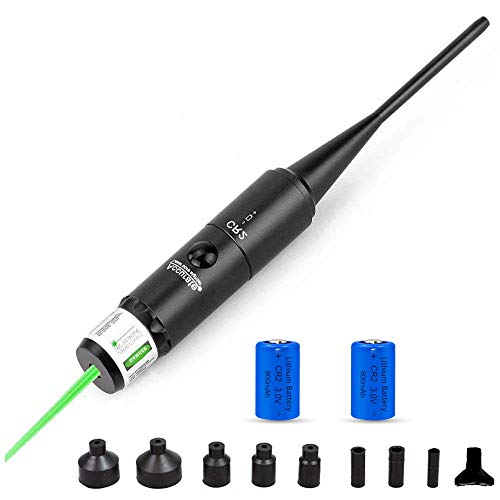
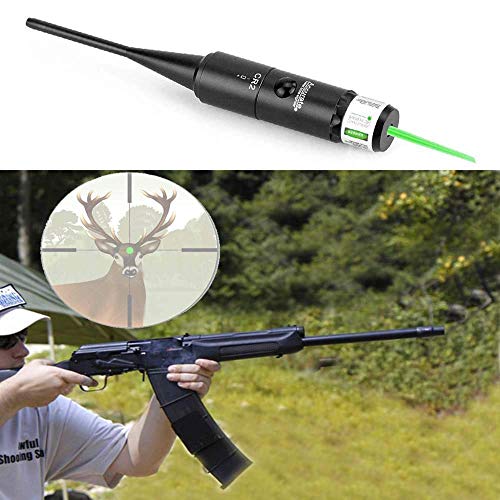
Green boresighter 3rd Version .177-.50 Bore Sight Collimator installs in the barrel of the firearm and projects a laser beam from the center of the bore axis. It allows the accurate alignment of scopes, iron sights or laser sights on handguns and rifles. NOTE: This is not suitable for rifle barrels like .17 HMR or Savage A17. Only for smooth barrels
It allows the accurate alignment of scopes, iron sights or laser sights on handguns and rifles. Increase the accuracy and speed to sight the bore for Hunters, Shooters, Policemen. CAUTION: Avoid direct eye exposure to beam
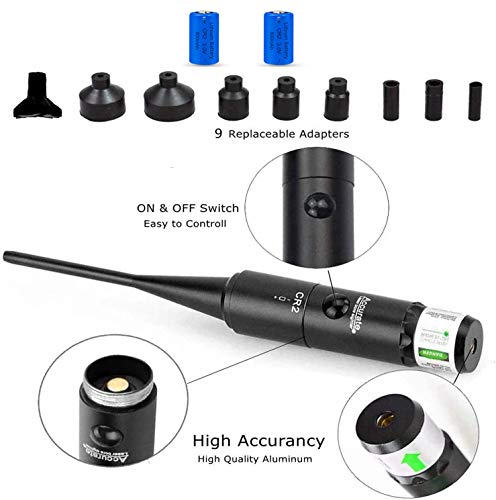
The Boresighter kit comes with 9pcs bore adapters to fit several specific from 0.177 to 0.50 caliber pistols, rifles, handguns, and scopes. Long sighting range, allows for quick and accurate resetting of any sights.
This bore sight is a precision instrument constructed of the finest materials and assembled by highly skilled craftsmen for a lifetime of trouble-free use. It is designed to quickly get your rifle. Simply choose the caliber adapter and place the laser unit in the muzzle. Press switch design is convenient to turn ON/OFF the laser
Package Includes: 1x Green Bore Sight (Boresighter) 9x Bore Adapters; 4 x Spare screws; 1 x Screwdriver; 2x CR2 Battery
ADAFZ is a brand who specializing in outdoor & sports products.
ADAFAZ (VTOGETHER SHOP)
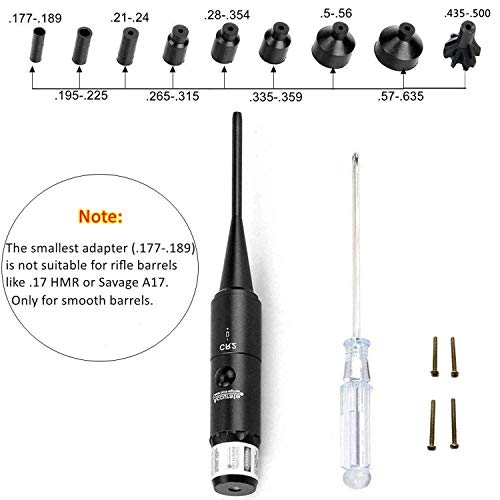
Adapter’s size:
[Adapter 1]: .177-.189 (This is not suitable for rifle barrels like .17 HMR or Savage A17. Only for smooth barrels)
[Adapter 2]: .195-.225.
[Adapter 3]: .21-.24.
[Adapter 4]: .265-.315.
[Adapter 5]: .28-.354.
[Adapter 6]: .335-.359.
[Adapter 7]: .50-.56.
[Adapter 8]: .57-.635.
[Adapter 9]: .435-.500
.177-.50 Green bore sight (3rd Version)
ADAFAZ—Make your get targets easier~
1. Our bore sight is zeroed in factory. Please do not hit the impact.
2. Please make sure the adapter is stable in barrel, otherwise it will have influence on zeroing when in barrel.
3. We recommend you to test the boresighter at about 15-30 meter, for getting the result you want.
4. The boresighter is mounted in the bore (means it sits in the barrel). It is used to adjust sights or optics to near zero
Specifications:
Material: High Quality Aluminum
Class: IIIa
Color: Green
Wavelength: 630-680nm
Boresighter’s Weight: 1.34oz
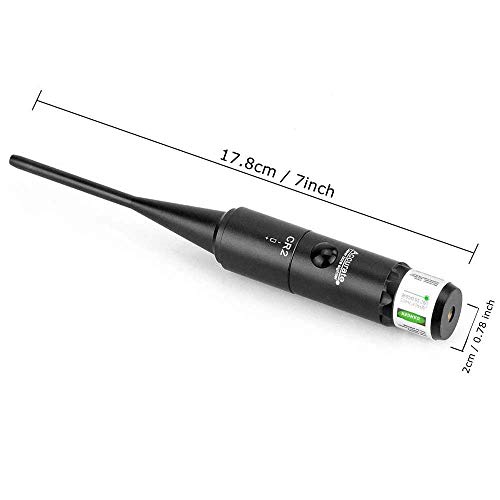
Boresighter’s Length: 6.1″ / 155 mm
Length of rod that fits into the barrel: 2.4″- 3.5″ / 60 mm – 90 mm (tapered)
Dimensions: 170mm x 20mm
Range: 330ft/100m
Power: 2 x CR2 battery
HOW TO USE IT
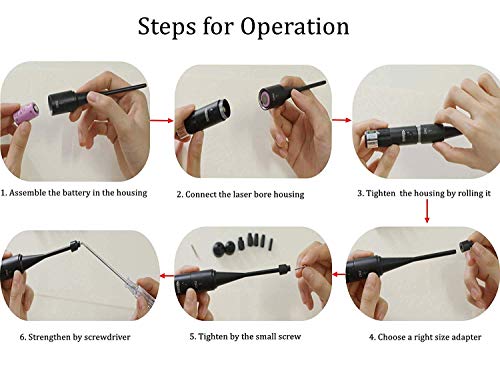
Step 1: Assemble the battery into the boresighter.
Step 2: Select the proper adapter that fits in the barrel of your firearm.
Step 3: Assemble the adapter on the small end of the laser boresighter,
then screw the adapter tight to make sure the adapter will be stable on your barrel.
Step 4: Push the small end of the boresighter with the adapter into the barrel of your firearm. Make sure the boresighter is inserted in till it is sung with the crown of your firearm.
Step 5: When you press the switch button, a bunch of green beam will be emitted. And then you can adjust your scope’s windage and elevation so that your crosshair aims at the green dot.
MORE PRODUCTS FROM ADAFAZ:
Hunting suit Outdoor Jacket Camo T-shirt Realtree T shirt .22-.50cal Boresighter (Red) Insect Gun Laser
About the ADAFAZ Brand
ADAFAZ is a premium supplier for weapon scopes, optics, mounts, and other add-ons used for guns like rifles and long guns. They style and supply their mounts and related products by applying elements which are resilient and long lasting. This includes the ADAFAZ Green Bore Sight Kit Boresighters Automatically Adjust Focus for .177 to .50 Caliber Pistols Rifles (3rd Version) by ADAFAZ. For more shooting items, visit their website.
What You Need to Know About Rifle Optics
Rifle scopes allow you to exactly aim a rifle at different targets by aligning your eye with the target at range. They accomplish this through zoom by utilizing a set of lenses inside the scope. The scope’s positioning can be adjusted for the consideration of separate environmental aspects like wind speed and elevation increases or decreases to make up for bullet drop.
The scope’s purpose is to help shooters understand precisely where the bullet will hit based on the sight picture you are viewing via the scope as you line up the scope’s crosshair or reticle with the target. Most modern-day rifle scopes and optics have about 11 parts which are found inside and outside of the optic. These parts consist of the rifle scope’s body, lenses, windage dials or turrets, focus rings, and other parts. See all eleven parts of scopes.
About Scope Styles
Rifle scopes can be either “first focal plane” or “second focal plane” type of scopes. The kind of focal plane a scope has determines where the reticle or crosshair is located in relation to the scopes magnification. It actually implies the reticle is located behind or ahead of the magnification lens of the optic. Picking out the most effective form of rifle optic is based upon what sort of shooting or hunting you plan on undertaking.
First Focal Plane Optic Details
First focal plane glass (FFP) include the reticle ahead of the zoom lens. This induces the reticle to increase in size based upon the extent of magnification being used. The result is that the reticle measurements are the same at the enhanced range as they are at the non amplified range. For example, one tick on a mil-dot reticle at one hundred yards without “zoom” is still the very same tick at one hundred yards using 5x “zoom”. These types of scopes work for:
- Quick acquisition, long distance types of shooting
- Shooting situations where calculations are small
- Experienced shooters who understand their target “hold over” and also “lead” ratios for their rifles
- Shooters who do not mind the reticle is enlarged and requires more visual eyesight space than a SFP reticle
Second Focal Plane Scopes
Second focal plane scopes (SFP) come with the reticle behind the magnification lens. This causes the reticle to stay at the same overall size in connection with the level of zoom being used. The outcome is that the reticle measurements evolve based on the zoom applied to shoot over longer distances due to the fact that the markings present various increments which fluctuate with the magnification. In the FFP illustration with the SFP scope, the 5x “zoom” one hundred yard tick reticle measurement would be 1/5th of the non “zoom” tick measurement. These sorts of scopes are useful for:
- Long distance kinds of shooting where shooters have more time to make ballistic computations
- Shooting where most of the shots happen within shorter ranges and proximities
- Shooters who want a clearer optic sight picture without area taken up by the larger size FFP reticle
About Glass Magnification
The amount of magnification a scope supplies is determined by the diameter, density, and curvatures of the lenses inside of the rifle scope. The zoom of the scope is the “power” of the scope.
Fixed Single Power Lens Rifle Optic Details
A single power rifle optic and scope comes with a magnification number designator like 4×32. This means the zoom power of the scope is 4x power and the objective lens is 32mm. The magnification of this type of scope can not change considering that it is set from the factory.
Adjustable Power Lens Glass
Variable power rifle scopes use enhanced power. The power modification is achieved by using the power ring part of the scope near the back of the scope by the eye bell.
Rifle Optic Power Level and Range Correlation
Here are some recommended scope powers and the distances where they may be successfully used. Highly magnified scopes will not be as efficient as lower powered glass due to the fact that too much magnification can be a bad thing. The exact same idea goes for extended distances where the shooter needs enough power to see where to properly aim the rifle.
Lens Finishing for Rifle Scopes
All modern-day rifle scope lenses are coated. There are various types and qualities of lens finishes. When looking at luxury rifle scope systems, Lens finishing can be a crucial aspect of defining the rifle’s capability. The lenses are one of the most significant pieces of the scope considering that they are what your eye looks through while sighting a rifle in on the target. The covering on the lenses protects the lens surface as well as helps with anti glare from excess sunlight and color profiles.
About Lens Coatings – HD Versus ED
Some rifle scope producers additionally use “HD” or high-definition lense coverings that employ different processes, aspects, rare earth compounds, and polarizations to enhance separate colors and viewable target visibility through lenses. This HD covering is typically used with greater density glass which lowers light’s ability to refract through the lens glass. Some scope manufacturers use “HD” to describe “ED” suggesting extra-low dispersion glass. ED deals with how certain colors are represented on the chroma spectrum and the chromatic aberration or deviance which is similarly called color distortion or fringing. Chromatic aberration can be obvious around things with hard edges and outlines as light hits the object from certain angles.
Single Rifle Scope Lens Finishing Versus Multi-Coating
Various optic lenses can likewise have various finishings used to them. All lenses generally have at least some type of treatment or finish used to them prior to being used in a rifle scope or optic.
This lens treatment can offer protection to the lens from scratches while minimizing glare and other less advantageous things experienced in the shooting environment while sighting in with the scope. The quality of a single layered lens depends on the scope producer and how much you paid for it.
Some scope producers also make it a point to define if their optic lenses are layered or “multi” covered. Being “much better” depends on the manufacturer’s lens treatment technology and the quality of materials used in constructing the rifle scope.
Info on Hydrophobic Finish
Water on a lens does not help with preserving a clear sight picture through an optic at all. Lots of top of the line or premium optic makers will coat their lenses with a hydrophilic or hydrophobic covering. The Steiner Optics Nano-Protection is a fine example of this kind of treatment. It treats the exterior of the Steiner scope lens so the H2O particles can not bind to it or develop surface tension. The outcome is that the water beads move off of the scope to maintain a clear, water free sight picture.
Optic Installing Alternatives
Mounting approaches for scopes come in a couple of options. There are the standard scope rings which are separately installed to the scope and one-piece scope mounts which cradle the scope. These various kinds of mounts also normally are made in quick release versions which use manual levers which enable rifle shooters to rapidly install and remove the optics.
Hex Key Rifle Glass Rings
Standard, clamp style mounting optic rings use hex head screws to install to the flattop style Picatinny scope mounting rails on rifles. These types of scope mounts use a pair of separate rings to support the scope, and are normally made from 7075 T6 billet aluminum which are created for long distance precision shooting. This form of scope mount is very good for rifle systems which need a resilient, unfailing mount which will not move no matter just how much the scope is moved or jarring the rifle takes. These are the style of mounts you should get for a specialized scope system on a far away scouting or competitors firearm that will hardly ever need to be modified or recalibrated. Blue 242 Loctite threadlocker can additionally be used on the scope mount screws to stop the hex screws from backing out after they are mounted firmly in place. An example of these mounting rings are the 30mm type made by the Vortex Optics company. The set normally costs around $200 USD
Rifle Glass Mounts with Quick-Release Cantilever Rings
These kinds of quick-release rifle scope mounts can be used to rapidly connect and detach a scope from a rifle. If they all use a similar design mount, multiple scopes can often be switched out. The quick detach mount style is CNC machined from anodized 6061 T6 aluminum and the mounting levers fasten firmly to a flat top design Picatinny rail. This lets the scope to be sighted in while on the rifle, taken off of the rifle, and remounted back on the rifle while keeping precision. These types of mounts are useful and handy for shooting platforms which are transferred a lot, to remove the scope glass from the rifle for protection, or for sight systems which are adopted between numerous rifles. An example of this mount type is the 30mm mount designed by the Vortex Optics brand. It typically costs around $250 USD
Sealing and Gas Purging for Optic Tubes
Wetness inside your rifle scope can ruin a day of shooting and your pricey optic by bringing about fogging and developing residue inside of the scope tube. Most scopes prevent wetness from getting in the scope tube with a system of sealing O-rings which are waterproof.
About Rifle Optic Tube Gas Purging
Another element of preventing the buildup of moisture within the rifle optic’s tube is filling the tube with a gas like nitrogen. Since this area is currently taken up by the gas, the scope is less impacted by temp alterations and pressure variations from the outdoor environment which might possibly allow water vapor to permeate in around the seals to fill the void which would otherwise be there. These are good qualities of a good rifle scope to seek out.


