



Description
Rifle Scope Product Details
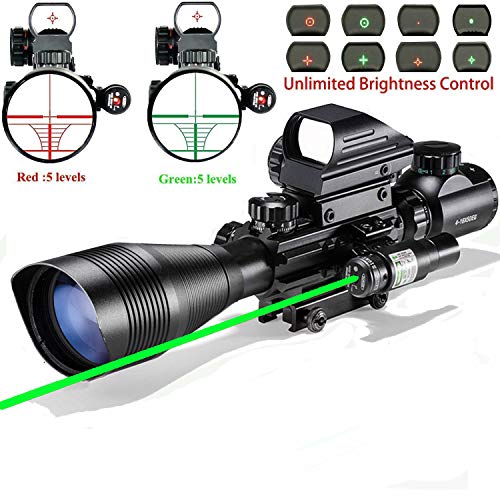
Hunting Rifle Scope Combo C4-12x50EG Dual Illuminated with Laser sight 4 Holographic Reticle Red/Green Dot for Weaver/Rail Mount
This Scope cannot be an assault weapon part or accessory.This scope is well suited for wide range shooting, with high optical clarity magnification and a 50mm objective diameter. The scope andMulti Optical Coated reticles are illuminated in red or green and in multiple brightness intensities, for a suitable sight picture regardless of lighting or environment. The red laser and sight allow for quick acquisition of close quarter and fast moving targets.
Hunting Scope Air Scope Description
Obj. Diameter50mm
Length328mm
Brightness ControlRed and green with 5 levels
ReticleRangefinder
Field of View10′ ~ 27′ @ 100yards
Eye Relief3″ ~ 3.4″
Windage & Elevation Click Value1/4′ @ 100 yards
Exit Pupil3.3mm ~10mm
Red and Green Dot Sight Specification
Obj. Aperture33 mm
Magnification1X
Field of View(@100yds)15.8m
Brightness Controlunlimited brightness control
Dot ColorRed and Green
Eye ReliefUnlimited
Rail:22
Weight: 290g
Length:82mm
Laser Wavelength: 650nm
Tube Diameter: 1.2”
Laser specification
Laser Class: IIIa
Standard 22 mm mount rail
Length: 29mm Maximum Output Power: 5 mw
Wavelength: 625~660nm
Tube Diameter: 26mm
Aluminum Construction Windage and elevation adjustable
Laser Distance:100m-200m(Green Laser:400m-500m )
Package Content
1* rifle scope with dual illuminated Rangefinder reticle
1* holographic sight
1*compact laser sight
3* Allen keys for rail mounting and sight adjustment
1*Lens caps
1*Cleaning cloth
Battery included
Notice:Any items not sold by our may be low quality item,we will not be responsible for this.
Rifle Scope Product Features
About this item
Rifle scope advantageHigh grade fully coated optical lens, Dry nitrogen filled with waterproof,shock proof,fog proof. Magnification4x-12x suit for any W/ 22mm Rail Moun.Made of Aluminium with High grade fully coated optical lens,1200G shockproof and 100% waterproof & fogproof test would keeps the scope more solid makes you can shoot more,1/4″ Fingertip Resettable Windage & Elevation adjustments provide a wide range adjustment.
This scope is Red and green Multi-X reticles with 5 levelsExit Pupil3.3mm-10mmField of View10′ ~ 27′ @ 100yardsEye Relief3″ ~ 3.4″Windage & Elevation Click Value1/4′ @ 100 yardsWith Long Eye Relief:66.8-99.06mm,Field of View:13.41-40.38 @100yards,Exit Pupil:3.3mm-10mm.Wide Magnification 4X-12X provide you a big view at 200-1000YARDS.5 Levels Red and Green Illuminated adjustment brings a better view in dark environment.
Fast Focus Eyepiece with 1/4″ Fingertip Resettable Windage & Elevation Adjustments.Green laser Reaching Distance about 200m-400mDetachable green laser sight with independent switch, green laser is good for quick acquisition of close quarter and fast moving targets.
Tubeless holographic sight with 33 mm reflex lens aperture provides a wide field of view, suitable for normal and rapid – firing shooting of moving targets
This Scope cannot be an assault weapon part or accessory.Integrated rails offers ample space for accessories.Best Service for every Customer
About the XOPin Company
XOPin is a premium maker for weapon scopes, optics, mounts, and other add-ons used for guns like rifles and long guns. They create and manufacture their scopes, mounts, and related products working with building materials which are resilient and long lasting. This includes the Hunting Rifle Scope Combo C4-12x50EG Dual Illuminated with Laser sight 4 Holographic Reticle Red/Green Dot for Weaver/Rail Mount by XOPin. For additional shooting products, visit their website.
What You Need to Know About Rifle Scopes
Rifle scopes permit you to precisely aim a rifle at various targets by aligning your eye with the target at range. They do this through zoom using a series of lenses within the scope. The scope’s positioning can be adapted for consideration of separate ecological considerations like wind speed and elevation increases to make up for bullet drop.
The scope’s purpose is to help shooters understand exactly where the bullet will hit based on the sight picture you are viewing through the optic as you align the scope’s crosshair or reticle with the target. Most modern-day rifle optics have around 11 parts which are found inside and outside of the optic. These parts consist of the rifle scope’s body, lenses, adjustment turrets, focus rings, and other parts. See all eleven parts of a rifle optical system.
About Scope Varieties
Rifle scopes can be either “first focal plane” or “second focal plane” kind of scopes. The type of focal plane a scope has establishes where the reticle or crosshair lies in connection with the optic’s magnification. It actually implies the reticle is situated behind or ahead of the magnifying lens of the scope. Selecting the most effective kind of rifle scope depends on what sort of shooting you plan on undertaking.
First Focal Plane Scope Info
Focal plane scopes (FFP) feature the reticle in front of the magnification lens. These styles of scopes are useful for:
- Quick acquisition, far away kinds of shooting
- Shooting scenarios where computations are very little
- Experienced shooters who recognize their aim point “hold over” and also “lead” ratios for their firearms
- Shooters who do not mind the reticle is bigger and uses up more visual sight space than a SFP reticle
About Second Focal Plane Glass
Second focal plane optics (SFP) come with the reticle behind the magnification lens. In the FFP example with the SFP scope, the 5x “zoom” one hundred yard tick reticle measurement would be 1/5th of the non “zoom” tick reticle measurement.
- Far away forms of shooting where shooters have extra time to make ballistic estimations
- Shooting where most shots happen within much shorter ranges and spaces
- Shooters who want a clearer optic picture without area used up by the enlarged FFP reticle
Zoom for Rifle Optics
The measure of scope magnification you require depends upon the style of shooting you plan to do. Nearly every type of rifle scope offers some amount of magnification. The amount of zoom a scope delivers is established by the dimension, thickness, and curvatures of the lenses within the rifle scope. The magnification level of the scope is the “power” of the opic. This indicates what the shooter is looking at through the scope is amplified times the power aspect of what can normally be seen by human eyes.
Fixed Power Lens Rifle Glass Facts
A single power rifle scope comes with a zoom number designator like 4×32. This indicates the magnification power of the scope is 4x power and the objective lens is 32mm. The zoom of this kind of scope can not fluctuate because it is fixed.
Variable Power Lens Optics
Variable power rifle scopes can be modified between magnified settings. The power change is performed by the power ring part of the scope near the back of the scope by the eye bell.
Scope Power and Range Correlation
Here are some suggested scope power levels and the distances where they can be efficiently used. High power rifle scope glass will not be as useful as lower magnification level scopes given that too much zoom can be a negative aspect depending on your shooting distance. The same concept goes for longer distances where the shooter needs increased power to see where to best aim the rifle at the target.
Glass Lens Coating
All modern-day rifle optic lenses are layered. There are different types and qualities of glass coverings. Lens finishing can be a crucial element of a rifle when looking into high-end rifle optics and targeting equipment. The lenses are one of the most key components of the glass considering they are what your eye sees through while sighting a rifle in on the target. The finishing on the lenses offers protection to the lens surface and even assists with anti glare capabilities from refracted direct sunlight and color profiles.
HD Versus ED Lens Coatings
Some scope producers also use “HD” or high-definition lens finishes which use various methods, chemicals, aspects, and polarizations to draw out a wide range of colors and viewable quality through the lens. Some scope makers use “HD” to refer to “ED” indicating extra-low dispersion glass.
Single Rifle Glass Lens Covering Versus Multi-Coating
Different optic lenses can even have various finishes applied to them. All lenses generally have at least some kind of treatment or coating applied to them before they are used in a rifle scope or optic assembly. This is due to the fact that the lens isn’t just a raw piece of glass. It is part of the finely tuned optic. It needs to have a coating placed on it so that the lens will be optimally functional in numerous kinds of environments, degrees of sunshine (full light VS shade), and other shooting conditions.
Single covered lenses have a treatment applied to them which is usually a protective and enhancing multi-purpose treatment. This lens treatment can shield the lens from scratches while decreasing glare and other less beneficial things experienced in the shooting environment while sighting in with the optic. The quality of a single covered lens depends upon the scope developer and how much you spent on it. Both the manufacturer and amount are indications of the lens quality.
Some scope manufacturers also make it a point to specify if their optic lenses are covered or “multi” covered. Being “much better” depends on the producer’s lens treatment technology and the quality of products used in building the rifle scope.
Anti-water Covering for Rifle Scopes
Water on a scope lens does not assist with maintaining a clear sight picture through a scope whatsoever. Lots of top of the line or high-end optic producers will coat their lenses with a hydrophilic or hydrophobic finishing. The Steiner Optics Nano-Protection is a fine example of this type of treatment. It provides protection for the surface of the Steiner scope lens so the water particles can not bind to it or develop surface tension. The outcome is that the water beads sheet off of the scope to keep a clear, water free sight picture.
Rifle Scope Installation Choices
Installing options for scopes come in a few options. There are the standard scope rings which are separately mounted to the scope and one-piece mounts which cradle the scope. These different types of mounts also typically are made in quick release versions which use toss levers which allow rifle operators to quickly mount and dismount the scope.
Hex Key Rifle Glass Ring Mounting Solutions
Basic, clamp style mounting scope rings use hex head screws to fix to the flattop style Picatinny scope mounting rails on rifles. These forms of scope mounts use two individual rings to support the scope, and are made from 7075 T6 billet aluminum which are designed for long distance accuracy shooting. This form of scope mount is good for rifle systems which are in need of a long lasting, hard use mount which will not move no matter how much the scope is moved about or abuse the rifle takes. These are the type of mounts you should get for a devoted scope setup on a far away scouting or interdiction rifle which will seldom need to be altered or adjusted. Blue 242 Loctite threadlocker can also be used on screws to stop the hex screw threads from wiggling out after they are mounted tightly in position. An example of these rings are the 30mm style from the Vortex Optics brand. The set generally costs around $200 USD
Quick-Release Cantilever Rifle Scope Rings
These types of quick-release rifle scope mounts can be used to quickly remove a scope and attach it to a different rifle. Numerous scopes can even be swapped out if they all use a compatible design mount. These types of mounts come in handy for rifle platforms which are carried a lot, to remove the optic from the rifle for protection, or for scopes which are used between several rifles.
Rifle Scope Tube Sealing and Gas Purging
Wetness inside your rifle optic can mess up a day of shooting and your expensive optic by triggering fogging and creating residue inside of the scope tube. Most scopes prevent wetness from going into the scope tube with a system of sealing O-rings which are water resistant.
Gas Purged Rifle Scope Tubes
Another part of avoiding the accumulation of moisture inside of the rifle optic tube is filling the tube with a gas like nitrogen. Because this space is currently taken up by the gas, the optic is less affected by condition shifts and pressure differences from the outside environment which may possibly enable water vapor to seep in around the seals to fill the void which would otherwise be there. These are good qualities of a decent rifle scope to look for.


