



Description
Rifle Scope Product Details
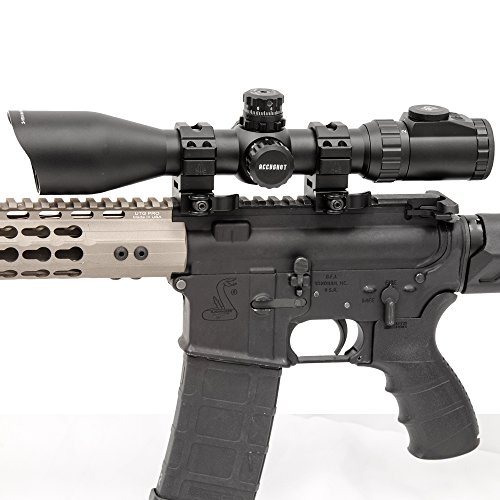
UTG 2-16X44 36-Color UMOA Reticle Multi-Range AO Scope, 30mm
UTG T8 Series 2-16X44 30mm mrc (multi-range combat & competition) scope, TS platform, etched glass MOA reticle with 36-Color illumination, multi Emerald lens coating, zero lockable/resettable windage/elevation turrets, SWAT AO, Tact Edge angled integral Sunshade, med. Profile QD rings & Flip-up lens covers.
Rifle Scope Product Features
UTG T8 optics series breaks through with 8x zoom ratio Technology provides Multi-range magnifications ideal at short, medium, and long range distances
30mm tube & multi Emerald coated lenses for maximum light and edge to edge clarity with tact edge angled Integral sunshade to reduce lens flare
Moa/MOA reticle/turrets allow convenient and faster dialing in of shots, resulting in less time and focus spent on the turret adjustments
Etched Glass Umea range Estimating reticle with 2 MOA increments for intuitive and on-the-fly calculations, holdovers, and leads
Side wheel Adjustable turret (SWAT) for Parallax adjustment from 10 yards to Infinity, premium zero lockable/Resettable turrets with 1/4 MOA per click
The TactEdge Angled objective provides a built-in, integral sunshade that reduces glare.
Featured Accessories:
Scope Owners Manual
CR2032 3V Lithium Battery X2
Cleaning Cloth
Hex Screw
Allen Wrench 2.5mm
Allen Wrench 3mm
Allen Wrench 4mm
Flip-open Lens Caps
Lever Lock QD Rings, 1 Pair
UTG 2-16X44 30mm Multi-range AO Scope
SCP3-216UMOA
Specification:
Magnification: 2-16X
Tube Diameter: 30mm
Objective Diameter: 44mm
Field of View @100 yards: 44.5′-6.3′
Eye Relief: 4.1″-3.5″
Exit Pupil: 22mm-2.7mm
Click Value @100 yards: 1/4″
Length: 315mm
Weight: 22.6 oz
Parallax Setting: 10 Yds-Infinity
Batteries: CR2023 3V Lithium
Product Summary:
The T8 2-16X44 CQB/MRC IE UMOA Scope represents the cutting edge of multi-applicative 8X zoom ratio scopes, something that is a challenge to design and manufacture. At the core of its design, this optic maximizes performance at close, medium, and long range distances by the simple adjustment of a turret. The side parallax adjustment turret quickly allows you to eliminate parallax from 10 yards to infinity, providing crisp clarity and a sharp reticle all along the way. Equipped with premium lockable and resettable turrets, manipulating the scope for fast and intuitive zero adjustment and retention takes only seconds and its 30mm main tube offers maximum a generous W/E adjustment range. As a bonus, this scope also includes an integral angled sunshade, flip-open lens caps, and a pair of Max Strength QD rings. Standard for UTG, you get everything you need to start shooting right out of the box.
UMOA RETICLE:
The high quality etched glass UMOA reticle, one of our latest reticles, utilizes hash marks at 2 MOA increments allowing intuitive and on-the-fly calculations, holdovers, and leads. When it comes to the environment and time of day, you can illuminate the center crosshair in virtually any color of your choosing with our patented 36 Color Illumination Enhancing System. Outstanding light transmission is achieved through emerald coated lenses for a crystal clear view. When it comes to straight to the point precision, this scope is like no other.
True Strength Platform
Built on the True Strength Platform, these scopes are completely sealed and nitrogen filled making them shockproof, fog proof, and rainproof. The innovative True Strength (TS) Platform is a signature scope construction platform that provides long lasting reliability in these interactions to guarantee precise and responsive windage/elevation adjustment.
About the UTG Company
UTG is a premium company for long gun scopes, optics, mounts, and other components used for guns like rifles and long guns. They innovate and manufacture their mounts and related products choosing elements which are long lasting and resilient. This includes the UTG 2-16X44 36-Color UMOA Reticle Multi-Range AO Scope, 30mm by UTG. For more shooting products, visit their site.
Rifle Glass Details
Rifle scopes permit you to specifically align a rifle at various targets by aligning your eye with the target at range. They accomplish this through magnifying the target using a series of lenses within the scope. The scope’s alignment can be adapted to account for varied environmental things like wind and elevation increases to account for bullet drop.
The scope’s purpose is to help shooters understand precisely where the bullet will hit based on the sight picture you are viewing through the scope as you align the scope’s crosshair or reticle with the target. A lot of modern rifle optics have around eleven parts which are located inside and on the exterior of the scope body. These optic pieces include the rifle scope’s body, lenses, adjustment turrets or dials, objective focus rings, and other components. See all eleven parts of a rifle optical system.
Rifle Optic Styles
Rifle scopes can be either “first focal plane” or “second focal plane” type of optics. Picking the best type of rifle glass depends on what type of shooting you plan to do.
About First Focal Plane Optics
Focal plane scopes (FFP) come with the reticle in front of the zoom lens. This induces the reticle to increase in size based upon the amount of zoom being used. The outcome is that the reticle measurements are the same at the enhanced distance as they are at the non magnified distance. One tick on a mil-dot reticle at one hundred yards without “zoom” is still the very same tick at one hundred yards with 5x “zoom”. These types of scopes are practical for:
- Quick acquisition, far away types of shooting
- Shooting situations where estimations are very little
- Experienced shooters who know their target “hold over” plus “lead” relationships for their long gun
- Shooters who do not mind the reticle is bigger and requires more visual eyesight room than a SFP reticle
Second Focal Plane Scope Facts
Second focal plane optics (SFP) feature the reticle behind the magnifying lens. This induces the reticle to remain at the same size relative to the quantity of magnification being used. The effect is that the reticle dimensions shift based upon the magnification used to shoot over greater distances because the reticle measurements present various increments which fluctuate with the magnification. In the FFP illustration with the SFP optic, the 5x “zoom” 100 yard tick measurement would be 1/5th of the non “zoom” tick measurement. These particular types of glass work for:
- Far away forms of shooting where shooters have more time to make ballistic computations
- Shooting where most shots occur within shorter ranges and spaces
- Shooters who want a clearer optic sight picture with less area used up by the larger sized FFP reticle
About Glass Magnification
The measure of scope zoom you need depends upon the type of shooting you would like to do. Practically every kind of rifle optic provides some level of magnification. The quantity of zoom a scope offers is identified by the size, thickness, and curves of the lenses within the rifle scope. The magnifying level of the scope is the “power” of the glass. This implies what the shooter is looking at through the scope is magnified times the power element of what can typically be seen by human eyes.
About Fixed Single Power Lens Optics
A single power rifle scope or optic will have a magnification number designator like 4×32. This implies the magnification power of the scope is 4x power while the objective lens is 32mm. The magnification of this kind of optic can not adjust since it is a fixed power scope.
Adjustable Power Lens Optics
Variable power rifle scopes have adjustable power. It will note the magnification degree in a configuration like 2-10×32. These numbers suggest the zoom of the scope could be changed between 2x and 10x power. This additionally involves the power levels in-between 2 and 10. The power adaptation is accomplished using the power ring part of the scope near the rear of the scope by the eye bell.
Power Levels and Range
Here are some recommended scope powers and the ranges where they could be successfully used. Consider that high power glass will not be as effective as lower powered glass due to the fact that too much zoom can be a detractor. The very same idea goes for extended distances where the shooter needs adequate power to see where to best aim the rifle at the target.
Rifle Glass Lens Finishing
All modern rifle optic lenses are covered. Lens finish can be an essential aspect of a rifle when thinking about high end rifle optics and scope setups.
Details on Lens Coatings – HD Versus ED
Some scope brands likewise use “HD” or high-definition lens finishings which use various processes, aspects, chemicals, and polarizations to draw out a wide range of colors and viewable definition through the lens. Some scope manufacturers use “HD” to refer to “ED” meaning extra-low dispersion glass.
Single Finish Versus Multi-Coating for Rifle Optics
Various optic lenses can likewise have various coatings applied to them. All lenses typically have at least some type of treatment or finish used to them before they are used in a rifle scope or optic.
This lens treatment can protect the lens from scratches while minimizing glare and other less helpful things experienced in the shooting environment while sighting in with the scope. The quality of a single covered lens depends on the scope maker and how much you paid for it.
Some scope manufacturers similarly make it a point to define if their optic lenses are coated or “multi” coated. Being “much better” depends on the manufacturer’s lens treatment technology and the quality of materials used in developing the rifle scope.
Anti-water Lens Coverings
Water on a lens does not help with preserving a clear sight picture through a scope at all. Lots of top of the line and high-end optic makers will coat their lenses with a hydrophobic or hydrophilic anti-water covering.
Alternatives for Mounting Rifle Scopes on Firearms
Installing solutions for scopes can be found in a couple of options. There are the basic scope rings which are separately mounted to the scope and one-piece scope mounts which cradle the scope. These various types of mounts also usually come in quick release variations which use toss levers which enable rifle operators to quickly mount and remove the scope.
Hex Key Scope Ring Mounting Solutions
Basic, clamp type mounting optic rings use hex head screws to fix to the flattop design Picatinny scope mount rails on the tops of rifles. These varieties of scope mounts use two detached rings to support the optic, and are normally constructed from 7075 T6 billet aluminum which are created for long distance precision shooting. This type of scope mount is great for rifles which need a long lasting, rock solid mount which will not move despite just how much the scope is moved about or abuse the rifle takes. These are the style of mounts you should have for a dedicated scope system on a long distance scouting or competition long gun that will rarely need to be modified or adjusted. Blue 242 Loctite threadlocker can additionally be used to stop the hex screws from wiggling out after they are installed tightly in position. An example of these mounting rings are the 30mm type made by Vortex Optics. The set normally costs around $200 USD
Rifle Optic Mounting Solutions with Quick-Release Cantilever Rings
These types of quick-release rifle scope mounts can be used to rapidly attach and remove a scope from a rifle before reattaching it to a different rifle. Numerous scopes can even be switched out if they all use a similar design mount. These types of mounts are handy for rifle platforms which are transferred a lot, to remove the optic from the rifle for protecting the scope, or for optics which are used in between numerous rifles or are situationally focused.
Rifle Scope Tube Sealing and Gas Purging
Wetness inside your rifle optic can destroy a day of shooting and your costly optic by causing fogging and creating residue inside of the scope tube. A lot of scopes prevent wetness from getting in the scope tube with a system of sealing O-rings which are waterproof.
Rifle Glass Gas Purging
Another component of preventing the buildup of moisture inside of the rifle scope’s tube is filling the tube with a gas like nitrogen. Because this space is already occupied by the gas, the glass is less impacted by temperature changes and pressure distinctions from the external environment which could possibly permit water vapor to seep in around the seals to fill the void which would otherwise exist. These are good qualities of a good rifle scope to seek out.


