Description
Rifle Scope Product Details
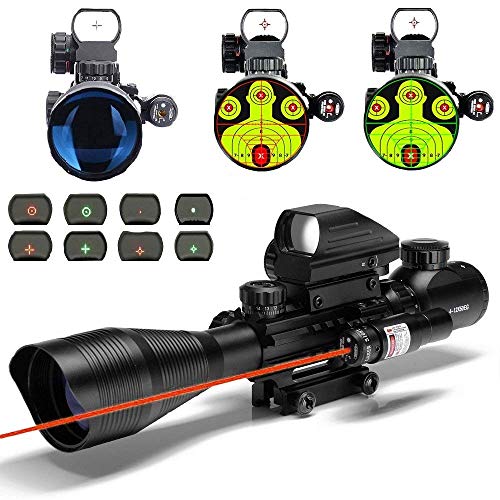
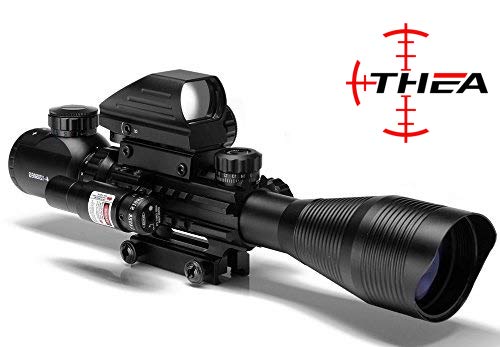
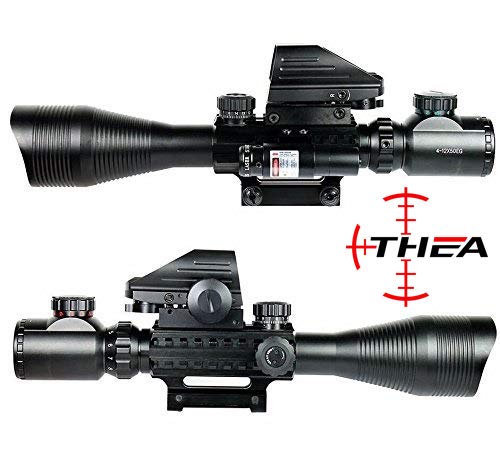
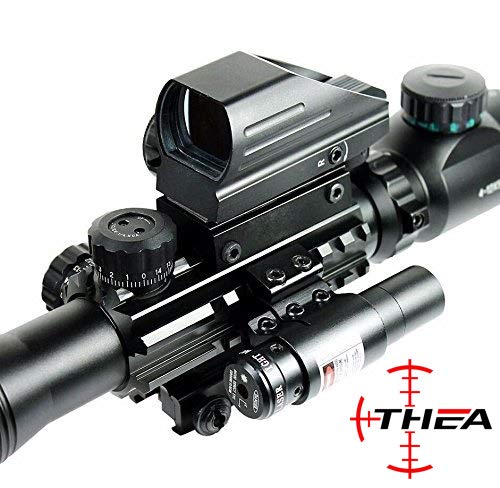
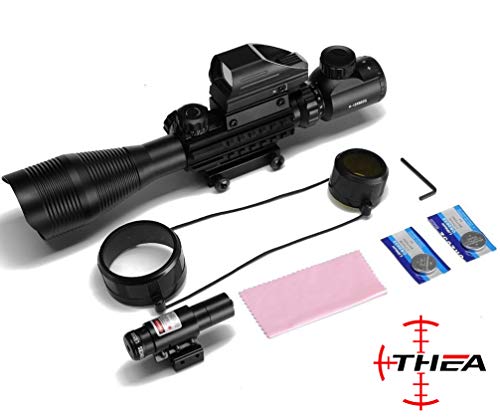
THEA C4-12X50 Scope Dual Illuminated Reticle w/Red/Green Laser Sight and 4 Tactical Holographic Dot Reflex Sight (12 Month Warranty)
Laser Class: 3R(IIIa); Maximum Output Power: 5 mw
Take Your Hunting Experience To The Next Level With The Best Tactical Rifle Scope By THEA.
Are you sick and tired of spending time hunting and going home empty handed
Not anymore.
Get The Most Advanced Equipment For Your Rifle And Make Sure That You Will Not Miss A Prey Again.
When it comes to hunting and shooting, the most important part is to aim correctly and shoot precisely without letting the prey to run away.
The only way to make sure that you will catch your prey is by using a high quality hunting rifle scope, which offers great accuracy while shooting.
This smart rifle scope, with its adjustable 4-12 magnifications and distance, ensures that your shots will be more accurate and precise than ever, even at 100m away.
About The Amazing Features Of The THEA Electro-Dot Sight Rifle scope:
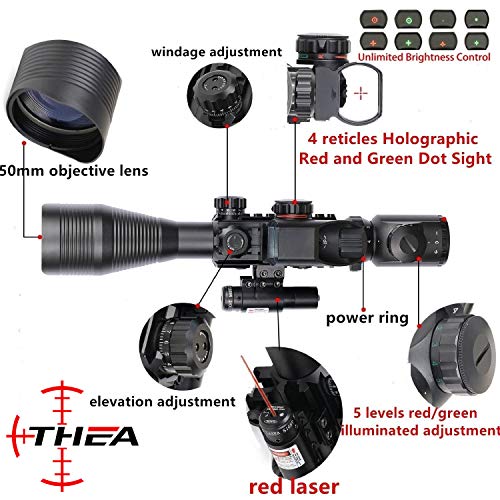
* Tubeless Design with 33mm reflex lens aperture, for a wide field of view (15.8 @ 100m)
* Multi-Riticle (4 Patterns) or Variable Dot (4 different sizes)
* Parallax corrected and unlimited eye relief ( 3″- 3.4″)
* Detachable RED or GREEN LASER sight reaching 100M-300M
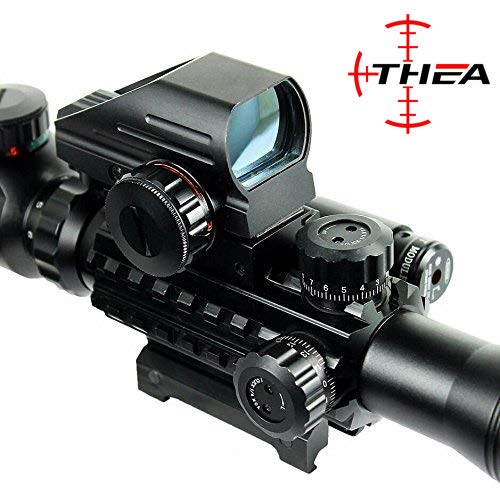
* Allen head screw type wintage and elevation click adjustment with locking screw
* Built in mount- integrated rail (no need to re-zero when mounting to dismounted sight)
* Low power consumption for long battery life (powered by one 3V lithium battery)
* Crosshair instead of traditional sight and gap
* Ergonomic design (82mm Length & 155g Weight)
* Great for rapid fire or moving targets
Backed Up By Great Customer Service Offered by THEA, What Are You Waiting For Order Yours Today!
THEA is registered brand in US, we provide 24X7 timely online customer service. Please contact seller for any inquiry and product issue.
Rifle Scope Product Features
Fully coated optics and Fast Focus Eyepiece/Eyebell are well suited for wide range shooting, with high optical clarity at 4-12 times magnification and a 50mm objective lens, allowing for quick acquisition of close quarter and fast moving targets.
The main scope has Red and Green illuminated range finder reticles in 5 brightness levels, easier shooting in dark environment. Picatinny mount easily mountable to any 22 &11mm rails (Picatinny or Weaver). Windage and elevation adjustments with 1/4 MOA audible-click stops and fingertip turrerts.
New design of electronic control system allows you easier and quicker setup the dot sight, reducing much hand work. High resolution image, unlimited eye relief and wide field of view competing high end reflex sight. DETACHABLE Red laser can reach over 100m.
Made of T6061 Aluminum, 1200G shockproof and 100% waterproof & fogproof test before release. Dry nitrogen is filled.
GET IT WITH CONFIDENCE- TRUST THE EXPERTS: Being so sure about the great quality and performance of this amazing Tactical Rifle Scope, THEA offer you great customer service. With nothing to worry about, order for you or for your hunting aficionados friends today!
About the THEA Brand
THEA is a premium producer for long gun scopes, optics, mounts, and other add-ons used for guns like rifles and long guns. They design and build their products working with building materials which are long lasting and durable. This includes the THEA C4-12X50 Scope Dual Illuminated Reticle w/Red/Green Laser Sight and 4 Tactical Holographic Dot Reflex Sight (12 Month Warranty) by THEA. For more shooting goods, visit their site.
Glass Facts
Rifle scopes enable you to precisely aim a rifle at different targets by lining up your eye with the target at range. They do this through magnifying the target by employing a series of lenses within the scope. The scope’s alignment can be adjusted to take into account separate ecological aspects like wind speed and elevation increases to make up for bullet drop.
The scope’s function is to help the shooter understand exactly where the bullet will hit based on the sight picture you are viewing through the optic as you align the scope’s crosshair or reticle with the intended target. A lot of contemporary rifle optics have about 11 parts which are found within and outside of the optic. These optic pieces consist of the rifle scope’s body, lenses, modification turrets, objective focus rings, and other components. Learn about the eleven parts of optics.
Rifle Glass Types
Rifle scopes can be either “first focal plane” or “second focal plane” kind of scopes. The style of focal plane an optic has establishes where the reticle or crosshair lies in relation to the scopes zoom. It actually implies the reticle is situated behind or ahead of the magnification lens of the optic. Deciding upon the most suitable kind of rifle glass depends upon what kind of shooting you anticipate doing.
Info on First Focal Plane Glass
Focal plane scopes (FFP) come with the reticle in front of the zoom lens. This triggers the reticle to increase in size based on the amount of zoom being used. The result is that the reticle measurements are the same at the enhanced distance as they are at the non magnified distance. For example, one tick on a mil-dot reticle at one hundred yards with no “zoom” is still the exact same tick at 100 yards with 5x “zoom”. These kinds of scopes are useful for:
- Quick acquisition, far away kinds of shooting
- Shooting circumstances where estimations are small
- Experienced shooters who recognize their target “hold over” and “lead” ratios for their firearm
- Shooters who do not mind the reticle is bigger and occupies more visual sight room than a SFP reticle
Second Focal Plane Glass Details
Second focal plane glass (SFP) come with the reticle to the rear of the magnifying lens. This induces the reticle to stay at the same scale in relation to the quantity of zoom being used. The end result is that the reticle measurements alter based upon the magnification applied to shoot over greater ranges since the reticle measurements represent various increments which vary with the zoom. In the FFP example with the SFP scope, the 5x “zoom” one hundred yard tick would be 1/5th of the non “zoom” tick measurement. These particular types of glass are convenient for:
- Long distance forms of shooting where shooters have extra time to make ballistic calculations
- Shooting where most of the shots occur within shorter distances and ranges
- Shooters who want a clearer optic sight picture without area taken up by the bigger FFP reticle
Scope Zoom
The level of scope zoom you need on your optic depends upon the kind of shooting you plan to do. Pretty much every kind of rifle optic provides some level of magnification. The amount of zoom a scope offers is determined by the dimension, density, and curves of the lens glass within the rifle scope. The magnification of the scope is the “power” of the scope. This indicates what the shooter is aiming at through the scope is magnified times the power aspect of what can normally be seen by human eyes.
Single Power Lens Glass
A single power rifle scope or optic comes with a zoom number designator like 4×32. This indicates the zoom power of the scope is 4x power and the objective lens is 32mm. The zoom of this type of optic can not adjust considering that it is a set power scope.
Variable Power Lens Rifle Scope Info
Variable power rifle scopes use enhanced power. The power modification is handled by making use of the power ring part of the scope near the back of the scope by the eye bell.
Scope Power and Range Correlation
Here are some advised scope powers and the ranges where they can be efficiently used. Highly magnified glass will not be as useful as lower magnification level glass due to the fact that too much zoom can be a negative aspect depending on your shooting distance. The exact same concept relates to extended distances where the shooter needs enough power to see precisely where to best aim the rifle.
Lens Finish for Scopes
All modern-day rifle scope and optic lenses are covered in special coatings. There are different types and qualities of finishes. When thinking about luxury rifle scope systems, Lens covering can be a vital aspect of a rifle. The lenses are one of the most essential components of the optic because they are what your eye looks through while sighting a rifle in on the target. The covering on the lenses shields the lens surface area as well as assists with anti glare from excess sunshine and color profiles.
HD Versus ED Lens Coatings
Some scope manufacturers even use “HD” or high-def lense finishes which employ various procedures, polarizations, chemicals, and elements to draw out different colors and viewable definition through lenses. This high-definition coating is normally used with greater density lens glass which decreases light’s potential to refract through the lens glass. Some scope producers use “HD” to refer to “ED” signifying extra-low dispersion glass. ED handles how colors are represented on the chromatic spectrum and the chromatic deviance or aberration which is similarly called color distortion or fringing. Chromatic aberration is often obvious over things with hard outlines as light hits the object from specific angles.
Single Coating Versus Multi-Coating for Rifle Scopes
Various optic lenses can likewise have various coatings applied to them. All lenses typically have at least some type of treatment or coating applied to them before they are used in a rifle scope or optic.
This lens treatment can safeguard the lens from scratches while lowering glare and other less beneficial things experienced in the shooting environment while sighting in with the scope. The quality of a single coated lens depends on the scope manufacturer and how much you paid for it.
Some scope manufacturers also make it a point to define if their optic lenses are covered or “multi” covered. Being “much better” depends on the maker’s lens treatment technology and the quality of materials used in developing the rifle scope.
Details on Hydrophobic Finish
Water on a scope lens doesn’t help with keeping a clear sight picture through an optic whatsoever. Numerous top of the line and premium optic makers will coat their lenses with a hydrophobic or hydrophilic finishing. The Steiner Optics Nano-Protection is a good example of this type of treatment. It deals with the surface of the Steiner optic lens so the water particles can not bind to it or create surface tension. The result is that the water beads roll off of the scope to maintain a clear, water free sight picture.
Alternatives for Installing Rifle Scopes on Long Guns
Installing options for scopes come in a few options. There are the standard scope rings which are individually installed to the optic and one-piece scope mounts which cradle the scope. These different kinds of mounts also typically come in quick release variations which use manual levers which enable rifle operators to rapidly mount and remove the scope.
Hex Key Scope Ring Mounts
Basic, clamp style mounting optic rings use hex head screws to fix to the flattop style Picatinny scope mounting rails on rifles. These forms of scope mounts use a pair of individual rings to support the scope, and are normally constructed from 7075 T6 billet aluminum or similar materials which are made for long distance precision shooting. This form of scope mount is great for rifles which are in need of a resilient, hard use mount which will not change no matter just how much the scope is moved or jarring the rifle takes. These are the design of mounts you should get for a specialized scope system on a reach out and touch someone hunting or sniper competition long gun that will seldom need to be changed or adjusted. Blue 242 Loctite threadlocker can additionally be used on the screws to keep the hex screw threads from backing out after they are installed securely in place. An example of these mounting rings are the 30mm style from the Vortex Optics brand. The set typically costs around $200 USD
Quick-Release Cantilever Rifle Optic Ring Mounts
These types of quick-release rifle scope mounts can be used to quickly attach and take off a scope from a rifle. If they all use a similar design mount, a number of scopes can often be switched in the field. The quick detach mount style is CNC crafted from anodized 6061 T6 aluminum and the mounting levers connect firmly to a flat top type Picatinny rail. This lets the scope to be sighted in while on the rifle, taken off of the rifle, and remounted back on the rifle while preserving the original sighting settings. These types of mounts are useful and handy for shooting platforms which are transferred between vehicles a lot, to remove the scope from the rifle for protection, or for optics which are used in between several rifles. An example of this mount style is the 30mm mount from the Vortex Optics manufacturer. It typically costs around $250 USD
Details on Rifle Scope Tube Sealing and Gas Purging
Wetness inside your rifle glass can destroy a day on the range and your highly-priced optic by resulting in fogging and generating residue inside of the scope’s tube. A lot of scopes protect against moisture from going into the optical tube with a system of sealing O-rings which are waterproof. Generally, these water resistant scopes can be submerged underneath 20 or 30 feet of water before the water pressure can push moisture past the O-rings. This should be more than enough moisture content avoidance for common use rifles for hunting and sporting purposes, unless you anticipate taking your rifle on boats and are concerned about the optic still performing if it is submerged in water and you can still salvage the firearm.
What to Know About Scope Tube Gas Purging
Another component of avoiding the buildup of moisture inside of the rifle scope tube is filling the tube with a gas like nitrogen. Given that this area is already taken up by the gas, the optic is less impacted by temperature level shifts and pressure variations from the external environment which could possibly enable water vapor to permeate in around the seals to fill the vacuum which would otherwise be there. These are good qualities of a decent rifle scope to seek out.


