



Description
Rifle Scope Product Details
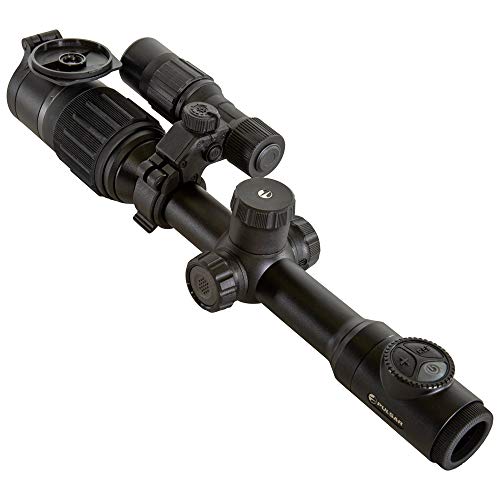
Pulsar Digex N455 Digital Night Vision Riflescope
Digex is the first to market, full featured, night vision riflescope designed in the shape of a classic day sight. The form factor of the Digex allows the lowest possible mounting point, flexible positioning on the rifle and an appealing external view. HD resolution sensor and display, enhanced night-time sensitivity, high quality fast optics, high magnification and powerful built-in IR for a moonless night make the Digex the perfect tool for detecting animals at distances out to over 546 yards. Activating the high precision aiming frame allows the user to closely control the image in the aiming area while being visually aware of the entire field of view at the same time. Digex Night Vision Riflescopes feature a built-in recorder to capture still images or HD quality video. Stream Vision transfers images from the Digex to the smartphone’s display, duplicates the controls for digital functions and helps to transfer, in real time, the images to the Internet.The Digex connects via Wi-Fi to mobile devices. The user only needs a smartphone, the free Stream Vision App and internet access to install new firmware. Digex is easy to use. Dedicated buttons for the basic functions are easily accessible. The Digex Riflescope will operate in sub-zero temperatures, precipitation of any intensity and even survive submersion. The riflescope is flexibly mounted on the weapon using 30mm mounting rings.
Rifle Scope Product Features
Enhanced Night-time Sensitivity with a 1280×720 HD Sensor and 4-16x Variable Magnification
High Precision Aiming with “Picture-in-Picture” Mode and 5 Individual Shooting Profiles that can hold up to 50 Zeroing Distances
Over 10 different reticle types in various color options and Scalable Ballistic Reticles Included
Remote Operation, Review, and Live YouTube Streaming using Smartphones
Fully Waterproof IPX7 – Rugged, Reliable All Metal Housing with Operating Temperatures of -13 °F to 122 °F
Pulsar Digital Night Vision Riflescops
Key Features
Over 500 m nighttime viewing range
All-Metal Housing
Integrated video and sound recorder
Highly sensitive HD-sensor
Enhanced nighttime sensitivity
Digex Night Vision Riflescopes
Digex night vision digital riflescopes are designed for use at night and in the daytime.
In low light conditions (no light from stars and the moon) it is recommended to use an infrared illuminator with a wavelength of 850 nm or 940 nm. DIGEX is the first to market, full featured, night vision riflescope designed in the shape of a classic day sight.
The form factor of the DIGEX allows the lowest possible mounting point, flexible positioning on the rifle and an appealing external view. HD resolution sensor and display, enhanced night-time sensitivity, high quality fast optics, high magnification and powerful built-in IR for a moonless night make the DIGEX the perfect tool for detecting animals at distances out to over five hundred meters.
Thermion Key Features
Instant Start-Up
Thanks to the revolutionary electronics unit can be started almost instantly. quick start-up helps to save the energy and thus prolongs time of operation. The unit can be kept switched off and then rapidly activated when the right time comes.
Color Palettes
Digex’s reticle is electronic and always stays in the same plane with the target. The Digex has reticles of ten various shapes and functions (direct shot type, ballistic, scalable and regular), all available in eight colors.
Supplied powerful long-range IR Illuminator
The Digex riflescopes are supplied with a detachable high power 850 nm or 940 IR illuminator. The 850nm IR features long-range action, the 940 nm IR operates in the invisible range. With this IR the hunter can observe animals staying unnoticed and without the fear that animals could be frightened away. Three adjustable IR power levels help choose preferred effective range and illumination level of an object observed. Adjustable power changes the operating range and illumination level of objects.
Remote Firmware Update
A smartphone, free mobile application Stream Vision and Internet access is all one needs to check updates and to install new firmware. Updates with new functions are implemented into the riflescope used by hunter without the need to send to repair center.
IPX7 Waterproof Rated
The Digex features IPX7 level of protection, which means it is fully waterproof. The riflescopes are able to operate in high humidity, precipitation of any intensity and survive a 30-minute long and 1m deep submersion.
High caliber recoil resistance: 12 gauge., 9.3×64, .375H&H
Digex riflescopes feature high shock resistance allowing use with large caliber hunting rifles such as 9.3Ñ64, .30-06, .300, .375. etc., as well as smooth-bore and airsoft weapons.
Stream Vision App Supported
Via Wi-Fi Digex connects to Android and iOS based smartphones and tablets. The free mobile application Stream Vision transfers image in real time to smartphone’s display, duplicates control of Digex’s digital functions, informs about new firmware update and installs it, transfers in real time the image from the riflescope to the Internet via YouTube and other online video platforms.
4Ñ-16x Variable Magnification
The base magnification of Digex N455 increases by four times ” from 4x to 16x. The zoom changes either gradually in 2x step or continuously for a truly optimum, customized field of view for specific situation.
About the Pulsar Scope Maker
Pulsar is a premium company for weapon scopes, optics, mounting solutions, and other add-ons used for firearms like rifles and long guns. They innovate and manufacture their scopes and related products working with materials which are long lasting and resilient. This includes the Pulsar Digex N455 Digital Night Vision Riflescope by Pulsar. For more shooting products, visit their site.
Scope Info
Rifle scopes enable you to precisely align a rifle at various targets by aligning your eye with the target over a range. They accomplish this through zoom by making use of a series of lenses within the scope. The scope’s alignment can be dialed in to take into account separate environmental things like wind speed and elevation increases or decreases to make up for bullet drop.
The scope’s purpose is to help shooters understand precisely where the bullet will hit based on the sight picture you are viewing via the optic as you align the scope’s crosshair or reticle with the target. The majority of modern rifle scopes have about eleven parts which are found internally and on the exterior of the optic. These parts consist of the rifle scope’s body, lenses, adjustment turrets, objective focus rings, and other elements. See all eleven parts of optics.
The Types of Rifle Scopes
Rifle scopes can be either “first focal plane” or “second focal plane” style of scopes. The form of focal plane an optic has decides where the reticle or crosshair lies relative to the scopes zoom. It actually means the reticle is behind or ahead of the magnifying lens of the optic. Picking the best kind of rifle scope is based upon what sort of shooting you intend on doing.
First Focal Plane Glass
First focal plane optics (FFP) include the reticle ahead of the magnifying lens. This induces the reticle to increase in size based on the extent of magnification being used. The benefit is that the reticle measurements are the same at the magnified distance as they are at the non magnified distance. As an example, one tick on a mil-dot reticle at one hundred yards without any “zoom” is still the very same tick at 100 yards with 5x “zoom”. These kinds of scopes work for:
- Quick acquisition, long distance types of shooting
- Shooting circumstances where estimations are marginal
- Experienced shooters who understand their target “hold over” plus “lead” ratios for their long gun
- Shooters who don’t mind the reticle is bigger and occupies more visual eyesight area than a SFP reticle
About Second Focal Plane Scopes
Second focal plane optics (SFP) include the reticle behind the zoom lens. In the FFP example with the SFP scope, the 5x “zoom” 100 yard tick reticle measurement would be 1/5th of the non “zoom” tick reticle measurement.
- Long distance kinds of shooting where shooters have extra time to make ballistic computations
- Shooting where most shots take place within shorter spaces and ranges
- Shooters who want a clearer optic sight picture with less area taken up by the bigger FFP reticle
Zoom for Rifle Glass
The quantity of scope zoom you need is based on the type of shooting you wish to do. Just about every kind of rifle glass offers some level of magnification. The quantity of zoom a scope gives is determined by the size, density, and curvatures of the lenses inside of the rifle scope. The zoom of the optic is the “power” of the scope. This means what the shooter is looking at through the scope is magnified times the power factor of what can generally be seen by human eyes.
Single Power Lens Scope Details
A single power rifle optic and scope comes with a magnification number designator like 4×32. This implies the magnification power of the scope is 4x power and the objective lens is 32mm. The magnification of this kind of optic can not change considering that it is fixed.
Adjustable Power Lens Glass Facts
Variable power rifle scopes use variable power levels. The power modification is handled by the power ring part of the scope near the back of the scope by the eye bell.
Glass Power and Range Correlation
Here are some advised scope power levels and the distances where they can be effectively used. Remember that higher power scopes will not be as effective as lower magnification level optics and scopes due to the fact that increased zoom can be a bad thing. The exact same concept applies to longer distances where the shooter needs to have adequate power to see precisely where to best aim the rifle at the target.
Info on Lens Finish
All modern rifle optic lenses are layered. There are various types and qualities of finishes. Lens coating can be an essential aspect of a rifle’s setup when looking at high end rifle optics and targeting systems. The lenses are among the most important pieces of the optic since they are what your eye looks through while sighting a rifle in on the point of impact. The coating on the lenses offers protection to the lens surface area and assists with anti glare from refracted sunshine and color presence.
HD Versus ED Lenses
Some scope producers also use “HD” or high-definition lens finishings which use different methods, chemicals, polarizations, and components to draw out various colors and viewable quality through the lens. Some scope makers use “HD” to refer to “ED” implying extra-low dispersion glass.
Single Coating Versus Multi-Coating for Rifle Optics
Different scope lenses can even have different coatings applied to them. All lenses normally have at least some type of treatment or finish applied to them prior to being used in a rifle scope or optic. This is since the lens isn’t simply a raw piece of glass. It is part of the carefully tuned optic. It requires a coating to be applied to it so that it will be optimally functional in lots of kinds of environments, degrees of sunshine (full light VS shade), and other shooting conditions.
Single covered lenses have a treatment applied to them which is typically a protective and improving multi-purpose treatment. This lens treatment can protect the lens from scratches while decreasing glare and other less advantageous things experienced in the shooting environment while sighting in with the scope. The quality of a single coated lens depends upon the scope manufacturer and the amount you spent for it. Both are indications of the lens quality.
Some scope makers also make it a point to specify if their optic lenses are covered or “multi” covered. This means the lens has multiple treatments applied to them. If a lens gets several treatments, it can indicate that a manufacturer is taking multiple steps to fight different natural factors like an anti-glare coating, a scratch resistant anti-abrasion coating, followed by a hydrophilic finishing. This also doesn’t necessarily suggest the multi-coated lens is better than a single covered lens. Being “better” depends on the maker’s lens treatment innovation and the quality of glass used in developing the rifle glass.
Anti-water Lens Finish
Water on a lens does not improve keeping a clear sight picture through a scope whatsoever. Lots of top of the line or high-end scope manufacturers will coat their lenses with a hydrophilic or hydrophobic finishing. The Steiner Optics Nano-Protection is a good example of this sort of treatment. It treats the surface of the Steiner optic lens so the H2O molecules can not bind to it or produce surface tension. The result is that the water beads slide off of the scope to preserve a clear, water free sight picture.
Optic Installing Choices
Mounting approaches for scopes can be found in a couple of choices. There are the standard scope rings which are individually installed to the scope and one-piece mounts which cradle the scope. These different types of mounts also usually can be found in quick release versions which use manual levers which permit rifle shooters to rapidly mount and dismount the glass.
Hex Key Optic Rings
Standard, clamp design mounting scope rings use hex head screws to mount to the flattop style Picatinny scope installation rails on rifles. These types of scope mounts use two separate rings to support the optic, and are made from 7075 T6 billet aluminum which are created for long distance accuracy shooting. This type of scope install is perfect for rifles which require a long lasting, rock solid mounting solution which will not move no matter how much the scope is moved or abuse the rifle takes.
Rifle Optic Mounts with Quick-Release Cantilever Rings
These types of quick-release rifle scope mounts can be used to rapidly attach and remove a scope from a rifle. If they all use a similar design mount, several scopes can also be swapped out. The quick detach design is CNC machined from anodized 6061 T6 aluminum and the mounting levers fasten securely to a flat top design Picatinny rail. This lets the scope to be sighted in while on the rifle, taken off of the rifle, and remounted while preserving precision. These types of mounts are useful and beneficial for rifles which are transferred between vehicles a lot, to remove the scope glass from the rifle for protection, or for aiming systems which are employed in between multiple rifles. An example of this mount style is the 30mm mount from the Vortex Optics manufacturer. It generally costs around $250 USD
What to Know About Rifle Optic Tube Sealing and Gas Purging
Moisture inside your rifle glass can destroy a day of shooting and your highly-priced optic by resulting in fogging and generating residue inside of the scope tube. Most scopes prevent wetness from going into the scope tube with a system of sealing O-rings which are water resistant. Usually, these water-resistant optics can be submerged within 20 or 30 feet of water before the water pressure can push moisture past the O-rings. This should be ample humidity avoidance for standard use rifles, unless you plan on taking your rifle sailing and are concerned about the scope still functioning if it is submerged in water and you can still salvage the rifle.
Gas Purged Rifle Optic Tubes
Another element of avoiding the accumulation of wetness within the rifle optic tube is filling the tube with a gas like nitrogen. Since this space is already occupied by the gas, the scope is less altered by temperature level shifts and pressure distinctions from the outdoor environment which might potentially permit water vapor to permeate in around the seals to fill the void which would otherwise exist. These are good qualities of a decent rifle scope to seek out.


