Description
Rifle Scope Product Details
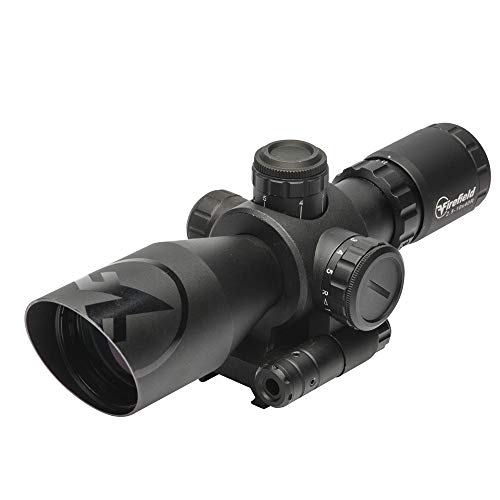
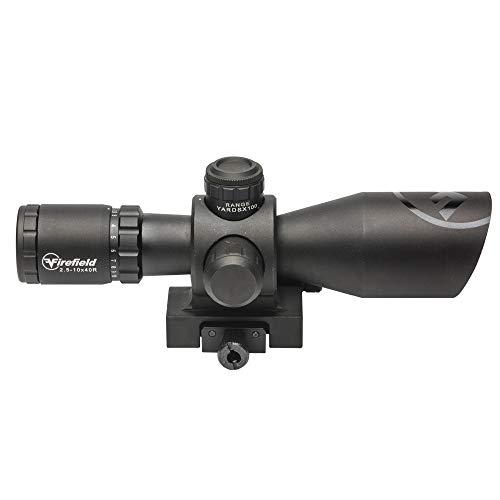
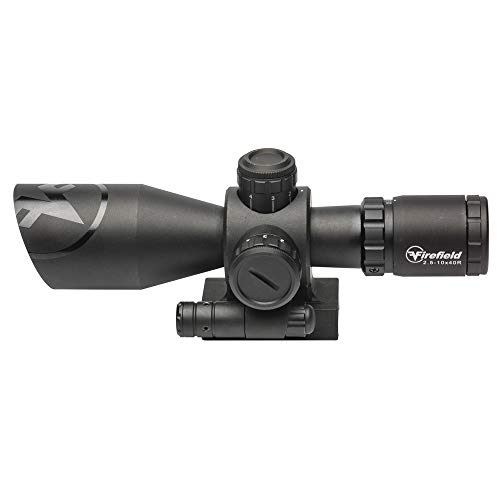
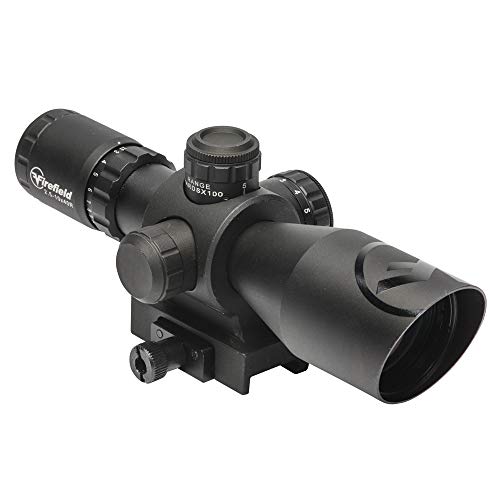
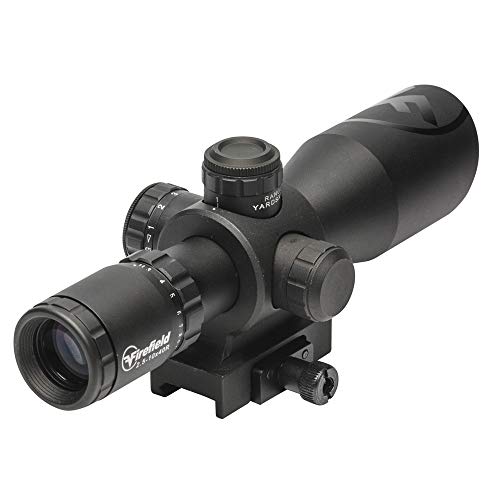
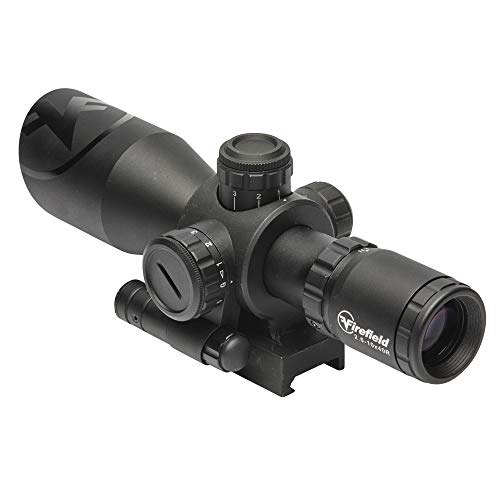
Firefield Barrage 2.5-10×40 Riflescope with Red Laser
From close quarter to mid-range engagements, the Firefield Barrage 2.5-10×40 Riflescope with Red Laser is the ideal ready-for-anything optic. Built reliable for the long haul, IPX4 waterproof Barrage Riflescopes boast an aircraft-grade 6061-T6 black anodized aluminum tube and 2 piece mount design. All Barrage optics feature a bullet drop compensation reticle for 55 gr .223 ammunition, with quick elevation adjustments out to 500 yards. While Barrage Riflescopes are deigned to handle your toughest engagements, it’s the Barrage’s fully multi-coated anti reflective green scratch-resistant, anti-reflective glass, precision 5mW 623-650nm Class IIIA red laser, illuminated red/green Mil-Dot reticle and 100-hr battery life that get you on target and keep you there even in low light.
Rifle Scope Product Features
About this item
<5Mw 632-650nm class IIIA red laser
2.5-10x variable magnification
Mil-dot reticle and Red/green reticle illumination
Precision windage and elevation adjustments
Reliable IPX4 waterproof design and Long-lasting 100-hr. battery life
Sport type: Climbing
Included components: Riflescope with batteries
Firefield Barrage Riflescope
Designed for precision placement at various distances, Firefield Barrage Riflescopes bridge the gap between rugged reliability and consistent performance. Available in 1.5-5x32 and 2.5-10x40 magnifications as well as red laser, green laser or no laser variations, the Barrage family boasts IPX4 waterproof, fogproof and shockproof performance. An effective mil-dot illuminated reticle ensures your Barrage stays on target in low-light situations, while fully multi-coated optics increase overall light transmission. Constructed from 6061-T6 aircraft-grade aluminum and offering a 100-hr. battery life, Firefield Barrage Riflescopes are ideal for anything from close quarter missions to engaging mid-range targets.
Features
Red or green illuminated Mil-Dot reticle
Precision windage and elevation adjustments
IPX4 Waterproof/fogproof/shockproof
Includes batteries and cleaning cloth
.223 Bullet-Drop Compensator
All Firefield Barrage 2.5-10x40 Riflescopes are equipped with a bullet drop compensator dial. The bullet drop compensation dial allows for quick adjustments of the reticle for shooting targets at specific distances. This compensator was designed for a .223 caliber 55 grain bullet. The bullet drop compensation dial has distances of 1 (100yds), 2 (200yds), 3 (300yds), 4 (400yds) and 5 (500yds) marked directly on the dial. By using the mil-dot reticle to determine the distance, the bullet drop compensation dial is adjusted to that distance to acquire an accurate shot. Note: To work effectively, the dial must be set to 1 when sighting in the riflescope at 100 yards.
Magnification Adjustment
Firefield Barrage Riflescopes come equipped with variable magnification options. By rotating the magnification ring to the desired setting, shooters can adjust to the most suitable magnification their shooting scenario. Note: Do not loosen the screw located on the magnification ring, doing so will cause problems with the variable magnification function.
Mil-Dot Reticle
Firefield Barrage Riflescopes feature a U.S. Army Mil-Dot reticle. Mil stands for milliradian (also known as MRAD). A milliradian is 1/6283.2th of a circle or 3.438 MOA. The milliradian represents one unit at 1000 yards. Put simply, a 1-yard-tall target at 1000 yards is equal to 1 milliradian.
Diopter Adjustment
The diopter is the measurement of the eye's curvature. Every eye is curved differently. Firefield Barrage Riflescopes have a diopter adjustment to help the shooter attain a clear, crisp sight picture. If the image does not appear clear and crisp, rotate the diopter adjustment clockwise or counterclockwise until a sharp sight picture and reticle are achieved, then tighten the eyepiece lock ring. This adjustment should stay the same unless the riflescope's operator changes.
Barrage 1.5-5X32 Riflescope Barrage 1.5-5X32 Riflescope with Red Laser Barrage 1.5-5X32 Riflescope with Green Laser Barrage 2.5-10x40 Riflescope Barrage 2.5-10x40 Riflescope with Red Laser Barrage 2.5-10X40 Riflescope with Green Laser
Magnification 1.5-5 1.5-5 1.5-5 2.5-10 2.5-10 2.5-10
Objective lens diameter (mm) 32 32 32 40 40 40
Eye relief (in/mm) 5.1-1.97 / 130-50 5.1-1.97 / 130-50 5.1-1.97 / 130-50 2.36-2.17 / 60-55 2.36-2.17 / 60-55 2.36-2.17 / 60-55
MOA adjustment (one click) 1/2 1/2 1/2 1/4 1/4 1/4
Focal plane Second Second Second Second Second Second
Mount type Weaver Weaver Weaver Weaver Weaver Weaver
Weight (oz) 17.2 18.3 20.6 17.7 18.8 21.4
About the Firefield Company
Firefield is a premium maker for firearm scopes, optics, mounts, and other accessories used for firearms like rifles and long guns. They innovate and make their mounts and related products by applying materials which are long lasting and resilient. This includes the Firefield Barrage 2.5-10×40 Riflescope with Red Laser by Firefield. For more shooting products, visit their site.
Optic Information
Rifle scopes enable you to exactly align a rifle at various targets by aligning your eye with the target at range. They do this through magnification by using a set of lenses within the scope. The scope’s alignment can be adapted for the consideration of many ecological things like wind and elevation decreases to account for bullet drop.
The scope’s function is to help the shooter understand exactly where the bullet will hit based upon the sight picture you are viewing via the scope as you line up the scope’s crosshair or reticle with the intended target. A lot of contemporary rifle optics have about 11 parts which are found inside and externally on the scope body. These scope parts consist of the rifle scope’s body, lenses, adjustment turrets, focus rings, and other components. See all eleven parts of an optic.
About Rifle Glass Styles
Rifle scopes can be either “first focal plane” or “second focal plane” style of scopes. The sort of focal plane a scope has decides where the reticle or crosshair is located in connection with the scopes magnifying adjustments. It actually indicates the reticle is situated behind or ahead of the magnification lens of the scope. Choosing the most desired type of rifle optic is dependent on what style of shooting or hunting you anticipate undertaking.
About First Focal Plane Scopes
Focal plane scopes (FFP) include the reticle in front of the zoom lens. These styles of scopes are beneficial for:
- Quick acquisition, long distance kinds of shooting
- Shooting situations where estimations are minimal
- Experienced shooters who understand their target “hold over” and also “lead” relationships for their firearm
- Shooters who don’t mind the reticle is enlarged and uses up more visual sight area than a SFP reticle
Second Focal Plane Scopes
Second focal plane scopes (SFP) feature the reticle behind the magnifying lens. This triggers the reticle to remain at the same dimensions in relation to the level of zoom being used. The effect is that the reticle dimensions adjust based upon the zoom applied to shoot over longer distances since the reticle markings present distinct increments which can vary with the magnification level. In the FFP illustration with the SFP optic, the 5x “zoom” one hundred yard tick measurement would be 1/5th of the non “zoom” tick reticle measurement. These types of glass are useful for:
- Far away types of shooting where shooters have extra time to make ballistic calculations
- Shooting where most of the shots happen within shorter distances and ranges
- Shooters who choose a clearer optic sight picture with less space taken up by the enlarged FFP reticle
Details on Rifle Scope Magnification
The quantity of magnification a scope supplies is figured out by the diameter, density, and curvatures of the lenses inside of the rifle scope. The zoom of the scope is the “power” of the scope.
Fixed Power Lens Scopes
A single power rifle scope will have a magnification number designator like 4×32. This implies the zoom power of the scope is 4x power while the objective lens is 32mm. The zoom of this kind of scope can not adjust considering that it is a set power scope.
About Adjustable Power Lens Scopes
Variable power rifle scopes can be adjusted between magnification power levels. These types of scopes will list the zoom amount in a configuration such as 2-10×32. These numbers suggest the magnification of the scope could be changed between 2x and 10x power. This additionally utilizes the power levels in-between 2 and 10. The power adaptation is accomplished by making use of the power ring part of the scope near the rear of the scope by the eye bell piece.
Glass Power Level and Range Correlation
Here are some suggested scope powers and the ranges where they could be effectively used. High power scopes will not be as beneficial as lower magnification level optics because too much magnification can be a negative aspect depending on your shooting distance. The same relates to extended ranges where the shooter needs sufficient power to see precisely where to best aim the rifle.
Details on Optic Lens Covering
All modern rifle optic and scope lenses are layered. There are various types and qualities of coverings. Lens coating can be an important aspect of a rifle when thinking of high end rifle optics and targeting units. The glass lenses are among the most key components of the scope because they are what your eye sees through while sighting a rifle in on the target. The finish on the lenses offers protection to the lens surface area and even helps with anti glare from excess sunrays and color recognition.
HD Versus ED Rifle Optic Lens Coatings
Some rifle glass manufacturers additionally use “HD” or high-def lens coverings that take advantage of different procedures, components, chemical substances, and polarizations to draw out separate colors and viewable target definition through the lens. This high-def finishing is normally used with more costly, high density lens glass which brings down light’s capability to refract through the lens glass. Some scope suppliers use “HD” to refer to “ED” implying extra-low dispersion glass. ED handles how certain colors are presented on the chromatic spectrum and the chromatic deviance or aberration which is similarly called color distortion or fringing. Chromatic aberration is often visible over things with hard outlines as light hits the item from specific angles.
Scope Lens Single Coating Versus Multi-Coating
Various optic lenses can likewise have various finishes used to them. All lenses usually have at least some type of treatment or coating used to them before being used in a rifle scope or optic.
Single layered lenses have a treatment applied to them which is typically a protective and enhancing multi-purpose treatment. This lens treatment can shield the lens from scratches while minimizing glare and other less advantageous things experienced in the shooting environment while sighting in with the optic. The quality of a single coated lens depends on the scope company and how much you spent on it. Both the manufacturer and amount are indications of the lens quality.
Some scope producers also make it a point to specify if their optic lenses are layered or “multi” covered. Being “much better” depends on the manufacturer’s lens treatment technology and the quality of products used in constructing the rifle scope.
Info on Hydrophobic Finishing
Water on a scope’s lens doesn’t improve preserving a clear sight picture through a scope at all. Lots of top of the line or high-end scope producers will coat their lenses with a hydrophilic or hydrophobic covering. The Steiner Optics Nano-Protection is a good example of this sort of treatment. It deals with the exterior surfaces of the Steiner glass lens so the H2O molecules can not bind to it or create surface tension. The outcome is that the water beads roll off of the scope to maintain a clear, water free sight picture.
Glass Mounting Alternatives
Mounting approaches for scopes come in a couple of options. There are the standard scope rings which are separately installed to the scope and one-piece scope mounts which cradle the scope. These various kinds of mounts also typically are made in quick release variations which use manual levers which permit rifle operators to rapidly install and dismount the scope.
Hex Key Scope Rings
Standard, clamp design mounting scope rings use hex head screws to mount to the flattop design Picatinny scope installation rails on rifles. These types of scope mounts use a couple of separate rings to support the optic, and are often made from 7075 T6 billet aluminum which is created for long range accuracy shooting. This type of scope install is wonderful for rifles which require a long lasting, rock solid mounting solution which will not move no matter how much the scope is moved or abuse the rifle takes.
Quick-Release Cantilever Rifle Glass Ring Mounts
These types of quick-release rifle scope mounts can be used to rapidly take off a scope and attach it to a different rifle. Multiple scopes can even be swapped out if they all use a similar design mount. These types of mounts come in handy for rifles which are carried a lot, to swap out the optic from the rifle for protecting the scope, or for scopes which are used between multiple rifles or are situationally focused.
About Optic Tube Sealing and Gas Purging
Moisture inside your rifle optic can wreck a day of shooting and your costly optic by triggering fogging and producing residue inside of the scope’s tube. Many scopes protect against wetness from entering the scope tube with a system of sealing O-rings which are waterproof. Typically, these optics can be submerged beneath 20 or 30 feet of water before the water pressure can force moisture past the O-rings. This should be plenty of humidity avoidance for common use rifles for hunting and sporting purposes, unless you plan on taking your rifle on boats and are concerned about the optic still working if it goes over the side and you can still salvage the gun.
Gas Purged Rifle Glass Tubes
Another component of preventing the buildup of wetness inside of the rifle optic tube is filling the tube with a gas like nitrogen. Since this space is already taken up by the gas, the optic is less influenced by climate changes and pressure differences from the external environment which could possibly permit water vapor to permeate in around the seals to fill the vacuum which would otherwise exist. These are good qualities of a decent rifle scope to seek out.


