Description
Rifle Scope Product Details
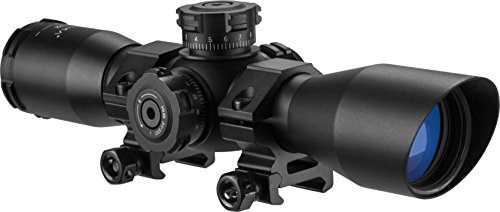
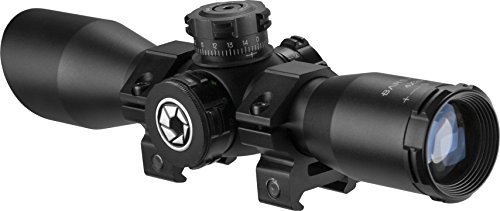
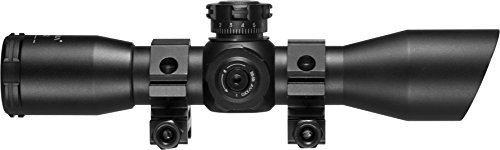
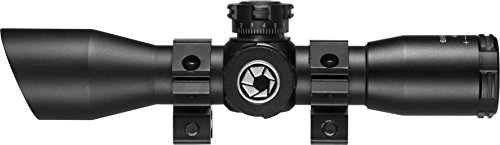
BARSKA AC11876 Contour Rifle Scope 4×32 Red/Green Illuminated Mil-Dot Reticle with Picotinny/Weaver Rings
From the Manufacturer
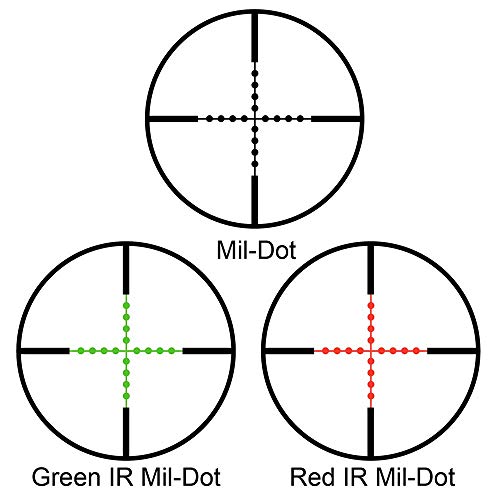
The 4×32 IR Contour Riflescope meets the hunter’s demands by combining performance and innovation in a compact riflescope without sacrificing ruggedness, dependability and craftsmanship. This scope offers low magnification combined with long eye relief making it ideal for close range action, from cross-bow hunting to pistol shooting even down to simple rim fire action. This scope is engineered with extra rigid shockproof construction to handle the demands of pistols, shotguns and other types of high recoil firearms. This scope also features an IR Black, Red and Green Mil-Dot Reticle. A built-in sun-shade is set back in the housing to allow the sun shade to cast a shadow and reduce glare for use in bright sun. Specifications: Magnification: 4x; Objective Lens: 32mm; Waterproof/Fog proof: Yes; Reticle: IR Black, Red and Green Mil Dot; Exit Pupil: 8mm; Optical Coating: Fully-Coated; Field of View (ft@100yds/m@100m): 31.5/6.6 ; Eye Relief: 3.3 Inches; Click Value: 1/4 Inch; Adjustment Knob: Adj. Rheostat, Windage and Elevation Adjustments; Tube Diameter: 1 Inch; Weight: 10.4 oz.; Length: 9 Inches; Included Accessories: 7/8 Inch Picatinny/Weaver Style Rings, Battery, Flip Covers and Lens Cloth; Warranty: Limited Lifetime.
Rifle Scope Product Features
About this item
material_type: Aluminum
AC11876
Specs
Item: AC11876
FOV: 31.5ft/ 6.6m @ 100 yds/m.
Eye Relief: 3.3″.
Exit Pupil: 8mm @ 4x.
Click Value: 1/4 MOA
Focal Plan: Second
Length: 8.5″
Weight: 10.4 oz
Precision Optics and Advanced Features
Barska’s 4×30 Contour scope fits a lot of features into a compact design without sacrificing performance. An illuminated Mil-Dot reticle can be switched between red and green options with adjustable brightness, while external windage and elevation turrets allow for quick, precise adjustments.
For precision targeting, the 4×32 Contour has been designed from the ground up as the perfect accessory for virtually any rifle platform.
1 inch Main Tube Diameter
Waterproof, Fogrproof, and Shockproof
Fully Coated Optics for Enhanced Detail
Integrated Sun Shade Scope
Features that Enhance Functionality
Customize Your View
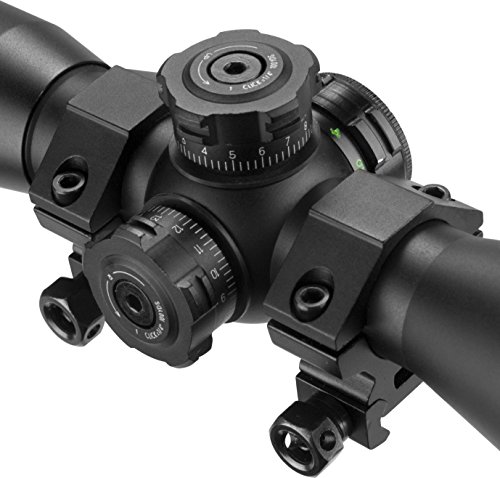
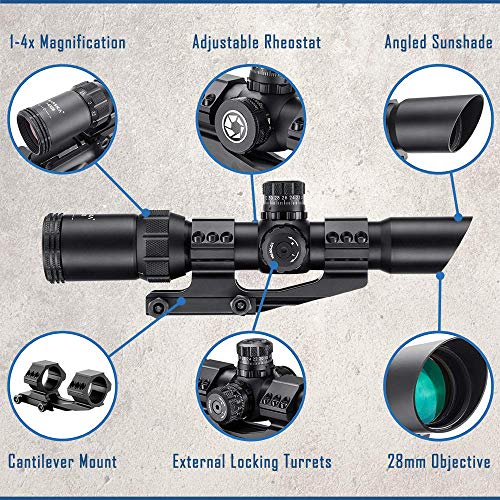
A side adjustable rheostat allows the user to quickly adjust the color and brightness of the Mil-Dot reticle. Adjust the reticle to green for easier targeting in bright environments. Select the red reticle when targeting in lowlight or indoor situations.
Glare Reduction
A built-in angled sunshade helps minimize glare on the objective lens, which in turn provides a clearer view to the user. This sunshade also works to reduce scope glint when targeting in sunny environments.
Locked In
External windage and elevation turrets allow the user to quickly adjust the impact point without needing to remove turret caps. The zero setting can be reset by loosening the turret and moving the zero mark back to the starting point.
Covers Included
Two included flip-up scope caps help prevent dust buildup and moisture on the lenses during storage and transport. These covers quickly open at the touch of a thumb, and can be accessed ambidextrously.
Barska AC11876 4×32 IR Contour Riflescope Barska 1-4×28 IR Hunting Scope Barska 1-6×32 IR SWAT-AR Rifle Scope with Red/Green Reticle Barska 3-9×42 IR 2nd Generation Sniper Riflescope
Magnification 4x 1-4x 1-6x 3-9x
Objective Lens (mm) 32 28 32 42
Lens Coating Fully Coated Fully Multi-Coated Fully Multi-Coated Multi-Coated
Tube Diameter 1 inch 30mm 35mm 1 inch
Reticle Red/Green Mil-Dot Red/Green Mil-Dot Red/Green Mil-Dot Red/Green Mil-Dot
Click Value (MOA)
Length (in) 8.5 10 11.25 10
Product Weight (oz) 10.4 16 29.6 20
About the BARSKA Scope Maker
BARSKA is a premium producer for rifle scopes, optics, mounting solutions, and other add-ons used for firearms like rifles and long guns. They innovate and build their scopes and related products by applying elements which are long lasting and durable. This includes the BARSKA AC11876 Contour Rifle Scope 4×32 Red/Green Illuminated Mil-Dot Reticle with Picotinny/Weaver Rings by BARSKA. For more shooting goods, visit their site.
What You Need to Know About Glass
Rifle scopes enable you to exactly aim a rifle at various targets by aligning your eye with the target over a range. They do this through magnifying the target by making use of a series of lenses inside the scope. The scope’s alignment can be adapted for the consideration of many ecological considerations like wind speed and elevation increases to account for bullet drop.
The scope’s function is to understand exactly where the bullet will hit based on the sight picture you are seeing via the scope as you align the scope’s crosshair or reticle with the target. A lot of modern-day rifle scopes have about 11 parts which are located within and outside of the optic. These parts include the rifle scope’s body, lenses, elevation dials, focus rings, and other components. Learn about the eleven parts of rifle scopes.
The Varieties of Rifle Scopes
Rifle scopes can be either “first focal plane” or “second focal plane” style of scopes. The type of focal plane an optic has identifies where the reticle or crosshair is located in relation to the optic’s magnification. It literally implies the reticle is situated behind or in front of the magnification lens of the scope. Deciding upon the best sort of rifle glass is based on what kind of shooting or hunting you intend on undertaking.
Info About First Focal Plane Optics
Focal plane scopes (FFP) feature the reticle in front of the magnification lens. This triggers the reticle to increase in size based upon the amount of zoom being used. The outcome is that the reticle measurements are the same at the enhanced distance as they are at the non magnified distance. One tick on a mil-dot reticle at 100 yards without “zoom” is still the same tick at 100 yards by using 5x “zoom”. These types of scopes are valuable for:
- Quick acquisition, long distance types of shooting
- Shooting situations where computations are minimal
- Experienced shooters who understand their aim point “hold over” and also “lead” correlations for their long gun
- Shooters who don’t mind the reticle is bigger and occupies more visual eyesight area than a SFP reticle
Second Focal Plane Glass Facts
Second focal plane scopes (SFP) feature the reticle behind the magnification lens. This triggers the reticle to remain at the exact same size relative to the level of magnification being used. The end result is that the reticle dimensions adjust based on the magnification employed to shoot over lengthier distances given that the markings represent distinct increments which differ with the magnification level. In the FFP example with the SFP scope, the 5x “zoom” one hundred yard tick would be 1/5th of the non “zoom” tick measurement. These varieties of glass are beneficial for:
- Far away kinds of shooting where shooters have increased time to make ballistic computations
- Shooting where most of the shots happen within shorter ranges and distances
- Shooters who would like a clearer optic sight picture with less room taken up by the enlarged FFP reticle
Magnification for Optics
The quantity of zoom a scope supplies is identified by the size, density, and curvatures of the lenses inside of the rifle scope. The zoom of the scope is the “power” of the scope.
Fixed Power Lens Glass Info
A single power rifle optic or scope will have a magnification number designator like 4×32. This suggests the zoom power of the scope is 4x power while the objective lens is 32mm. The zoom of this kind of optic can not change considering that it is a set power scope.
Variable Power Lens Rifle Optic Facts
Variable power rifle scopes use enhanced power. The power modification is handled using the power ring part of the scope near the back of the scope by the eye bell.
The Power and Range Correlation of Optics
Here are some advised scope power settings and the distances where they can be effectively used. Always remember that high power optics and scopes will not be as effective as lower powered optics and scopes since increased magnification can be a detractor. The same concept relates to longer distances where the shooter needs sufficient power to see where to properly aim the rifle.
Details on Lens Finishing
All cutting-edge rifle scope lenses are coated. Lens coating can be an essential aspect of a shooting system when considering high end rifle optics and scope systems.
HD Versus ED Lenses
Some scope producers even use “HD” or high-def lens coatings which make the most of various procedures, polarizations, aspects, and chemicals to enhance different colors and viewable target visibility through the lens. This high-definition finishing is normally used with higher density glass which brings down light’s opportunity to refract by means of the lens glass. Some scope suppliers use “HD” to describe “ED” implying extra-low dispersion glass. ED deals with how colors are represented on the chroma spectrum and the chromatic difference or aberration which is also called color distortion or fringing. Chromatic aberration is often obvious over items with hard edges and outlines as light hits the object from specific angles.
Single Finish Versus Multi-Coating
Different optic lenses can likewise have various coatings applied to them. All lenses typically have at least some type of treatment or coating applied to them prior to being used in a rifle scope or optic.
This lens treatment can safeguard the lens from scratches while reducing glare and other less advantageous things experienced in the shooting environment while sighting in with the scope. The quality of a single layered lens depends on the scope producer and how much you paid for it.
Some scope producers also make it a point to define if their optic lenses are covered or “multi” coated. Being “better” depends on the maker’s lens treatment technology and the quality of materials used in building the rifle scope.
Anti-water Rifle Optic Lens Finish
Water on a lens doesn’t help with keeping a clear sight picture through a scope at all. Lots of top of the line and high-end scope makers will coat their lenses with a hydrophilic or hydrophobic finishing.
Rifle Optic Installing Choices
Mounting options for scopes come in a couple of options. There are the basic scope rings which are separately installed to the scope and one-piece mounts which cradle the scope. These different kinds of mounts also typically are made in quick release versions which use manual levers which allow rifle shooters to quickly install and remove the scope.
Rifle Optic Mounts with Hex Key Rings
Basic, clamp style mounting optic rings use hex head screws to position to the flattop design Picatinny scope mounting rails on rifles. These varieties of scope mounts use double individual rings to support the scope, and are normally constructed from 7075 T6 billet aluminum or similar materials which are made for long distance precision shooting. This type of scope mount is good for rifle systems which require a long lasting, rock solid mount which will not shift no matter just how much the scope is moved about or jarring the rifle takes. These are the style of mounts you want for a faithful scope system on a far away hunting or competition firearm which will seldom need to be modified or recalibrated. Blue 242 Loctite threadlocker can also be used on the scope mount screws to stop the hex screw threads from backing out after they are installed safely in position. An example of these rings are the 30mm style made by the Vortex Optics brand. The set generally costs around $200 USD
Quick-Release Cantilever Rifle Glass Rings
These types of quick-release rifle scope mounts can be used to rapidly attach and remove a scope from a rifle. If they all use a similar style mount, multiple scopes can often be switched out on the range. The quick detach mount style is CNC machined from anodized 6061 T6 aluminum and the mounting levers fasten firmly to a flat top design Picatinny rail. This allows the scope to be sighted in while on the rifle, removed from the rifle, and remounted while keeping precision. These kinds of mounts come in convenient for shooting platforms which are shipped a lot, to remove the glass from the rifle for protection, or for aiming systems which are employed between multiple rifles. An example of this mount type is the 30mm mount from the Vortex Optics brand. It normally costs around $250 USD
What to Know About Rifle Optic Tube Sealing and Gas Purging
Moisture inside your rifle optic can mess up a day of shooting and your expensive optic by bringing about fogging and developing residue inside of the scope tube. A lot of scopes prevent wetness from getting in the scope tube with a system of sealing O-rings which are waterproof.
Rifle Optic Gas Purging
Another part of avoiding the accumulation of moisture within the rifle optic tube is filling the tube with a gas like nitrogen. Because this area is currently taken up by the gas, the scope is less influenced by climate changes and pressure differences from the outside environment which may possibly enable water vapor to leak in around the seals to fill the void which would otherwise be there. These are good qualities of a decent rifle scope to seek out.


