Description
Rifle Scope Product Details
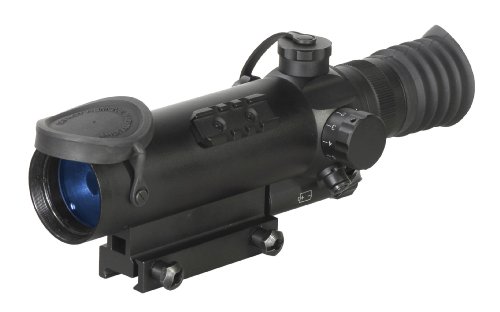
ATN Gen CGT Night Arrow 2-CGT Night Vision Weapon Sight
Product Description
The ATN Night Arrow2-CGT from ATN is a Gen CGT with 2X magnification rugged night vision weapon sight are simple and easy to operate one-knob operation with automatic brightness control, illuminated center red reticle, and red on green reticle system.
Amazon.com
The Night Arrow 2-CGT is a rugged night vision weapon sight that allows you to confidently observe your prey, acquire the target, and aim. As a result, the 2x magnification sight is an ideal choice for sports shooters or varmint hunters. The sight is outfitted with a “red on green” reticle system, with an illuminated red center crosshair that provides optimal contrast against the green night-vision background. The reticle makes it possible to identify and lock on targets even in complete darkness. The sight also offers an automatic brightness control (ABC) to protect the tube, along with a single knob for easy operation. And thanks to the rugged, nitrogen-sealed housing, the sight is water- and fog-resistant. The lightweight, compact Night Arrow 2-CGT sight–which mounts to standard weaver rails–operates on a single AA battery and carries a limited two-year warranty.
The Night Arrow’s “red on green” reticle system lets you lock on targets in complete darkness.
How Night Vision Works
All ATN night vision devices consist of several main parts: an objective lens, an eyepiece, a power supply, and an image intensifier tube (photocathode tube). The devices function by gathering existing ambient light, such as starlight, moonlight, or infrared light, through the front lens. This light, which is made up of photons, goes into the photocathode tube and is converted into electrons. Next, the device amplifies the electrons to a much greater number through an electrical and chemical process, and then hurls them against a phosphorous screen that changes them back into visible light. The image will appear through the eyepiece as a clear, black-and-white or green-hued, amplified re-creation of the scene you were observing.
All night vision devices need some light to amplify. That’s why all ATN night vision devices have a built-in infrared illuminator (IRI). An IRI essentially throws out a beam of infrared light that is near invisible to the naked eye, but your night vision device can see it. This allows you to use your scope even in total darkness. The IRI works like a flashlight, which is why the distance you can see with it is limited. Although ATN IRIs extend out to 100 yards, the IRI may cover only 40 to 60 percent of the viewing area.
How Far Can You See
There are many different variables that can affect the distance you see with a night vision device. First, what are you trying to see Are you looking for another boat on the water or are you looking for a rabbit in the woods The larger the object, the easier it is to see. Plus, are you trying to see details (commonly called “recognition range”), or are you just trying to see if something is there Maybe you will see just the movement, but won’t be able to determine 100 percent who are what it is. This is called “detection range.” Another variable is lighting conditions. The more ambient light you have, the better and further you will be able to see. You can always see further on a night where the moon and stars are out than if it’s cloudy and overcast. ATN typically states that you can tell the difference between a male and female or a dog and a deer at about 75 to 100 yards. However, if you were looking across an open field and there was a half moon out, you could see a barn or a house 500 yards away.
Specifications:
Finish: Non-reflective matte black
Total darkness IR system: Yes
SMART technology: No
IIT generation: CGT
Resolution: 45-54 lp/mm
Magnification: 2x
Proshield lens coating: Yes
Field of view: 17 degrees
Exit pupil: 11mm
Eye relief: 46mm
Range of focus: 10m to infinity
Diopter adjustment: -4 to +6
Controls: Direct
Remote control: No
Automatic brightness control: Yes
Bright light cutoff: Yes
Infrared illuminator: Detachable IR450
IR indicator: Yes
Low battery indicator: Yes (in FOV)
Battery life: 30 hours
Reticle system: Red on green
Windage and elevation adjustment: 1/4 MOA
Power supply: One 1.5-volt AA battery
Waterproof: Yes
Fog-resistant: Yes
Complies with MIL-STD-810: No
Dimensions: 8.9 by 4.1 by 3.7 inches (W x H x D)
Weight: 2.4 pounds
Warranty: 2 years
Rifle Scope Product Features
“RED ON GREEN” Reticle System with 1/4 MOA Adjustment
Light and Compact Design
Water and Fog Resistant
Illuminated Center Red Reticle for Optimal Contrast Against a Dark or Light Target
This item is restricted for sale to the state of California and outside the US
About the ATN Manufacturer
ATN is a premium company for firearm scopes, optics, mounts, and other accessories used for guns like rifles and long guns. They style and manufacture their scopes, mounts, and related products by choosing materials which are resilient and long lasting. This includes the ATN Gen CGT Night Arrow 2-CGT Night Vision Weapon Sight by ATN. For additional shooting items, visit their site.
Rifle Optic Facts
Rifle scopes allow you to specifically align a rifle at various targets by aligning your eye with the target at range. They do this through magnifying the target by utilizing a series of lenses within the scope. The scope’s positioning can be adjusted for the consideration of separate ecological elements like wind and elevation to make up for bullet drop.
The scope’s purpose is to understand exactly where the bullet will land based upon the sight picture you are seeing via the optic as you align the scope’s crosshair or reticle with the intended point of impact. A lot of modern-day rifle scopes and optics have around eleven parts which are found internally and outside of the optic. These scope parts include the rifle scope’s body, lenses, elevation turrets, objective focus rings, and other parts. Learn about the eleven parts of glass.
The Types of Rifle Scopes
Rifle scopes can be either “first focal plane” or “second focal plane” style of scopes. The form of focal plane an optic has identifies where the reticle or crosshair is located in regard to the scopes magnifying adjustments. It simply implies the reticle is located behind or ahead of the magnification lens of the optic. Selecting the most desired form of rifle optic is based on what variety of hunting or shooting you intend on doing.
Info on First Focal Plane Scopes
Focal plane scopes (FFP) feature the reticle in front of the magnifying lens. This triggers the reticle to increase in size based upon the extent of zoom being used. The benefit is that the reticle measurements are the same at the magnified range as they are at the non amplified range. One tick on a mil-dot reticle at one hundred yards with no “zoom” is still the very same tick at one hundred yards with 5x “zoom”. These types of scopes work for:
- Quick acquisition, long distance kinds of shooting
- Shooting scenarios where computations are minor
- Experienced shooters who have an idea for their aim point “hold over” as well as “lead” relationships for their rifles
- Shooters who don’t mind the reticle is enlarged and occupies more visual sight area than a SFP reticle
About Second Focal Plane Glass
Second focal plane scopes (SFP) come with the reticle behind the zoom lens. In the FFP example with the SFP scope, the 5x “zoom” 100 yard tick reticle measurement would be 1/5th of the non “zoom” tick reticle measurement.
- Far away forms of shooting where shooters have increased time to make ballistic calculations
- Shooting where most shots take place within shorter ranges and spaces
- Shooters who desire a clearer optic picture with less area taken up by the enlarged FFP reticle
Magnification for Rifle Optics
The amount of zoom a scope offers is identified by the diameter, density, and curvatures of the lenses inside of the rifle scope. The magnification of the scope is the “power” of the scope.
Fixed Power Lens Rifle Glass
A single power rifle optic and scope will have a zoom number designator like 4×32. This indicates the magnification power of the scope is 4x power while the objective lens is 32mm. The magnification of this type of optic can not adjust because it is set from the factory.
Variable Power Lens Rifle Optic Info
Variable power rifle scopes can be changed between magnification increments. These types of scopes will note the zoom degree in a configuration like 2-10×32. These numbers suggest the magnification of the scope could be adjusted between 2x and 10x power. This additionally utilizes the power levels in-between 2 and 10. The power modification is accomplished using the power ring part of the scope near the rear of the scope by the eye bell.
Rifle Optic Power and Range Correlation
Here are some advised scope power levels and the distances where they can be successfully used. Consider that high power scopes and optics will not be as efficient as lower magnification level optics and scopes since too much zoom can be a negative thing in certain situations. The very same idea applies to extended distances where the shooter needs adequate power to see where to properly aim the rifle at the target.
Info on Lens Finishes
All modern-day rifle optic lenses are covered in special coatings. There are various types and qualities of finishings. When shopping for luxury rifle targeting units, Lens finish can be a crucial aspect of a rifle. The lenses are among the most critical components of the scope given that they are what your eye sees through while sighting a rifle in on the target. The finishing on the lenses shields the lens surface and also helps with anti glare capabilities from refracted sunlight and color presence.
HD Versus ED Lens Coatings
Some optic suppliers additionally use “HD” or high-definition lens finishings which apply different procedures, polarizations, components, and chemicals to extract various colors and viewable definition through lenses. This high-definition coating is typically used with more costly, high density lens glass which drops light’s potential to refract through the lens glass. Some scope manufacturers use “HD” to describe “ED” implying extra-low dispersion glass. ED handles how colors are represented on the chromatic spectrum and the chromatic deviance or aberration which is also called color distortion or fringing. Chromatic aberration is often noticeable over things with defined outlines as light hits the object from various angles.
Single Rifle Optic Lens Coating Versus Multi-Coating
Different optic lenses can also have various finishings applied to them. All lenses usually have at least some type of treatment or covering applied to them before they are used in a rifle scope or optic.
Single coated lenses have a treatment applied to them which is typically a protective and boosting multi-purpose treatment. This lens treatment can shield the lens from scratches while decreasing glare and other less advantageous things experienced in the shooting environment while sighting in with the scope. The quality of a single coated lens depends upon the scope company and how much money you spent for it. The scope’s maker and cost are indicators of the lens quality.
Some scope makers also make it a point to specify if their optic lenses are layered or “multi” covered. Being “better” depends on the maker’s lens treatment innovation and the quality of materials used in developing the rifle scope.
Hydrophobic Finish for Rifle Glass
Water on an optic’s lens does not assist with preserving a clear sight picture through a scope whatsoever. Many top of the line or premium optic producers will coat their lenses with a hydrophobic or hydrophilic covering. The Steiner Optics Nano-Protection is a good example of this kind of treatment. It deals with the exterior surfaces of the Steiner scope lens so the water particles can not bind to it or develop surface tension. The outcome is that the water beads move off of the scope to keep a clear, water free sight picture.
Options for Installing Rifle Optics on Firearms
Installing approaches for scopes are available in a few options. There are the basic scope rings which are individually mounted to the scope and one-piece mounts which cradle the scope. These various types of mounts also generally are made in quick release variations which use toss levers which enable rifle shooters to rapidly install and remove the scope.
Optic Mounts with Hex Key Rings
Standard, clamp design mounting scope rings use hex head screws to install to the flattop style Picatinny scope mount rails on the tops of rifles. These kinds of scope mounts use double detached rings to support the scope, and are made from 7075 T6 billet aluminum or similar materials which are developed for far away accuracy shooting. This type of scope mount is effective for rifle systems which are in need of a durable, unfailing mount which will not change regardless of how much the scope is moved or jarring the rifle takes. These are the design of mounts you should get for a dedicated scope system on a far away hunting or sniper competition rifle that will hardly ever need to be changed or recalibrated. Blue 242 Loctite threadlocker can additionally be used on the mount’s screws to keep the hex screws from wiggling out after they are installed safely in place. An example of these mounting rings are the 30mm type from Vortex Optics. The set generally costs around $200 USD
Quick-Release Cantilever Rifle Glass Rings
These types of quick-release rifle scope mounts can be used to rapidly attach and detach a scope from a rifle before reattaching it to a different rifle. Numerous scopes can even be swapped out if they all use a compatible style mount. These types of mounts come in handy for rifles which are transported a lot, to remove the optic from the rifle for protection, or for scopes which are used in between several rifles.
Info on Rifle Scope Tube Sealing and Gas Purging
Moisture inside your rifle glass can ruin a day on the range and your pricey optic by inducing fogging and generating residue inside of the scope’s tube. Most optics protect against moisture from going into the optical tube with a system of sealing O-rings which are waterproof. Usually, these optics can be submerged under 20 or 30 feet of water before the water pressure can push moisture past the O-rings. This should be sufficient moisture content prevention for standard use rifles for hunting and sporting purposes, unless you plan on taking your rifle boating and are concerned about the scope still working if it is submerged in water and you can still retrieve the firearm.
About Optic Tube Gas Purging
Another part of preventing the buildup of moisture inside of the rifle optic’s tube is filling the tube with a gas like nitrogen. Considering that this area is already taken up by the gas, the optic is less impacted by climate alterations and pressure distinctions from the external environment which may potentially allow water vapor to leak in around the seals to fill the void which would otherwise be there. These are good qualities of a good rifle scope to seek out.


